Public companies are not obligated to return all available cash to shareholders at the end of the year. When you buy a share of stock, you receive the portion of the firm’s free cash flow that it decides to distribute as dividends. Textbook finance theory assumes that shareholders focus on these future payoffs when pricing a stock. Asset-pricing theory all stems from one simple concept: price equals expected discounted payoff. This is a foundational principle behind every model.
The “cash flows” in the classic discounted cash-flow (DCF) model refer to the money paid to investors, not the money received by the company. The Gordon model says to value a stock by scaling up next year’s per-share dividend forecast to capture the value of all subsequent dividend payments
(1) ![\begin{equation*}\text{Gordon Valuation} = \sum_{h=1}^{\infty} \frac{\mathbb{F}[\mathrm{DPS}_h]}{(1{+}r)^h} = \mathbb{F}[\mathrm{DPS}_1] \times \bigg( \frac{1}{r - g} \bigg) \end{equation*}](https://alexchinco.com/wp-content/ql-cache/quicklatex.com-7da7943d17e20d34e3c31d02b7cf096e_l3.svg "Rendered by QuickLaTeX.com")
![\mathbb{F}[\mathrm{DPS}_h]](https://alexchinco.com/wp-content/ql-cache/quicklatex.com-39f22c15ddbadd7a1b6a2942014a86eb_l3.svg "Rendered by QuickLaTeX.com") is the forecasted dividend per share in
is the forecasted dividend per share in  years, and
  is the discount rate applied to these future payoffs, which are predicted to grow the same amount every year in perpetuity,
 ![\mathbb{F}[\mathrm{DPS}_h] = (1{+}g)^h \times \mathrm{DPS}](https://alexchinco.com/wp-content/ql-cache/quicklatex.com-470623fd87a6e54fb0d651ff3f234ea9_l3.svg "Rendered by QuickLaTeX.com") .
.
This may be how every academic model works, but it is not how sell-side analysts typically value a company. Most reports set a price target by capitalizing the firm’s predicted earnings at a reasonable recent multiple. The default valuation method is next year’s EPS (earnings per share) forecast times a trailing P/E. Instead of asking, “How much would the firm’s entire future dividend stream be worth in today’s dollars?”, analysts ask, “If the company were to announce next year’s predicted EPS today, how would it be valued given current market pricing?” Only around  of sell-side reports pay lip service to DCF analysis.
Roughly  in
in  reports includes a full-blown DCF model. This post examines how analysts actually implement DCF analysis in these reports. How do they arrive at a per-share equity valuation for a particular company? It turns out that the procedure looks very different from what most researchers have in mind. Analysts are not just plugging
  key numbers into Equation (1). The standard DCF playbook is connected to the Gordon model, but it isn’t approximately Gordon in a way that’s captured by time-varying parameters. The protocol deviates from textbook theory in fundamental ways. My point is not that analysts are wrong. My point is that they’re doing something much more interesting than most researchers currently appreciate.
Standard Playbook
Analysts do not use DCF to compute a company’s share price directly. Instead, the approach gets used to estimate the enterprise value (EV) of the entire firm as a whole. Analysts forecast the company’s free cash flow (FCFF) for the next few years and discount these anticipated cash flows at a weighted average cost of capital (WACC). Then they tack on a terminal value (TV), reflecting the present discounted value of all subsequent free cash flows. The combined expression looks something like this
(2) ![\begin{equation*}\mathrm{EV} = \sum_{h=1}^{H} \frac{\mathbb{F}[\mathrm{FCFF}_h]}{(1 {+} r)^h} + \frac{\mathrm{TV}}{(1 {+} r)^H} \end{equation*}](https://alexchinco.com/wp-content/ql-cache/quicklatex.com-382f94038d3206193054787e765403dc_l3.svg "Rendered by QuickLaTeX.com")
![\mathbb{F}[\mathrm{FCFF}_h]](https://alexchinco.com/wp-content/ql-cache/quicklatex.com-cd5ff78abac5611826980d9a25d3840a_l3.svg "Rendered by QuickLaTeX.com") denotes the firm’s forecasted FCFF years from now.
denotes the firm’s forecasted FCFF years from now.  denotes the length of the firm’s transitionary period. During this time, the company’s FCFF is assumed to grow at a faster rate, settling down at a lower sustainable growth rate from year
  onward.
After arriving at an enterprise value, the analyst then uses a bridge to convert the number into a per-share equity valuation. First, they deduct the book value of net debt. Then, they divide the result by the company’s current share count. The fair value is thus
(3) 
 is the difference between a company’s outstanding debt and its cash holdings.
Running Example
To fix ideas, I’ll be using a running example involving a company in the midst of a transformation. Over the next  years, the company’s FCFF is expected to grow quickly:
 ![\mathbb{F}[\mathrm{FCFF}_1] = \mathdollar 8\mathrm{M}](https://alexchinco.com/wp-content/ql-cache/quicklatex.com-455702dbf048446ebb3bd986b991e5f0_l3.svg "Rendered by QuickLaTeX.com") ,
, ![\mathbb{F}[\mathrm{FCFF}_2] = \mathdollar 12\mathrm{M}](https://alexchinco.com/wp-content/ql-cache/quicklatex.com-9f4de464fafa73a2b7bb5123a9a09245_l3.svg "Rendered by QuickLaTeX.com") ,
, ![\mathbb{F}[\mathrm{FCFF}_3] = \mathdollar 16\mathrm{M}](https://alexchinco.com/wp-content/ql-cache/quicklatex.com-8e1a55d08070f7ca4baeea296e91c906_l3.svg "Rendered by QuickLaTeX.com") , and
, and ![\mathbb{F}[\mathrm{FCFF}_4] = \mathdollar 20\mathrm{M}](https://alexchinco.com/wp-content/ql-cache/quicklatex.com-94f5aecfb54106d0affacb517bead6bf_l3.svg "Rendered by QuickLaTeX.com") . These forecasts give the company a -year compound annual growth rate (CAGR) of
. These forecasts give the company a -year compound annual growth rate (CAGR) of  . From year
  onward, the firm’s FCFF will grow at a more modest rate,
  . The firm has
  shares outstanding, and each share is priced at
  , giving the firm a market cap of
  . Assume a cost of equity of
  .
.
Yesterday, the company issued a -year coupon bond with a face value of  and a
and a  annual coupon rate. The bond was issued at par. Unfortunately for the firm, the yield on this bond jumped to
  this morning, causing the price to drop by roughly
  to
to  . Since the bond was issued at par, the firm’s balance sheet carries it at because GAAP does not mark debt to market. The firm holds
  in cash. Net debt at book is
  . Net debt at market would be
  . The firm faces a
  effective tax rate.
The Discount Rate
Analysts usually pick a discount rate equal to the firm’s weighted average cost of capital (WACC). It is the average tax-adjusted return on the firm’s capital
(4) 
Note that the  and
and  numbers in the WACC formula denote current market pricing, not book value at issuance. An unlevered firm will have a WACC equal to its cost of equity,
  . A highly leveraged firm will get discounted at a rate closer to its tax-adjusted cost of debt,
  , which will be lower.
Plugging in numbers, the firm in our running example would face an annual discount rate of
(5) 
The company’s  leverage ratio closes
  of the gap between
  and
and  . Debt gets discounted at rather than
  because interest payments don’t face a tax.
The Terminal Value
During the next couple of years, the firm is growing quickly. The terminal-value term in Equation (2),  , reflects the present value of the company’s subsequent FCFF stream after this transitionary period has ended. It is usually computed with either a perpetuity or with a trailing/comps multiple
(6) ![\begin{equation*}\mathrm{TV} = \mathbb{F}[\mathrm{FCFF}_{H+1}] \times \begin{cases} \big( \tfrac{1}{r - g}\big) &\text{Gordon} \\ \mathrm{EV/FCFF} &\text{Comps} \end{cases}\end{equation*}](https://alexchinco.com/wp-content/ql-cache/quicklatex.com-3cbca3dce80390086eb46824589623de_l3.svg "Rendered by QuickLaTeX.com")
The first option assumes that the firm’s FCFF will grow at an annual rate of  from year onward. The second option uses the firm’s current EV/FCFF multiple or the average multiple for a set of comparable firms to capitalize the company’s anticipated FCF in year .
In our running example, the firm has a -year transitionary period in which its FCFF grows at per year. The analyst believes that its FCFF will grow from ![\mathbb{F}[\mathrm{FCFF}_1]=\mathdollar 8\mathrm{M}](https://alexchinco.com/wp-content/ql-cache/quicklatex.com-ca2cc8c8660368cf7cb4766f8f13d708_l3.svg "Rendered by QuickLaTeX.com") next year to
next year to ![\mathbb{F}[\mathrm{FCFF}_4]=\mathdollar 20\mathrm{M}](https://alexchinco.com/wp-content/ql-cache/quicklatex.com-0f0538ddb89d94345929f2ea0a5ea284_l3.svg "Rendered by QuickLaTeX.com") in year
in year  . After that, the company’s FCFF stream will grow at
  per year in perpetuity. This lower more-sustainable growth rate puts the firm’s forecast for year
  at
at
(7) ![\begin{equation*}\mathbb{F}[\mathrm{FCFF}_5] = (1{+}3\%)\times \mathdollar 20\mathrm{M} = \mathdollar 20.6\mathrm{M}\end{equation*}](https://alexchinco.com/wp-content/ql-cache/quicklatex.com-6d108c92d7845e36b79dbc9cb0993bf0_l3.svg "Rendered by QuickLaTeX.com")
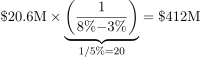
The firm’s  WACC and
  growth rate give it a cap rate of
  . At a terminal multiple of
  , the company’s terminal value would be
(8) 
Discounting this terminal value back years at  gives
gives 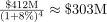 .
.
All Together Now
Here’s how all the pieces come together in the running example. The table below shows the company’s predicted FCFF stream over the next years as well as its terminal value
![\begin{equation*}\begin{array}{r|ccccc} \text{Horizon, } h & 1 & 2 & 3 & 4 & \mathrm{TV} \\ \hline \mathbb{F}[\mathrm{FCFF}_h] & \mathdollar 8.0\mathrm{M} & \mathdollar 12.0\mathrm{M} & \mathdollar 16.0\mathrm{M} & \mathdollar 20.0\mathrm{M} & \mathdollar 412.0\mathrm{M} \\ \frac{\mathbb{F}[\mathrm{FCFF}_h]}{(1+8\%)^h} & \mathdollar 7.4\mathrm{M} & \mathdollar 10.3\mathrm{M} & \mathdollar 12.7\mathrm{M} & \mathdollar 14.7\mathrm{M} & \mathdollar 302.8\mathrm{M} \end{array}\end{equation*}](https://alexchinco.com/wp-content/ql-cache/quicklatex.com-c3c7341a1007570f5dce8a9f6723d09e_l3.svg "Rendered by QuickLaTeX.com")
Combined, the firm’s first years of FCFF are worth  in today’s dollars. After discounting, its terminal value is worth
  . Together, these two components produce a total enterprise value of
  , with roughly
  coming at the end.
An analyst would now need to convert this  enterprise value into a per-share equity valuation. They do this using a bridge. The first step involves deducting the book value of the firm’s net debt,
  . The resulting difference is meant to capture the combined value of shareholders’ equity stake. To get a per-share number, the analyst then divides by the company’s current share count
(9) 
The company in our running example is trading at , so this implies  upside.
FCFF, Not Payoffs
Now that we understand what analysts do, let’s talk about the ways that it differs from what researchers assume. First and foremost, the standard DCF implementation capitalizes the cash the firm could pay rather than the cash the firm will pay. The resulting share price doesn’t reflect the discounted payoff stream that investors expect to receive. Analysts use a DCF model to capitalize money received by the firm, not money paid to investors. Every textbook model takes it for granted that investor payoffs and corporate proceeds are the same thing. If that’s the case, then the way that analysts implement DCF analysis isn’t inconsistent with standard theory.
The decision to focus on FCFF is particularly noteworthy. The line item represents the maximum dividend that an unlevered firm could distribute to its shareholders, not the dividend payment shareholders actually receive. The firm in our running example will produce  of FCFF next year. The company has promised
  to bondholders. After adjusting for taxes, this leaves
  . The firm can use this money to distribute a dividend, buy back shares, pay down its existing debt, acquire another firm, or add to its cash balance. In principle, shareholders might not receive any of these funds. For Equations (1) and (3) to be equivalent, a firm would have to invest any money not paid to *current stakeholders* at exactly .
Every report that builds a DCF model could have calculated the total payout to all stakeholders. The enterprise-level analog to dividend payments would be
(10) 
All you need to do is take FCFF and subtract off the tax adjusted interest payment and any increase in cash. The resulting amount of money must have been paid to current shareholders (dividends or buybacks), the firm’s creditors (debt paydown), or outside shareholders (acquisitions). Nobody does this.
Transition Period
Roughly of sell-side reports include a full-fledged DCF model. Almost all of these reports include a transition period with higher FCFF growth. When researchers think about a DCF model, they usually picture some version of the Gordon pricing rule in Equation (1). But the vast majority of DCF models that analysts write down do not assume sustainable long-term growth right away.  out of reports that include a detailed DCF analysis set
  . The analyst assumes the existence of an initial transition period in which the firm will grow at a much faster rate than .
In the running example, the transition lasts years. Think about what would happen if an analyst tried to remove this part of the model. First, suppose the analyst tried to set  without changing any other inputs. In this case, the resulting enterprise value would be far too low. The company is only predicted to generate of FCFF next year. So, with and , the Gordon-implied valuation would be
(11) 
After subtracting off net debt of and dividing by shares, the analyst would arrive at a share price of  . The analyst can’t publish such a low number. The firm is currently trading at .
Maybe the analyst can fix the problem by discounting at a lower discount rate? Nope. This would require discounting FCFF at the firm’s cost of debt, . To get an enterprise value of , you’d need
(12) 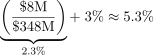
The implied multiple would also be absurdly high,  . Those are laughable numbers.
Thus, the requirement that puts analysts between a rock and a hard place. Allowing for provides a way out. A short-term runup makes it possible to quote a valuation of  without violating professional norms. The analyst gets to use a reasonable sounding WACC. They can point to a sensible
  multiple. All they have to do is argue that, before settling onto a more stable trajectory, the firm will initially grow at a faster
  clip for the next years.
Identification Problem
These transition periods create a serious identification problem for researchers looking to back out an analyst’s discount rate from IBES data. Those numbers contain an analyst’s forecast for next year (ignore the FCFF-vs-EPS distinction), their predicted long-term growth rate, and a price target. The choice of that justifies this price target depends on the analyst’s choice of transition dynamics. How long will the firm’s transition period last,  ? How fast will the firm grow during this time? Neither variable shows up in IBES.
To illustrate the severity of the problem, think about what the firm from the running example would look like in IBES. A researcher would see the analyst’s forecast for next year, , and the analyst’s long-term growth rate, . IBES might also contain a price target of . What IBES doesn’t tell you is the length of the analyst’s assumed transition period, , or the assumed CAGR during this period, . The table below shows how the implied changes as you adjust , holding fixed all observable quantities and setting 
![\begin{equation*}\begin{array}{r|rrrrr} H & 0 & 2 & 4 & 6 & 8 \\ \hline \mathbb{F}[\mathrm{FCFF}_{H+1}] & \mathdollar 8.0\mathrm{M} & \mathdollar 12.7\mathrm{M} & \mathdollar 20.6\mathrm{M} & \mathdollar 32.7\mathrm{M} & \mathdollar 51.9\mathrm{M} \\ \text{Implied }r & 5.3\% & 6.4\% & 8.0\% & 9.9\% & 11.9\% \end{array}\end{equation*}](https://alexchinco.com/wp-content/ql-cache/quicklatex.com-202ca84589a528684a681a7d99f257c3_l3.svg "Rendered by QuickLaTeX.com")
Without knowing how long the analyst assumed that the firm would grow , a researcher cannot tell whether  ,
,  , or
, or  . All these numbers are consistent with a valuation.
Required Precision
DCF analysis comes with a natural measuring stick for the size of the errors: the present value of the firm’s FCFF forecast for next year. In the running example, this is ![\frac{\mathbb{F}[\mathrm{FCFF}_1]}{1+r} = \frac{\mathdollar 8\mathrm{M}}{1+8\%} = \mathdollar 7.4\mathrm{M}](https://alexchinco.com/wp-content/ql-cache/quicklatex.com-47e99bc17e8e595d82cd99a1956f4b20_l3.svg "Rendered by QuickLaTeX.com") . If all you’re doing is adding up expected discounted cash flows, then it’d be a problem if you skipped or double-counted one. An error of
. If all you’re doing is adding up expected discounted cash flows, then it’d be a problem if you skipped or double-counted one. An error of  in enterprise value is the same as forgetting to count next year’s FCFF or including the number twice. Either way, a decision that alters enterprise value by
  is a big deal.
If the firm’s enterprise value fell to  , the company’s share price would fall by
  to
to
(13) 
That is a change of roughly  . So, anything that moves the company’s share price by more than
  is tantamount to forgetting to count a year of FCFF or double counting that year.
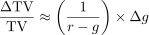
The terminal growth rate, , describes how a firm’s FCFF will grow in steady state. Forever is a long time. And, with so many years to worry about, small differences in an analyst’s choice of can compound into huge changes in the firm’s terminal value. The effect of a  change in the long-run growth rate will scale with the firm’s Gordon multiple
(14) 
The precision with which analysts quote tells you that they aren’t thinking along these lines. Most quote nice round numbers near  or .
or .
The firm in our running example has a cap rate of  , which implies that a
  increase in the terminal growth rate will cause the firm’s terminal value to rise by
(15) 
Apply that to the  present value of the terminal value in the running example.
  would move this number by roughly , an amount equal to the present value of next year’s anticipated FCFF. Yet, most reports quote in steps of
  , an increment half as precise as required by theory.
Market vs Book Value
The firm’s debt shows up in two different places in Equation (3): a) the WACC formula for the discount rate used to compute the firm’s EV; and b) the bridge used to translate this number into a share price. In the first case, the debt is taken at market value. In the second case, the book value of debt is used. For the firm in the running example, the bridge subtracts for a bond the firm could buy back for . That  gap understates the firm’s equity value by , resulting in a share price that is
  too low. The WACC is right. The bridge is wrong. Suppose that the firm’s credit rating deteriorates further so that its bond trades at
  , not . Market net debt would now be
  , but the bridge would still sit at . The firm’s equity value would now be understated by
  , which amounts to .
The analyst above calculated his WACC assuming a leverage of  . The equity value in the denominator comes from the fact that the company’s shares currently trade at and there are shares in circulation. However, this choice of WACC puts the value of each share at . At this price point, the firm’s equity value would be
  , not , and the firm’s leverage would be
  , not
, not  . The internally consistent calculation would produce a higher WACC,
  , because there is less debt and less shield. Iterating to this fixed point gives an enterprise value of
  and per-share valuation of
  . Nobody does that. Literally. No one. Analysts just ignore this fixed-point problem. The result is a rate that is
  too low and a share price that is overvalued by
  .
.
Why does a  move in the rate produce an move in the price? Start with a company that has no runup, just a perpetuity growing at . Its price is
  times
times  , so a change in the rate moves prices by
(16) 
The  company in the running example sees its enterprise value fall by
  in response to a
  increase in the rate. The firm’s enterprise value falls by
  , from to .
The extra of decline comes from the bridge. Net debt is a fixed , so the entire  drop in enterprise value is borne by shareholders
(17) 
Since equity only constitutes  of enterprise value, the bridge turns the
  decline in enterprise value into a
  drop in the share price.
Tax shield of interest
The firm in our running example has an WACC when including the tax shield of interest. Without the factor of  , the company’s discount rate would rise to
(18) 
At this higher rate, the firm’s anticipated FCFF path would be worth just  . In other words, the firm’s enterprise value contains a tax shield worth around
  .
.
The full  does not appear on the firm’s financial statements. Its balance sheet shows a single bond that will mature in year . The shield on that bond is
  a year for three years. This
  gap is roughly
  larger than the precision cutoff
(19) 
The difference will be even larger for newly distressed firms with high costs of debt. Discounting FCFF at a WACC is only exact when the firm continually rebalances its debt to a fixed share of value.
The Point Of DCF
Each section above describes a discrepancy. Each one vanishes under certain special conditions. Together, these conditions describe a particular kind of firm. For such a company, none of the issues outlined above would matter. Here’s what that company would look like:
- The firm must be investment grade. The company’s debt should trade at par. Its bonds ought to be issued recently or carry a floating rate. The firm’s credit rating should be AAA and never budge. Under these conditions, it won’t matter whether you use net debt at book or market value. Both are .
- The firm’s tax shield must be correctly valued. Its debt-to-EV ratio must remain constant. The company must refinance every bond at maturity. And it must have steady taxable income, so that every dollar of interest gets deducted. Under those conditions, the firm will collect the full shield implied by discounting FCFF at WACC.
- The analyst’s valuation must be close to the current market price. Otherwise the leverage ratio used to compute the WACC will not match the leverage ratio implied by the analyst’s own valuation, and the discount rate will be inconsistent with the number it produced. In practice, this means DCF confirms the market rather than disputes it.
- The firm must pay out nearly all available free cash flow each year or reinvest the money at the analyst’s WACC. If retained cash and acquisitions are either
 or NPV neutral, then discounting expected future FCFF is the same thing as discounting expected future payouts. In practice, only large dividend payers meet this condition. Growth-stock initiations never do.
 - The firm must have a clearly defined runup period, which everyone can agree upon. A massive production facility will come online in years. A new drug will get approved in years. It will take
 years for a merger to close. The company’s favorable current lease agreement will expire in years. The interim path is a schedule rather than a story, and the terminal year is the first normal year. Very few reports tie the runup to a dated event. The ones that do are hotel chains with an opening schedule that halves at stated dates, a device maker with an approval year, and Tesla with 2013 Model S volumes. Everywhere else the runup is a fade toward with nothing scheduled.
 - The firm’s terminal growth rate must be a credible forecast. The firm’s FCFF stream should grow with the economy after completing the runup phase. at nominal GDP growth must be a credible belief.
These statements describe a mature, investment-grade, fully-distributing firm going through one well-defined transition with a known end date. Think about a regulated utility completing a rate-base build. An oil-pipeline company with a contracted expansion coming online in a year or two. A stable industrial company that is midway through integrating a big recent acquisition.
Now notice what the DCF adds for such a firm. Once the transition ends, the firm trades like its peers. So the terminal multiple is a number the analyst could have looked up. and a peer EV/FCFF of are the same number doing the same job. Only one of them can be checked against a screen. That is why analysts so often close with a comp multiple rather than a Gordon multiple. The comp close is the analyst admitting that and were never the point.
The point of writing down a DCF model has nothing to do with the core logic behind the Gordon pricing rule in Equation (1). The only thing DCF analysis adds for this kind of firm is the runup. It answers one question: How long until this firm will look like its peers again? For a firm with a real transition, that answer is worth having. For a firm with no transition, there is no point to performing the DCF exercise. You might as well capitalize next year’s FCFF forecast at a reasonable recent multiple and be done with it.
![\begin{equation*}\mathrm{Price} = \sum_{t=1}^{\infty} \frac{\mathbb{E}[\mathrm{Div}_{t}]}{(1{+}r)^t}\end{equation*}](https://alexchinco.com/wp-content/ql-cache/quicklatex.com-e740d15243226a40f9859705993a55a1_l3.svg "Rendered by QuickLaTeX.com")
![\mathbb{E}[\mathrm{Div}_t]](https://alexchinco.com/wp-content/ql-cache/quicklatex.com-4f132be91547ba0d7049b725b7643ef3_l3.svg "Rendered by QuickLaTeX.com") is the company’s expected dividend in
is the company’s expected dividend in  years, and
  is the firm’s discount rate.
![\mathbb{E}[\mathrm{Div}_t] = (1{+}g)^t \cdot \mathrm{Div}_0](https://alexchinco.com/wp-content/ql-cache/quicklatex.com-9923bba3f0b8170d2a78cb3fd900a5a2_l3.svg "Rendered by QuickLaTeX.com") for all
for all  . Under this assumption, the DDM’s infinite sum reduces to
![\begin{equation*}\mathrm{Price} = \mathbb{E}[\mathrm{Div}_1] \times \bigg( \frac{1}{r-g} \bigg)\end{equation*}](https://alexchinco.com/wp-content/ql-cache/quicklatex.com-09dd017bd5225c56dad159ad8ae601b0_l3.svg "Rendered by QuickLaTeX.com")
![\mathbb{E}[\mathrm{Div}_1]](https://alexchinco.com/wp-content/ql-cache/quicklatex.com-16c1bcbfb42443adc0e687454257092e_l3.svg "Rendered by QuickLaTeX.com") ), when investors don’t discount its future dividend stream very heavily (small
), when investors don’t discount its future dividend stream very heavily (small  . The excess volatility puzzle should be viewed as an excess precision puzzle. SPY’s return fluctuates by
  from year to year. If you think the price reflects Gordon logic, then how are equity investors keeping things so stable?
 . Investors expect SPY to pay a dividend of
 ![\mathbb{E}[\mathrm{Div}_1] = \mathdollar 7.70/\mathrm{sh}](https://alexchinco.com/wp-content/ql-cache/quicklatex.com-e4c8bde691ecf2baa15f8079234a6c98_l3.svg "Rendered by QuickLaTeX.com") over the next year, giving it a
over the next year, giving it a  . The Gordon model says the index’s dividend yield reflects the difference between its annual discount rate and its expected dividend growth rate,
  . SPY’s price level comes from capitalizing its
  dividend forecast at a price-to-dividend multiple of
![\begin{equation*}\mathrm{Price} = \mathbb{E}[\mathrm{Div}_1] \times \bigg( \frac{1}{r-g} \bigg) = \mathdollar 7.70/\mathrm{sh} \times 100 = \mathdollar 770/\mathrm{sh}\end{equation*}](https://alexchinco.com/wp-content/ql-cache/quicklatex.com-1a08175be166eaee6d90e28a1df23893_l3.svg "Rendered by QuickLaTeX.com")
 , from
  . If SPY’s multiple remains the same, the Gordon model predicts that its price will rise by
  as well
![\begin{equation*}\frac{\mathrm{d}\mathrm{Price}}{\mathrm{Price}} = \frac{\mathrm{d}\mathbb{E}[\mathrm{Div}_1]}{\mathbb{E}[\mathrm{Div}_1]}\end{equation*}](https://alexchinco.com/wp-content/ql-cache/quicklatex.com-b6a8456a837f347f566cbaba56d08e85_l3.svg "Rendered by QuickLaTeX.com")
 increase in SPY’s dividend forecast will lead to a
  price pop. This is nothing to sneeze at, but SPY’s dividend is fairly stable. Dividend-growth volatility is in the low single digits.
 get magnified by a factor of

 rather than
  . This
  error would cause you to undervalue the index by
  . The Gordon-implied price would go from
  to
to  .
. increase in SPY’s cap rate would cause its share price to plummet by
  . These two channels differ in strength by two orders of magnitude. This is not a coincidence. SPY trades at
  its forward dividend. If you want to get SPY’s price level correct using the Gordon model, then you should put almost all your effort into estimating its right cap rate. The question is: how precisely can investors estimate this quantity? To an accuracy of
  ? To within
  ? What’s the tightest plausible error bound?
 today. This bond promises to pay a
  in each of the next two years and then return its
  at maturity. The bond trades at a discount to its face value. The going one-year interest rate is
  . A forward price is the price you agree to today for buying this bond next year after its first coupon has been paid. No one has to guess this price. It can be manufactured. Borrow
  today and buy the bond. This portfolio would cost you nothing since
  on the
  after collecting the first coupon. Thus, your break-even sale price would be
  . This is the bond’s one-year-ahead forward price,
  .
. next year. In that case, someone who paid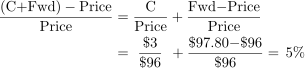
 . Collect the
  . The
. The  yield. The
  price increase contributes an extra
  . The two components sum to deliver
  .
.![\mathrm{Fwd}_t \approx \mathbb{E}_t[\mathrm{Price}_{t+1}]](https://alexchinco.com/wp-content/ql-cache/quicklatex.com-4233f79a812fa312ec679a2096b5fca0_l3.svg "Rendered by QuickLaTeX.com") . Nothing riskless holds the realized price to this prediction. A trader convinced that
. Nothing riskless holds the realized price to this prediction. A trader convinced that  will come in above
  can buy the forward and wait, but waiting entails risk. Rates can move against him before the year is out. So the gap between the forward price and the realized price is a bet, not an arbitrage. The market cannot squeeze it to zero. It can only keep it small. How small? The prediction could be amazingly accurate, or it could be incredibly noisy. To find out, we just need to compare the traded forward price at time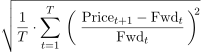
 away from bond traders’ best guess today.
 . Its price will be that
  discounted at whatever the 1-year rate turns out to be. Every ingredient of
  price miss is a
  rate miss. Treasury forward-price errors are estimates of the noise in
  per year on average from 1988 to 2003 (
 a year, which implies the rate is off by
  . With a duration of
  years, this pricing error translates to rate mistakes of
  . The long bond misses by
  , which translates to rate noise of
  when assuming a duration of
  years. Every point on the curve tells the same story. The bond market’s best forecast of a rate is accurate to within
  to
to  .
. multiple. Above, we saw that the same factor of
  , then the Gordon price can only be accurate to within
 , the Gordon model says SPY should trade at
  . If the correct cap rate could be as high as
  or as low as
  , then the true valuation could be anywhere from
  to
to  , a range of more than
  .
. . This is not a prediction of stock-market volatility. It is the size of the price fluctuations that could be explained by the unavoidable noise in the market’s best estimate of
  .
. more volatile than the implied price. The index’s dividend is extremely stable while its returns fluctuate by
 is the last year in the sample.
  is the S&P 500’s average detrended real price level during the sample period. This is not the theoretically correct thing to do. It parks every dividend payment beyond the sample in a single assumed terminal value. It uses the S&P 500’s realized future dividend payments rather than investors’ expectations of these payoffs. The correct discount rate need not be constant.
 . This level of precision is far below anything observed even in bond markets.
 to
to  , a span of over
  :
:  to
to  . This massive improvement in accuracy is hard to fathom on present-value grounds.
 is observed: the risk-free leg alone moves by
  to shadow
  and
and  with a correlation to
  , year after year, decade after decade. Measured long-run growth expectations show nothing like that co-movement with rates. That is not an assumption. It is a century of coincidences stacked one on top of the other.
![\mathbb{E}_t[\text{Div}_{t+1}]](https://alexchinco.com/wp-content/ql-cache/quicklatex.com-a3e7ed9d8130d74988c875bef3986246_l3.svg "Rendered by QuickLaTeX.com") , times a forward multiple,
, times a forward multiple,  ,
,![\begin{equation*}\text{Price}_t = \mathbb{E}_t[\text{Div}_{t+1}] \times \bigg( \frac{1}{\mathrm{r} {-} \mathrm{g}}\bigg)\end{equation*}](https://alexchinco.com/wp-content/ql-cache/quicklatex.com-9a9efc6aaab4d9c389e196e4f87995e1_l3.svg "Rendered by QuickLaTeX.com")
 is the stock’s annual risk-adjusted discount rate. A dollar paid out
  today.
 ![\mathrm{g} = \big(\frac{\mathbb{E}_t[\text{Div}_{t+h}]}{\text{Div}_t}\big)^{1/h}{-}1](https://alexchinco.com/wp-content/ql-cache/quicklatex.com-685a29716a494c701c0bc74e558545b5_l3.svg "Rendered by QuickLaTeX.com") is the company’s anticipated dividend-growth rate at every horizon
is the company’s anticipated dividend-growth rate at every horizon  .
. to capture the
  onward. e.g., suppose a firm has promised to pay
  in dividends next year. If investors apply a
  annual dividend growth, then the Gordon model would price the stock at
  .
.
 denotes the annual discount rate.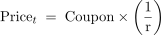
 years. Both pay the same coupon each year. However, in the final year
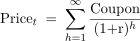
  . The price of a coupon bond reflects the present value of its payout stream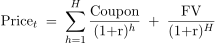
 . Thus, we can write the price as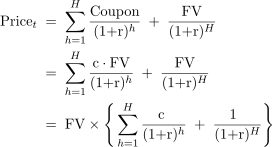
 , is the present value of the coupons spun off by each dollar of face value. The second term,
  , is the present value of receiving that dollar when the bond matures.
 , then we say that a bond is
  coupon once a year for the next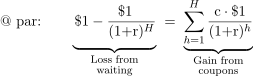
 .
. , it doesn’t matter whether you get paid the face value at time
  or continue to collect an infinite stream of coupons from year
 ![([t{+}H]{+}1)](https://alexchinco.com/wp-content/ql-cache/quicklatex.com-2aee41888b057df56c6f3cc390732141_l3.svg "Rendered by QuickLaTeX.com") onward
onward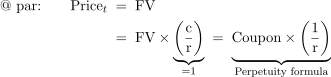
 , then the bond’s priced at a discount (below par). If
  , then it’s priced at a premium (above par).
![\begin{align*}\text{bond:} \qquad \text{Price}_t \;&=\; \frac{\;\;\!\mathrm{Coupon}\;\;\!}{1{+}\mathrm{r}} + \frac{\;\;\;\;\;\;\;\!\mathrm{FV}\;\;\;\;\;\;\;\!}{1 {+} \mathrm{r}} \\ \text{stock:} \qquad \text{Price}_t \;&=\; \frac{\mathbb{F}_t[\text{Div}_{t+1}]}{1{+}\mathrm{r}} + \frac{\mathbb{F}_t[\text{Price}_{t+1}]}{1 {+} \mathrm{r}}\end{align*}](https://alexchinco.com/wp-content/ql-cache/quicklatex.com-3ce406ca619d416db9dd29eb9c70ace2_l3.svg "Rendered by QuickLaTeX.com")
![\mathbb{F}_t[\cdot]](https://alexchinco.com/wp-content/ql-cache/quicklatex.com-c41565336510190935c557bf9fb935a6_l3.svg "Rendered by QuickLaTeX.com") denotes investors’ forecast given time-
denotes investors’ forecast given time-![\mathbb{E}_t[\cdot]](https://alexchinco.com/wp-content/ql-cache/quicklatex.com-1bc50689ea90ae6d13bcd8df908f8841_l3.svg "Rendered by QuickLaTeX.com") for forecasts that do. This distinction will play a big role later on.
for forecasts that do. This distinction will play a big role later on.  and
and  or
or ![\mathbb{F}_t[\mathrm{Price}_{t+1}]](https://alexchinco.com/wp-content/ql-cache/quicklatex.com-a601397c4d4aee86081309e364cedd5b_l3.svg "Rendered by QuickLaTeX.com") . If you’re trying to figure out the functional form of
. If you’re trying to figure out the functional form of  , then how are you supposed to know the right value to plug in for next year’s resale price? It is always possible to write an equation in which a stock’s current price equals the discounted payoff to owning a share next year. But for this equation to mean something, you need to remove the dependency of next year’s payoff on the future resale price. Otherwise, the relationship is circular.
 are constant. This is the least interesting part of the derivation. Let’s walk through what’s required to get from the one-period-ahead present-value formula to Myron Gordon’s result
![\begin{equation*}\text{Price}_t \;=\; \frac{\mathbb{F}_t[\text{Div}_{t+1}] + \mathbb{F}_t[\text{Price}_{t+1}]}{1 + \mathrm{r}_t} \qquad \rightsquigarrow \qquad \text{Price}_t \;=\; \mathbb{E}_t[\mathrm{Div}_{t+1}] \times \bigg( \frac{1}{\mathrm{r}{-}\mathrm{g}} \bigg)\end{equation*}](https://alexchinco.com/wp-content/ql-cache/quicklatex.com-5d4cb50d7d6833f967933fd968751b25_l3.svg "Rendered by QuickLaTeX.com")
 vary over time. There are 5 steps. The first 4 are where all the real heavy lifting takes place.
  . The same formula that governs today’s price must also govern the price targets in investors’ heads
![\begin{equation*}\text{Price}_{t+h} = \frac{\mathbb{F}_{t+h}[\text{Div}_{(t+h)+1}] + \mathbb{F}_{t+h}[\text{Price}_{(t+h)+1}]}{1 + \mathrm{r}_{t+h}} \qquad \text{for all } h \geq 0\end{equation*}](https://alexchinco.com/wp-content/ql-cache/quicklatex.com-2a44857e7a3e9cce19234221cc9e7fef_l3.svg "Rendered by QuickLaTeX.com")
 is the one-period discount rate applied to payouts received at time
 ![([t{+}h]{+}1)](https://alexchinco.com/wp-content/ql-cache/quicklatex.com-94a0d319bcd8570f5fac5059a9c88172_l3.svg "Rendered by QuickLaTeX.com") . i.e., each dollar paid the following year is worth
. i.e., each dollar paid the following year is worth  at time
  is known at time
  , and applying the formula in future years,
 ![\begin{equation*}\mathbb{F}_t\big[\mathbb{F}_{t+1}[\,\cdot\,]\big] = \mathbb{F}_t[\,\cdot\,]\end{equation*}](https://alexchinco.com/wp-content/ql-cache/quicklatex.com-46154d55adff6bc5a286f6287ea8168c_l3.svg "Rendered by QuickLaTeX.com")
 , with any other longer horizon. Arbitrary forecasts do not have this feature. The tower property is only satisfied by conditional expectations that stem from a well-posed
 ![\begin{equation*}\text{Price}_t \;=\; \underbrace{\sum_{h=1}^{H} \frac{\mathbb{E}_t[\text{Div}_{t+h}]}{\prod_{k=0}^{h-1} (1 {+} \mathrm{r}_{t+k})}}_{\text{PV first H dividends}} \;+\; \underbrace{\frac{\mathbb{E}_t[\text{Price}_{t+H}]}{\prod_{k=0}^{H-1} (1 {+} \mathrm{r}_{t+k})}}_{\text{PV resale price}}\end{equation*}](https://alexchinco.com/wp-content/ql-cache/quicklatex.com-66a8a9b0680c152fa8fc0b6004fec8a9_l3.svg "Rendered by QuickLaTeX.com")
 or
or  years in the future? At this point, it’s not obvious progress has been made.
 . We’re looking to remove the dependency of the current price on the expected future resale value. For this to happen, we need two things to be true:
![\begin{equation*}\lim_{H \to \infty} \, \frac{\mathbb{E}_t[\text{Price}_{t+H}]}{\prod_{k=0}^{H-1} (1 {+} \mathrm{r}_{t+k})} \;=\; \mathdollar 0\end{equation*}](https://alexchinco.com/wp-content/ql-cache/quicklatex.com-1049a8de73ffd8d7821185fb1bb0d8cf_l3.svg "Rendered by QuickLaTeX.com")
 onward
![\begin{equation*}\text{Price}_t \;=\; \sum_{h=1}^{\infty} \frac{\mathbb{E}_t[\text{Div}_{t+h}]}{\prod_{k=0}^{h-1} (1 {+} \mathrm{r}_{t+k})}\end{equation*}](https://alexchinco.com/wp-content/ql-cache/quicklatex.com-b87bee30cf9faf9de04ae29deca17ef1_l3.svg "Rendered by QuickLaTeX.com")
![\begin{equation*}\mathbb{E}_t[\text{Div}_{t+h}] \;=\; (1 + \mathrm{g})^{h-1} \!\cdot \mathbb{E}_t[\text{Div}_{t+1}] \;=\; (1 + \mathrm{g})^h \cdot \text{Div}_t\end{equation*}](https://alexchinco.com/wp-content/ql-cache/quicklatex.com-a322901579b028fea46a8d44e4b61c69_l3.svg "Rendered by QuickLaTeX.com")


![\begin{align*}\text{Price}_t \;&=\; \sum_{h=1}^{\infty} \frac{\mathbb{E}_t[\text{Div}_{t+h}]}{\prod_{k=0}^{h-1} (1 {+} \mathrm{r}_{t+k})} \\ &=\; \sum_{h=1}^{\infty} \frac{(1{+}\mathrm{g})^{h-1} \cdot \mathbb{E}_t[\text{Div}_{t+1}]}{(1 {+} \mathrm{r})^h} \\ &=\; \mathbb{E}_t[\text{Div}_{t+1}] \times \sum_{h=1}^{\infty} \frac{(1{+}\mathrm{g})^{h-1}}{(1 {+} \mathrm{r})^{h\phantom{-1}}} \\ &=\; \mathbb{E}_t[\text{Div}_{t+1}] \times \bigg(\frac{1}{\mathrm{r} {-} \mathrm{g}}\bigg)\end{align*}](https://alexchinco.com/wp-content/ql-cache/quicklatex.com-0fc0e70ff0fd3fb28ed58850894f00a2_l3.svg "Rendered by QuickLaTeX.com")
 . If this condition is violated,
  , then the present value of the stock’s expected discounted dividend stream will be infinite. e.g., suppose a stock’s future payout stream gets discounted at
  annually and the company paid a
  dividend last year. If the firm’s dividend-growth rate is
  , then next year investors expect
 ![\mathbb{E}_t[\mathrm{Div}_{t+1}] = \mathdollar 1.04/\mathrm{sh}](https://alexchinco.com/wp-content/ql-cache/quicklatex.com-d18fd2e87d2522e9253d7337a43e897a_l3.svg "Rendered by QuickLaTeX.com") . Had the firm maintained the same dividend, this cash flow would only be worth
. Had the firm maintained the same dividend, this cash flow would only be worth  today. But they expect an extra
  in dividends next year, and this is more than enough to make up for the valuation drag created by discounting.
 . Suppose the level of the stock market rises by
  of their holdings. The data disagrees. There, the aggregate demand elasticity is much much lower.
  .
. . This is well within spitting distance of the estimated
  .
.
 , which creates a difference between stock-level and aggregate demand elasticities. There’s also a belief channel. A change in today’s price can impact the investor’s views about next year’s payoff. This is the
  term, and it pins down the overall level. Here’s where this formula comes from.
 denote an asset’s share of an investor’s wealth. Hold her forecasted return fixed, which switches off the belief channel and keeps a fixed fraction of her wealth in the asset. Under this assumption, a
  percent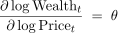
 and
and  . For an investor choosing how much to invest in the market as a whole, we have
  and
and  . The whole term vanishes.
 next year. The realized gross return on this investment will be

 and an average forecasted return
  . A
. A  , and a
 ![\mathbb{F}_t[\mathrm{Payout}_{t+1}]](https://alexchinco.com/wp-content/ql-cache/quicklatex.com-111a0d12dfec50d41e34bbbaa79df4c8_l3.svg "Rendered by QuickLaTeX.com") that is differentiable in
that is differentiable in  , and her return forecast is given by
![\begin{equation*}\mathbb{F}_t[\mathrm{Ret}_{t+1}] \;=\; (1 {+} \overline{\mathrm{DY}}) \cdot \big( \log \mathbb{F}_t[\mathrm{Payout}_{t+1}] \,-\, \log \mathrm{Price}_t \big) \,+\, \mathrm{constant}\end{equation*}](https://alexchinco.com/wp-content/ql-cache/quicklatex.com-68cf1d9df05c606dfe75a5dad70d90e8_l3.svg "Rendered by QuickLaTeX.com")
![\mathbb{F}_t[\mathrm{EPS}_{t+1}]](https://alexchinco.com/wp-content/ql-cache/quicklatex.com-c440ee3ecfec6def0744b4f2e57d6f34_l3.svg "Rendered by QuickLaTeX.com") need not have any impact on the PE. A1 does not impose
need not have any impact on the PE. A1 does not impose  . This parameter represents the price sensitivity of the investor’s forecasted return for the upcoming year
![\begin{equation*}\mu \;=\; {-}\frac{\partial \, \mathbb{F}_t[\mathrm{Ret}_{t+1}]}{\partial \log \mathrm{Price}_t} \;=\; (1 {+} \overline{\mathrm{DY}}) \times \bigg( 1 \,-\, \frac{\partial \log \mathbb{F}_t[\mathrm{Payout}_{t+1}]}{\partial \log \mathrm{Price}_t} \bigg)\end{equation*}](https://alexchinco.com/wp-content/ql-cache/quicklatex.com-23c4dc8ca23e0cb2d33b37c60d21ef47_l3.svg "Rendered by QuickLaTeX.com")
![\frac{\partial \log \mathbb{F}_t[\mathrm{Payout}_{t+1}]}{\partial \log \mathrm{Price}_t} = 0](https://alexchinco.com/wp-content/ql-cache/quicklatex.com-eaed5236194bda61fd36d93e67ce572e_l3.svg "Rendered by QuickLaTeX.com") and
and  . She suffers the full drag.
 has the same units. So the ratio
  is dimensionless, which an elasticity term has to be. The two terms combine to form the elasticity of the forecasted return with respect to the current price.
 . A
. A  . When we compare this effect to the long-run average return forecast,
  , we get a relative change of
  . The original
  converts this elasticity of forecasted returns into an elasticity of demand. You might think this conversion requires a full-fledged asset-pricing model. It turns out any allocation rule with the following form will do.
![\mathrm{Wealth}_t \times w\big(\mathbb{F}_t[\mathrm{Ret}_{t+1}]\big)](https://alexchinco.com/wp-content/ql-cache/quicklatex.com-3983a52d81dd9f09a97a42e02287810a_l3.svg "Rendered by QuickLaTeX.com") for a smooth increasing rule
for a smooth increasing rule  .
. times the ratio of her initial wealth and the asset’s share price
![\begin{equation*}\mathrm{Dmnd}_t \;=\; w\big(\mathbb{F}_t[\mathrm{Ret}_{t+1}]\big) \times \bigg\{ \frac{\mathrm{Wealth}_t}{\mathrm{Price}_t}\bigg\}\end{equation*}](https://alexchinco.com/wp-content/ql-cache/quicklatex.com-4f57c4dc0b5faeeddc7336ef4d130d58_l3.svg "Rendered by QuickLaTeX.com")
 .
. represents the elasticity of the investor’s dollar position in the asset with respect to her forecasted return next year evaluated at the asset’s long-run average forecast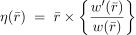
 , the investor scales her dollar allocation in the asset up by
  .
. to leading order. For mean-variance preferences, we have
  exactly. To see why, take any smooth rule with
  . A
. A  , so
, so
 and
and  for all
  . Hence, we have
  and
and  would do the same to leading order.
![\begin{equation*}\log \mathrm{Dmnd}_t \;=\; \log w\big(\mathbb{F}_t[\mathrm{Ret}_{t+1}]\big) \,+\, \log \mathrm{Wealth}_t \,-\, \log \mathrm{Price}_t\end{equation*}](https://alexchinco.com/wp-content/ql-cache/quicklatex.com-87e8d4f51c5d13fbd8a0020d84bd4177_l3.svg "Rendered by QuickLaTeX.com")
 . Together they are the rebalancing channel,
 ![\log w\big(\mathbb{F}_t[\mathrm{Ret}_{t+1}]\big)](https://alexchinco.com/wp-content/ql-cache/quicklatex.com-960913866c779ced5b358464fc3aae6f_l3.svg "Rendered by QuickLaTeX.com") term is the belief channel. The forecasted return falls by
term is the belief channel. The forecasted return falls by 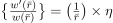 per unit of forecasted return. Flipping the sign delivers the headline formula
 . This change in next year’s return forecast represents roughly
  of the average return forecast. With
  , this return elasticity translates to a
  change in demand. For the market as a whole,
  , so
, so  . For an individual stock,
  and
and  , giving a demand elasticity that is one turn higher,
  . Gabaix-Koijen estimate an aggregate demand elasticity of
  . The textbook prediction is off by two orders of magnitude,
  !
! , which is known as the trailing PE ratio
![\begin{equation*}\mathbb{F}_t[\mathrm{Price}_{t+1}] = \mathbb{F}_t[\mathrm{EPS}_{t+1}] \times \mathrm{PE}_t\end{equation*}](https://alexchinco.com/wp-content/ql-cache/quicklatex.com-70b551899765b82e3303734a47c4b3fc_l3.svg "Rendered by QuickLaTeX.com")
![\begin{align*}\mathbb{F}_t[\mathrm{Ret}_{t+1}] \;&=\; \bigg(\frac{\mathbb{F}_t[\mathrm{Div}_{t+1}]}{\mathrm{Price}_t}\bigg) \,+\, \bigg(\frac{\mathbb{F}_t[\mathrm{Price}_{t+1}] - \mathrm{Price}_t}{\mathrm{Price}_t}\bigg) \\ &=\; \bigg(\frac{\mathbb{F}_t[\mathrm{Div}_{t+1}]}{\mathrm{Price}_t}\bigg) \,+\, \bigg(\frac{\mathbb{F}_t[\mathrm{EPS}_{t+1}] {\times} \mathrm{PE}_t - \mathrm{EPS}_t {\times} \mathrm{PE}_t}{\mathrm{EPS}_t {\times} \mathrm{PE}_t}\bigg) \\ &=\; \bigg(\frac{\mathbb{F}_t[\mathrm{Div}_{t+1}]}{\mathrm{Price}_t}\bigg) \,+\, \bigg(\frac{\mathbb{F}_t[\mathrm{EPS}_{t+1}] - \mathrm{EPS}_t}{\mathrm{EPS}_t}\bigg)\end{align*}](https://alexchinco.com/wp-content/ql-cache/quicklatex.com-067b21fdb9767421b5580af9e40d65bf_l3.svg "Rendered by QuickLaTeX.com")
 last year. Over the next year, analysts anticipate that the company’s earnings will grow by
  to
to ![\mathbb{F}_t[\mathrm{EPS}_{t+1}] = \mathdollar 5.035/\mathrm{sh}](https://alexchinco.com/wp-content/ql-cache/quicklatex.com-535d2b58ca7cf2c03ff969391f85e788_l3.svg "Rendered by QuickLaTeX.com") . The stock starts out trading at
. The stock starts out trading at  , giving the firm a trailing multiple of
  . Given how the market is currently pricing the company’s earnings, analysts expect the firm to be trading at a price of
 ![\mathbb{F}_t[\mathrm{Price}_{t+1}] = \mathdollar 5.035/\mathrm{sh} \times 20 = \mathdollar 100.70/\mathrm{sh}](https://alexchinco.com/wp-content/ql-cache/quicklatex.com-5085eb4ef709b92339020d76642bd4b4_l3.svg "Rendered by QuickLaTeX.com") next year. The company has committed to paying
next year. The company has committed to paying  in dividends next year, giving the firm an anticipated dividend yield of
  and a return forecast of
 ![\mathbb{F}_t[\mathrm{Ret}_{t+1}] = 0.7\% + 3.7\% = 4.4\%](https://alexchinco.com/wp-content/ql-cache/quicklatex.com-15fb95472b64834656ef545dbf1bb7b0_l3.svg "Rendered by QuickLaTeX.com") .
. . The firm’s earnings over the last twelve months don’t move,
  , when setting a price target,
 ![\mathbb{F}_t[\mathrm{Price}_{t+1}] = \mathdollar 5.035/\mathrm{sh} \times 20.2 = \mathdollar 101.71/\mathrm{sh}](https://alexchinco.com/wp-content/ql-cache/quicklatex.com-ccd9417cbd9c450ac846415c6767a6b9_l3.svg "Rendered by QuickLaTeX.com") . Yet the higher price target has no impact on analysts’ beliefs about future price growth because the current earnings are also being priced using a multiple that is
. Yet the higher price target has no impact on analysts’ beliefs about future price growth because the current earnings are also being priced using a multiple that is  higher. The higher current price level only affects analysts’ return forecast for next year by diluting the dividend yield. Instead of
  , analysts now anticipate a dividend yield of
 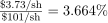 .
. target price plus the
  total. The resale price contributed
 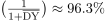 of the total payout. Following the unilateral
 vs
vs  , the resulting elasticity of returns is much smaller,
  rather than
  . Assuming
  and an aggregate demand elasticity of
  . The remaining distance, from
  . An
. An  closes the gap. On this reading, the trailing-PE rule and demand-side frictions are complements, not competitors. Beliefs deliver the first factor of
  . Frictions deliver the last factor of
  .
.

 is the
  implies that prices are more informative about the stock’s likely payout next year.
![\begin{equation*}\mathbb{E}_t[\log \mathrm{Payout}_{t+1}|\log \mathrm{Price}_t] \;=\; (1 {-} \lambda) \cdot \log \mathrm{Prior}_t \,+\, \lambda \cdot \log \mathrm{Price}_t\end{equation*}](https://alexchinco.com/wp-content/ql-cache/quicklatex.com-0f40570da89b78a75e33be679afdf4af_l3.svg "Rendered by QuickLaTeX.com")
 .
.![\begin{equation*}\frac{\partial \log \mathbb{E}_t[\mathrm{Payout}_{t+1}|\log \mathrm{Price}_t]}{\partial \log \mathrm{Price}_t} \;=\; \lambda \qquad \rightsquigarrow \qquad \mu \;=\; (1 {+} \overline{\mathrm{DY}}) \cdot (1 {-} \lambda)\end{equation*}](https://alexchinco.com/wp-content/ql-cache/quicklatex.com-c3e9e00a81b71437642624d587a27a5e_l3.svg "Rendered by QuickLaTeX.com")
 . There’s no impact on how this drag gets converted into a return elasticity. For the market as a whole, we get a predicted demand elasticity of
 , you get back the original formula. If the price signal is perfectly revealing,
  , the entire belief channel dies. Only the rebalancing term remains.
 . The learning story says
  . For both to produce the same value, you need
 . A learner who put
  weight on the current price signal would have the same demand curve as an analyst who set price targets using a trailing PE,
  for a single stock and
  or higher. This is worth pausing on. The learning model in Bastianello is built from standard Bayesian ingredients. The paper never talks in terms of trailing multiples. Yet at the weight implied by the data, the investor submits the same demand curve as an analyst using a trailing PE ratio. Fit to the data, the learning story does not offer an alternative to the trailing-PE mechanism. It approximates it.
 exactly.
 , both investors mark up their payout forecast by
  in response to a
  shortfall. But the two stories aren’t equivalent. They each place that
  on the capital gain and
  on the dividend yield. In the running example, both investors would forecast the same payout next year,
  . The analyst gets there as
  . The learner gets there as
  . Same number, different tickets, and the dividend line is the tell.
![\mathbb{E}[\mathrm{Mkt}]{-}\mathrm{rf} \approx 4\%](https://alexchinco.com/wp-content/ql-cache/quicklatex.com-28e825713c369899ca12d0d22b6c71ac_l3.svg "Rendered by QuickLaTeX.com") . Academic researchers call this the
. Academic researchers call this the ![\mathbb{E}[\mathrm{Ret}_n {-} \mathrm{rf}] \;=\; \beta_n \times \mathbb{E}[\mathrm{Mkt} {-} \mathrm{rf}]](https://alexchinco.com/wp-content/ql-cache/quicklatex.com-14b31a40d6809d8a038d3924e63fd233_l3.svg "Rendered by QuickLaTeX.com") . Suppose you plot each stock’s expected excess return,
. Suppose you plot each stock’s expected excess return, ![\mathbb{E}[\mathrm{Ret}_n] {-} \mathrm{rf}](https://alexchinco.com/wp-content/ql-cache/quicklatex.com-071ab4801987ad3cffe151ac82236637_l3.svg "Rendered by QuickLaTeX.com") (y-axis), against its
(y-axis), against its  (x-axis). The resulting line is called the
 ![\begin{equation*}\mathbb{E}[\mathrm{Ret}_n] {-} \mathrm{rf} \;=\; \beta_n \times \lambda\end{equation*}](https://alexchinco.com/wp-content/ql-cache/quicklatex.com-ee872e9b69594041c2cd702d683a5b14_l3.svg "Rendered by QuickLaTeX.com")
![\lambda = \mathbb{E}[\mathrm{Mkt}] {-} \mathrm{rf}](https://alexchinco.com/wp-content/ql-cache/quicklatex.com-3696d07a301553ffb2fcd05267eb568b_l3.svg "Rendered by QuickLaTeX.com") .
.![\begin{equation*}\nu \;\approx\; \frac{1}{\mathbb{E}[\mathrm{Mkt}] {-} \mathrm{rf}}\end{equation*}](https://alexchinco.com/wp-content/ql-cache/quicklatex.com-e65be16f812657425710f5ce1ca48b14_l3.svg "Rendered by QuickLaTeX.com")
 , then a unilateral
  increase in the current price of equities will cause a
  reduction in investors’ stock holdings.
 , the slope of the SML is basically zero. The aggregate stock market is much less elastic than theory predicts. Instead of
  ,
,  in the stock market raises its aggregate value by about
  .
. next year.
 . The stock market’s payout next year is
  . The investor starts with wealth
  . Today, he must choose how much to consume,
  , and how many shares of the risky asset to purchase,
  . His goal is to maximize
 ![\mathrm{U}(\mathrm{C}_t) + \mathbb{E}\big[ \, e^{-\rho} \cdot \mathrm{U}(\mathrm{C}_{t+1}) \, \big]](https://alexchinco.com/wp-content/ql-cache/quicklatex.com-985ae78c29521e61a4e433244b16cc31_l3.svg "Rendered by QuickLaTeX.com") where
where  is his rate of time preference. The investor parks any remaining wealth,
 ![(\omega - [\mathrm{C}_t {+} \mathrm{Q}_t \cdot \mathrm{Price}_t])](https://alexchinco.com/wp-content/ql-cache/quicklatex.com-114068be3af793f97ce2e4cb46f1263a_l3.svg "Rendered by QuickLaTeX.com") , in the riskfree bond. Next year, the investor eats the combined payout from his risky and safe investments
, in the riskfree bond. Next year, the investor eats the combined payout from his risky and safe investments![\begin{equation*}\mathrm{C}_{t+1} \;=\; (1 {+} \mathrm{rf}) \times \big( \, \omega - [\mathrm{C}_t {+} \mathrm{Q}_t \cdot \mathrm{Price}_t] \, \big) \,+\, \mathrm{Q}_t \cdot \mathrm{Payout}_{t+1}\end{equation*}](https://alexchinco.com/wp-content/ql-cache/quicklatex.com-e1ffc4f1a7376500c95c2617e90a81ef_l3.svg "Rendered by QuickLaTeX.com")
 denote the supply of shares in circulation.
  . An
. An  , and a current price level for the risky asset,
  , such that (i) the allocation solves the investor’s optimization problem given the price, and (ii) the price clear the market given the investor’s allocation.
![\begin{equation*}\mathrm{U}'(\mathrm{C}_t) \times \mathrm{Price}_t \;=\; \mathbb{E}\big[ \, e^{-\rho} \cdot \mathrm{U}'(\mathrm{C}_{t+1}) \times \mathrm{Payout}_{t+1} \, \big]\end{equation*}](https://alexchinco.com/wp-content/ql-cache/quicklatex.com-6be48d329912287e4d06f2ee53acb367_l3.svg "Rendered by QuickLaTeX.com")
 next year, so its Euler equation is
![\begin{equation*}\mathrm{U}'(\mathrm{C}_t) \;=\; \mathbb{E}\big[ \, e^{-\rho} \cdot \mathrm{U}'(\mathrm{C}_{t+1}) \times (1{+}\mathrm{rf}) \, \big]\end{equation*}](https://alexchinco.com/wp-content/ql-cache/quicklatex.com-23df7629650a6cdee85ec511808d1ab2_l3.svg "Rendered by QuickLaTeX.com")
 in Equation (4) with this expression, then the
  cancels out, and the price becomes a marginal-utility-weighted average of the discounted payout. The definition of a
 ![\mathbb{E}[\mathrm{Payout}_{t+1}] - \gamma \times \mathbb{C}\mathrm{ov}[\mathrm{C}_{t+1}, \, \mathrm{Payout}_{t+1}]](https://alexchinco.com/wp-content/ql-cache/quicklatex.com-1067e7e4d1005ada60f1961ed7947718_l3.svg "Rendered by QuickLaTeX.com") . What’s more, Equation (3) shows that next year’s consumption will be linear in the payout, so
. What’s more, Equation (3) shows that next year’s consumption will be linear in the payout, so ![\mathbb{C}\mathrm{ov}[\mathrm{C}_{t+1}, \mathrm{Payout}_{t+1}] = \mathrm{Q}_t \cdot \sigma^2](https://alexchinco.com/wp-content/ql-cache/quicklatex.com-d779c5d0f02c89033e209ab26363d58f_l3.svg "Rendered by QuickLaTeX.com") . Given market clearing,
. Given market clearing, ![\begin{equation*}\mathrm{Price}_t = \frac{\mathbb{E}[\mathrm{Payout}_{t+1}] - \gamma \cdot \sigma^2 \cdot \psi}{1 + \mathrm{rf}}\end{equation*}](https://alexchinco.com/wp-content/ql-cache/quicklatex.com-7e61ce3b0f6e11d25e972b8488580f1b_l3.svg "Rendered by QuickLaTeX.com")
 . Let
. Let  index the cross-section of risky assets… i.e., each stock in the stock market. The same SDF should price every one of them. If you use the SDF to write stock
  ‘s Euler equation and divide by its current price, then you get a statement about its expected return
![\begin{equation*}1 \;=\; \mathbb{E}\bigg[ \, \mathrm{SDF}_{t+1} \times \underbrace{\bigg(\frac{\mathrm{Payout}_{n,t+1}}{\mathrm{Price}_{n,t}}\bigg)}_{1+\mathrm{Ret}_{n,t+1}} \, \bigg]\end{equation*}](https://alexchinco.com/wp-content/ql-cache/quicklatex.com-c737bd5bea3b1c45b826074b1d4905dd_l3.svg "Rendered by QuickLaTeX.com")
![1 = \mathbb{E}[ \, \mathrm{SDF} \times (1{+}\mathrm{rf}) \, ]](https://alexchinco.com/wp-content/ql-cache/quicklatex.com-ec739c2c013644632cff60a9463a0f09_l3.svg "Rendered by QuickLaTeX.com") , then you get
, then you get![\begin{equation*}0 \;=\; \mathbb{E}\big[ \, \mathrm{SDF} \times (\mathrm{Ret}_n{-}\mathrm{rf}) \, \big]\end{equation*}](https://alexchinco.com/wp-content/ql-cache/quicklatex.com-789db147eedd3efde4cabdb98512d63d_l3.svg "Rendered by QuickLaTeX.com")
 , is stock
 ![\mathbb{C}\mathrm{ov}[X, \, Y] = \mathbb{E}[X \cdot Y] - \mathbb{E}[X] \cdot \mathbb{E}[Y]](https://alexchinco.com/wp-content/ql-cache/quicklatex.com-5e2219c3c4de633088b9edca349a79b9_l3.svg "Rendered by QuickLaTeX.com") , to this excess-return SDF formula
, to this excess-return SDF formula![\begin{align*}0 &= \mathbb{E}[ \, \mathrm{SDF} \times (\mathrm{Ret}_{n}{-}\mathrm{rf}) \, ] \\ &= \mathbb{E}[\,\mathrm{SDF}\,] \times (\mathbb{E}[\mathrm{Ret}_{n}]{-}\mathrm{rf}) + \mathbb{C}\mathrm{ov}[ \, \mathrm{SDF}, \, \mathrm{Ret}_{n} \, ]\end{align*}](https://alexchinco.com/wp-content/ql-cache/quicklatex.com-1472477c3244f11449661fc52b199c05_l3.svg "Rendered by QuickLaTeX.com")
![\begin{align*}\mathbb{E}[\mathrm{Ret}_{n}] {-} \mathrm{rf} &= \bigg( \frac{\mathbb{C}\mathrm{ov}[ -\mathrm{SDF}, \, \mathrm{Ret}_{n} ]}{\mathbb{E}[\mathrm{SDF}]} \bigg) \\ &= \underbrace{\bigg( \frac{\mathbb{C}\mathrm{ov}[ -\mathrm{SDF}, \, \mathrm{Ret}_{n} ]}{\mathbb{V}\mathrm{ar}[\mathrm{SDF}]} \bigg)}_{\beta_n} \times \underbrace{\bigg( \frac{\mathbb{V}\mathrm{ar}[ \mathrm{SDF}]}{\mathbb{E}[\mathrm{SDF}]} \bigg)}_{\lambda} \end{align*}](https://alexchinco.com/wp-content/ql-cache/quicklatex.com-339f54eda454eddcd7505172052d3711_l3.svg "Rendered by QuickLaTeX.com")
 term is constant across stocks. It answers the following question: If a stock’s
 is linear in
  by definition. So the SDF is approximately linear in the market’s return.
 and an average excess return of
  and an average excess return of
  . Two points define the slope of a straight line. So textbook theory predicts that
 ![\lambda = \mathbb{E}[\mathrm{Mkt}]{-}\mathrm{rf} \approx 4\%](https://alexchinco.com/wp-content/ql-cache/quicklatex.com-7deca31116db7ee62ef4c1185e2b6ee9_l3.svg "Rendered by QuickLaTeX.com") .
. .
.  index individual investors, each with his own risk-aversion coefficient,
  . Repeat the steps that led to the pricing rule in Equation (6), but stop short of market clearing. Isolating investor
  ‘s demand on the left-hand side, you get the formula below
![\begin{equation*}\mathrm{Q}_i \;=\; \frac{\mathbb{E}[\mathrm{Payout}] - (1 {+} \mathrm{rf}) \cdot \mathrm{Price}}{\gamma_i \cdot \sigma^2}\end{equation*}](https://alexchinco.com/wp-content/ql-cache/quicklatex.com-b4a58e53aae12e19439884799850591a_l3.svg "Rendered by QuickLaTeX.com")

 , as the
  . In equilibrium, each investor’s position in the CARA-normal model will be inversely proportional to his risk aversion,
  . Thus, the denominator in the elasticity formula is the same for everyone,
  . A single elasticity describes every investor. More risk-tolerant investors will hold bigger positions, but their percentage response is identical. This is analogous to the common
 ![\gamma \cdot \sigma^2 \cdot \psi = \mathbb{E}[\mathrm{Payout}] - (1 {+} \mathrm{rf}) \cdot \mathrm{Price}](https://alexchinco.com/wp-content/ql-cache/quicklatex.com-9bad3f33e10536ad935437aff126cff0_l3.svg "Rendered by QuickLaTeX.com") . Replace the denominator in Equation (15) with this expression and divide through by the current price. If the riskfree rate isn’t too large, then you get
. Replace the denominator in Equation (15) with this expression and divide through by the current price. If the riskfree rate isn’t too large, then you get![\begin{equation*}\nu \;=\; \frac{(1 + \mathrm{rf}) \cdot \mathrm{Price}}{\mathbb{E}[\mathrm{Payout}] - (1 + \mathrm{rf}) \cdot \mathrm{Price}} \;\approx\; \frac{1}{\mathbb{E}[\mathrm{Ret}] {-} \mathrm{rf}} \end{equation*}](https://alexchinco.com/wp-content/ql-cache/quicklatex.com-008e59112ad422d4ec9682dd0a89e21d_l3.svg "Rendered by QuickLaTeX.com")
 . In other words, theory predicts that
  , is the exchange rate between flows and prices. How much do investors have to adjust their holding in response to a
  , far above the value near
 ![\mathbb{E}[\mathrm{Mkt}]{-}\mathrm{rf}](https://alexchinco.com/wp-content/ql-cache/quicklatex.com-e0a13ce4c2fe25bdcf04701b9ff6d815_l3.svg "Rendered by QuickLaTeX.com") down to fit the slope of the SML makes the elasticity error worse and vice versa. The too-flat SML and the too-steep demand curve are both manifestations of the same underlying problem.
down to fit the slope of the SML makes the elasticity error worse and vice versa. The too-flat SML and the too-steep demand curve are both manifestations of the same underlying problem.