1. Introduction
In this note, I outline the main results in Hassan and Mertens (2011)1 for use in a 5min presentation in Prof. Sargent‘s reading group.
This paper asks the question: “Suppose that you air dropped a bit of noise into equity prices, how much worse off would everyone be in the context of a macroeconomic model with production?” As it turns out, adding a bit of noise can have a first order effect on welfare as noising up equity prices causes agents to disinvest in firms in favor of riskless debt, leading to lower production and thus lower consumption as agents can only consume what has been produced. To answer this question, the authors overcome  main challenges. First, they define a new equilibrium concept that allows for heterogeneous beliefs. Second, they solve for the equilibrium asset prices which vary non-linearly with their information set.2
To my knowledge, this paper is the first to address the costs of noisy asset prices in a dynamic general equilibrium setting; however, other papers such as Angeletos and Pavan (2007) have looked at the social costs and benefits of correct prices. Veldkamp (2011, Ch 8) also provides a good reference for solving noisy rational expectations models.
2. Model
Consider a standard linear homogeneous production function that produces output  using inputs of capital
  and labor
  .
.  denotes the total factor productivity and evolves according to a diffusion process with mean
  and variance
  :
:
(1) 
Capital evolves according to the law of motion below where  is the depreciation rate and
  is the aggregate investment level:
(2) 
There are a continuum of households indexed on the real line by ![i \in [0,1]](https://alexchinco.com/wp-content/ql-cache/quicklatex.com-d4b6b704cfa1a255d8c1ddaa96ae337a_l3.svg "Rendered by QuickLaTeX.com") . At the beginning of every period, each household
. At the beginning of every period, each household  gets a signal about tomorrow’s TFP with noise
  that is distributed normally with mean
  and variance
  :
:
(3) 
I refer to  as the “knowledge” of agent about tomorrow’s productivity. Given this knowledge, at time each agent then has a value function
  over consumption streams
  given his relative investment in stocks rather than bonds
  :
:
(4) ![\begin{align*} \begin{split} V_t(i) &= \max_{ \left\{ C_t(i) \right\}_{t=0}^\infty, \left\{ \omega_t(i) \right\}_{t=0}^\infty} \mathcal{E}_{i,t} \left[ \sum_{s=t}^\infty \beta^{s-t} \cdot \log C_s(i) \right] \\ &\text{s.t.} \\ W_{t+1} &= \left[ (1 - \omega_t(i)) \cdot (1 + r) + \omega_t(i) \cdot \left( 1 + \tilde{r}_{t+1} \right) \right] \\ &\qquad \times \left( W_t(i) + w_t \cdot L - C_t(i) \right) + \tau_t(i) \end{split} \end{align*}](https://alexchinco.com/wp-content/ql-cache/quicklatex.com-deef5a4c95cda2ac840d31d4cbb1cf55_l3.svg "Rendered by QuickLaTeX.com")
In the optimization program above,  denotes agent ‘s subjective views on how the future will unfold given his knowledge ,
  denotes agent ‘s financial wealth at time
  ,
,  denotes the return on stocks,
  denotes the wage rate for all agents,
  denotes the amount of labor supplied by each household and
  denotes the payments from the contingent claims trading. Equity prices are given by
  which is related to dividends
  via the market return :
(5) 
Let  be the “true” rational expectations operator which is linked to each agent’s subjective expectations via a common mean shock
  which has volatility
  :
:
(6) ![\begin{align*} \begin{split} \mathbb{E}_{i,t} \left[ \cdot \right] &= \mathbb{E} \left[ \cdot \mid s_t(i), Q_t, K_t, B_{t-1}, \eta_t \right] \\ \mathcal{E}_{i,t} \left[ \eta_{t+1} \right] &= \mathbb{E}_{i,t} \left[ \eta_{t+1} \right] + \tilde{\varepsilon}_t \end{split} \end{align*}](https://alexchinco.com/wp-content/ql-cache/quicklatex.com-277b7ab1321964393cdfd98131acb67c_l3.svg "Rendered by QuickLaTeX.com")
The representative firm solves the maximization program below and tries to produce as much output as possible given the production technology  and factor prices
  and
and  :
:
(7) 
All profits are dispersed immediately to shareholders. Firms take the market price of capital as given and then invest in capital accumulation according to the rule below where  represents the value of acquiring units of capital,
  represents cost from selling units of consumption good and
  represents an adjustment cost:
(8) 
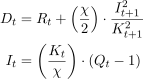
Thus, we can characterize the dividends paid per share as:
(9) 
With this machinery in place, I can now define an equilibrium in which agents have heterogeneous beliefs about firm productivity:
Definition (Equilibrium): Given a time path of shocks
an equilibrium in this economy is a time path of quantities

, signals
and prices
with the properies:
solve the households’ maximization problem given the vector of prices, initial wealth and the random sequences
;
solve the representative firm’s maximization problem given the vector of prices;
is the investment sector’s optimal policy given the vector of prices;
clears the labor market,
clears the stock market and
clears the market for capital services;
- There is a perfectly elastic supply of the consumption good and of bonds in world markets where bonds pay the interest rate
and the price of the consumption good is normalized to
;
are defined such that all households enter each period with the same amount of wealth; and
are given by the identities:
(10)
![\begin{align*} B_t(i) &= \left[ 1 - \omega_t(i) \right] \cdot \left( W_t(i) - C_t(i) \right) \\ X_t &= \int_0^1 X_t(i) \cdot di, \ \ \forall X \in \left\{ B, C, W \right\} \\ \omega_t &= \frac{Q_t \cdot K_{t+1}}{W_t - C_t} \end{align*}](https://alexchinco.com/wp-content/ql-cache/quicklatex.com-a7f13550ee13b247c63514996f4caa6c_l3.svg "Rendered by QuickLaTeX.com")
This definition collapses down to the standard noisy rational expectation equilibrium in the case of  :
:
Definition (Rational Expectations Equilibrium): A rational expectations equilibrium is an equilibrium as defined above in which the volatility of inference shocks
.
However, it also has a sensible interpretation even when agent’s have a common component to their belief heterogeneity:
Definition (Near Rational Expectations Equilibrium): A near rational expectations equilibrium allows for
. Such an equilibrium is
stable if the welfare gain to an individual household of obtaining rational expectations is less that
3. Financial Economy
In this section, I consider a world in which all agents hold beliefs that are slightly wrong in the same way. To formalize this idea, I define a new error term  which represents the difference between the average expectation of the total factor productivity at time in a world where
  and the average expectation in a world where :
(11) ![\begin{align*} \varepsilon_t &= \gamma \cdot \tilde{\varepsilon}_t \\ &= \int_{\tilde{\varepsilon}_t>0} \mathcal{E}_{i,t} \left[ \eta_{t+1} \right] \cdot di - \int_{\tilde{\varepsilon}_t=0} \mathcal{E}_{i,t} \left[ \eta_{t+1} \right] \cdot di \end{align*}](https://alexchinco.com/wp-content/ql-cache/quicklatex.com-5bc09f23db13ed60630cb72d6760acb0_l3.svg "Rendered by QuickLaTeX.com")
In particular, by expressing  as a ratio we can ask: How much market forces amplify (
 ) the existing common error?
To solve for the equilibrium values in the financial economy, I start with the Euler equations linking consumption in subsequent periods to the riskless rate of return and the rate of return on equities. Let  denote the state space. Then, I can express these Euler equations as:
(12) ![\begin{align*} \begin{split} C_t \left( \Theta_t, \nu_t(i) \right)^{-1} &= \beta \cdot \mathcal{E}_{i,t} \left[ \left( 1 + \tilde{r}_{t+1} \right) \cdot C_{t+1} \left( \Theta_{t+1}, \nu_{t+1}(i) \right)^{-1} \right] \\ C_t \left( \Theta_t, \nu_t(i) \right)^{-1} &= \beta \cdot \mathcal{E}_{i,t} \left[ \left( 1 + r \right) \cdot C_{t+1} \left( \Theta_{t+1}, \nu_{t+1}(i) \right)^{-1} \right] \end{split} \end{align*}](https://alexchinco.com/wp-content/ql-cache/quicklatex.com-3319262519ede4f04760fd82256bd4ac_l3.svg "Rendered by QuickLaTeX.com")
Next, given these Euler equations, I now face a complicated problem of trying to figure out households’ optimal allocation of consumption, stock purchases and bond purchases given that  households’ expectations depend non-linearly on their beliefs about the current and
  asset prices depend non-linearly on the average belief about future productivity. In a related paper, Mertens (2009) shows how to execute a non-linear change of variables that transforms the problem into a optimization program that resembles a more standard noisy rational expectations equilibrium. After this change of variables, I write the stock price as:
(13) ![\begin{align*} \begin{split} \hat{q}_t &= \int \mathcal{E}_{i,t} \left[ \eta_{t+1} \right] \cdot di \\ &= \int \mathbb{E}_{i,t} \left[ \eta_{t+1} \mid \hat{q}_t , s_t(i) \right] \cdot di + \tilde{\varepsilon}_t \end{split} \end{align*}](https://alexchinco.com/wp-content/ql-cache/quicklatex.com-1043fea60fc485fca548b663a67b1bc0_l3.svg "Rendered by QuickLaTeX.com")
i.e., the stock price equals the market expectation of  .
.
I now proceed down the lines of the solution to a standard noisy rational expectations model with value and noise term . I conjecture that the price  is an affine function of the value and the noise term with parameters
  ,
,  and
and  :
:
(14) 
Thus, we can interpret as the loading on the noise term in this pricing rule. This is quite natural as the price is the average expected value of the total factor productivity and ![\int_{\tilde{\varepsilon}_t=0} \mathcal{E}_{i,t} \left[ \eta_{t+1} \right] \cdot di](https://alexchinco.com/wp-content/ql-cache/quicklatex.com-c18b727d14fa3319fa73c3b8c6dbb44c_l3.svg "Rendered by QuickLaTeX.com") is the price in a world with no common error . Thus, the loading on the noise term should be , the amplification parameter defined above.
is the price in a world with no common error . Thus, the loading on the noise term should be , the amplification parameter defined above.
Next, using results from Mertens (2009), I write the true rational expectation of tomorrow’s total factor productivity ![\mathbb{E}_{i,t} \left[ \eta_{t+1} \right]](https://alexchinco.com/wp-content/ql-cache/quicklatex.com-c6a623985c0779286874566b169407e7_l3.svg "Rendered by QuickLaTeX.com") as an affine function of each agent’s beliefs and the prevailing price using the coefficients
as an affine function of each agent’s beliefs and the prevailing price using the coefficients  ,
,  and
and  which derive from the change of variables procedure which I do not outline here:
(15) ![\begin{align*} \mathbb{E}_{i,t} \left[ \eta_{t+1} \right] &= A_0 + A_1 \cdot s_t(i) + A_2 \cdot \hat{q}_t \end{align*}](https://alexchinco.com/wp-content/ql-cache/quicklatex.com-3e6add15cd2c2bbc2bfbe4cf6a758dcd_l3.svg "Rendered by QuickLaTeX.com")
By adding in the common noise term and then summing across agents , I get another affine expression below which links the average expectation of tomorrow’s total factor productivity to its true value and the amplified noise term:
(16) ![\begin{align*} \begin{split} \int \mathcal{E}_{i,t} \left[ \eta_{t+1} \right] \cdot di &= \left( A_0 + A_2 \cdot \pi_0 \right) \\ &\qquad \qquad + \left( A_1 + A_2 \cdot \pi_1 \right) \cdot \eta_{t+1} \\ &\qquad \qquad \qquad \qquad + \left( A_2 \cdot \gamma + 1 \right) \cdot \tilde{\varepsilon}_t \end{split} \end{align*}](https://alexchinco.com/wp-content/ql-cache/quicklatex.com-dfac36ec8a2f8fb518149ddd02c6812b_l3.svg "Rendered by QuickLaTeX.com")
Using this expression, I can then show that as households look more and more to the price of capital when forming prices, the amplification of common shocks to expectations via the pricing mechanism grows:
Proposition (Inference Shock Amplifier): The more weight the households place on the market price of capital when forming their expectations about
(17)

The proof of this proposition follows directly from taking first order conditions:
Proof: Combining the equations for
above yields a system of
equations and
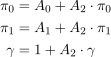
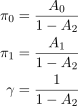
(18)
Solving for the unknowns yields:
(19)
Next, I look at how much information prices can hold in regimes that vary based on the the magnitude of the underlying common shock. For instance, consider the following thought experiment. Think about a world in which there was no common shock. If you knew nothing about asset values and then looked at prices, how precisely could you now pin down those values? To within  ?
?  ?
?  ? Now consider a world in which
  so that agents experience a common shock to their preferences. Now, for instance, agents might revise their expectations upward, hold more stocks as a result, and then influence others to do the same for capital gains purposes as the price depends on the average value of agent’s expectations. In such a world with a positive feedback loop, how much worse are prices at conveying the true value of the asset? If in the world with no common shock, you could see a price of
  and know that the asset was worth something between
  and
and  , in a world with a common shock have the bounds now expanded to
  ?
?
The proposition below dictates that the bounds will be increasing in the volatility of the common shock:
Proposition (Information Absorbency): The amount of information aggregated in the stock prices decreases with the volatility of the common shock
:
(20)

The proof comes via Mathematica by taking partial derivative of  with respect to where is bound up in the and terms so I omit it here.
4. Real Economy
In the previous section I showed how to derive equilibrium values for the financial economy and that the market became substantially less efficient as the volatility of the common shock increased due to the feedback loop between beliefs and asset prices. I now turn to the real economy and show that common errors in expectations distort aggregate consumption in the steady state as well. First, suppose that in equilibrium stock prices are log-normally distributed with variance  . Then we know that the optimal consumption plan will be myopically proportional to his wealth as agent’s have log utility:
(21) 
What’s more, his optimal stock holdings will also follow the standard log utility rule:
(22) ![\begin{align*} \omega_t(i) &= \frac{\mathcal{E}_{i,t} \left[ 1 + \tilde{r}_{t+1} \right] - \left( 1 + r\right)}{\sigma^2} \end{align*}](https://alexchinco.com/wp-content/ql-cache/quicklatex.com-853f6e69bc814b5dfc7148c72312cbd8_l3.svg "Rendered by QuickLaTeX.com")
Next, I characterize the steady state levels of stock holdings as well as the marginal product of capital:
Proposition (Steady State): The equilibrium has a unique stochastic steady state if and only if
. At the steady state, the aggregate degree of stock holdings is:
(23)
and the stochastic steady state capital stock is characterized by:
(24)
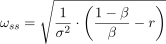

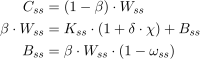
The restriction on the time preference parameter  makes sure that agents do not want to perpetually accumulate capital. The steady state stock holdings links the gap between the time preference parameter and the riskless rate to agent’s depend to hold capital with a volatility of
  . The full proof of this result is given below:
Proof: First, I characterize the steady state marginal product of capital. To do this, I start by linking it to the dividend payout rate:
(25)
Next, I observe that the excess return on capital can be linked to the marginal product of capital via the relationship:
(26)
This last statement yield the desired result after rearranging. Next, I turn to the steady state asset holdings which falls out of the budget constraint. First, I rewrite the budget constraint so that it only contains terms from
(27)
Next, I write the aggregate wealth, consumption and borrowing terms as functions of the steady state asset holdings:
(28)
Finally, I substitute these terms back in and rearrange to yield a result linking the steady state asset holdings to the constants:
(29)
![\begin{align*} D_{t+1} &= e^{\eta_{t+1}} \cdot \left( \frac{d}{dK} F(K_{t+1}, L) \right) \\ \mathbb{E}_{ss} \left[ D_{ss} \right] &= \left( \frac{d}{dK} F(K_{ss}, L) \right) \end{align*}](https://alexchinco.com/wp-content/ql-cache/quicklatex.com-38b50fcb082466de53f3d799c7fa0141_l3.svg "Rendered by QuickLaTeX.com")



Next, I look at the steady state capital accumulation rate of the economy conditional on the volatility of the stock market:
Proposition (Capital Accumulation): An increase in the conditional variance of stock returns decreases the level of capital stock and total output:
(30)

This result says that the economy will acquire less and less capital as the volatility of stock returns increases. This result stems directly from the full derivative of the steady state capital level:
Proof: First, start with the equation above characterizing the steady state stock holdings
and then take the full derivative:
(31)
Rearranging terms and signing the RHS yields the necessary relationship.

Thus, in this section I showed that the economy is worse off when stock market volatility increases as a result of a common error in expectations.
- See Tarek Hassan and Thomas Mertens ↩
- By contrast, in the standard noisy rational expectations setup (e.g., see here) all outcomes are linearly related. ↩
 students denoted by
  . There is a set of
  courses,
  with
with  seats in each course
  . A consumption bundle
  for student
  with
with  :
:  . Each student
  . Let
. Let  be the set of admissible schedules where the utility from an inadmissible schedule is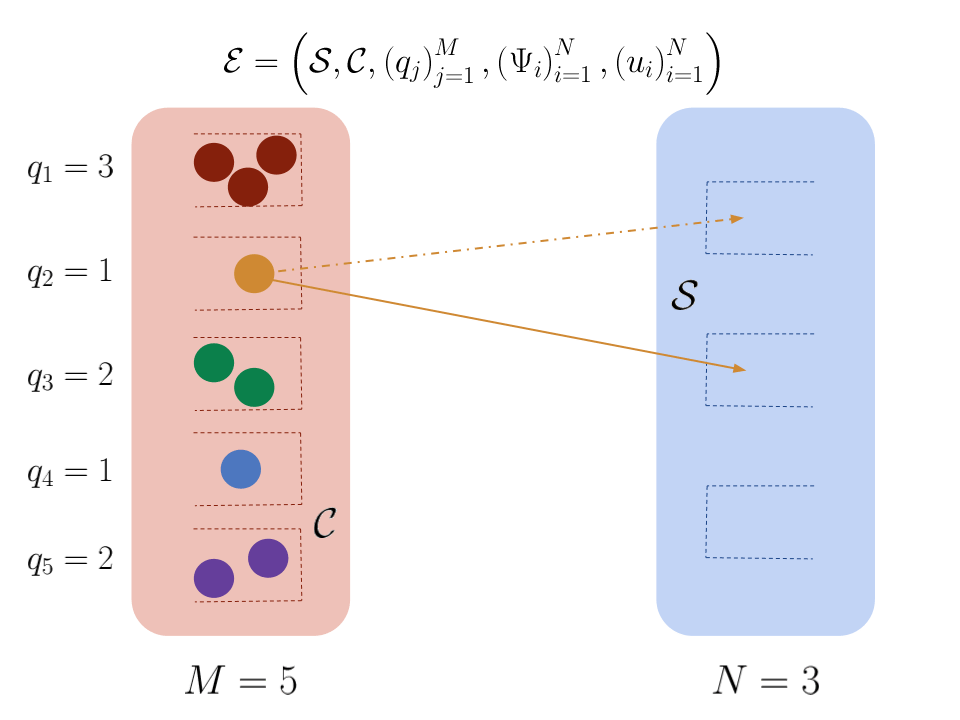
 of fake currency and the market clears at prices
  for each class
  .
. . For this economy, the allocation
  , budgets
  and prices
  constitute a
  -Approximate CEEI if the following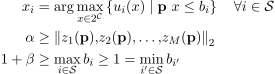
 .
. is controlling the approximation of the market clearing condition and
  , and then there are at most
  too many students:
  . Alternatively, there could be
  students too many students. Turning to
  , then the student with the least fake class-seat-buying currency has
  dollars.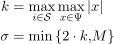
 , there exists a
  -Approx CEEI.
![[1,1+\beta]](https://alexchinco.com/wp-content/ql-cache/quicklatex.com-a3b5b2a971b44c6924df1a1b0575b3db_l3.svg "Rendered by QuickLaTeX.com") interval and any
interval and any  , there exists a
  that satisfy the condition:
 . The second part of the result captures the fact that, for any budget vector
  items between them:
 . Then, Alice would be able to buy the big diamond at a price of
  . Given that Alice would then have no more money, Bob could then afford to purchase both the small diamond and the big rock:
 that satisfy the
  and
and 
 -Approximate CEEI. The jump from this baseline result to the tighter
  with
with  . The Euclidean distance in the change in the aggregate demand due to such a shift would be
  . To get a clearer idea of this magnitude, consider the
  case below:
 , such a shift might lead to an
  change in the aggregate demand vector. However, if every agent has a unique budget
  , then in general there will be at most
  who is closest to his budget constraint hyperplane in the
  direction:
 shift in the aggregate demand vector.
 might make you demand less of asset
  might make you demand more as the good you would have liked to buy is now too expensive and you have to settle. To do this, I use a limiting result. Consider a tatonnement process
  such that:
 would represent a set of market clearing prices. Then convexify the mapping
  as follows:
 is upper hemi-continuous and convex. Thus, if I can find a fixed point for
  is compact and convex and
  is any mapping, then we have that:
 .
. is particularly nice because it doesn’t depend on either
  or
or  is an
is an  that Pareto improves on
  we have that
  . However, this means that the consumption bundle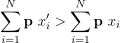
 , either:
 such that
 in the economy where
  and give them to me. Then, I will show you the good
  is an
is an  -Approx CEEI with
 times the amount of money as Bob so that she could buy both the big and small diamonds. Thus, we should suspect that envy bounded by a single good will fall out of an
  denote the number of objects envied in bundle
  by agent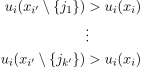
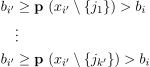
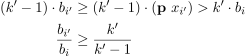
 we can replace
  in the above inequality with the term
  . However, we know that at most the ratio of
  can be
  so have that if
  there is a contradiction!
 .
. -Approximate CEEI’s.
 .
. uniformly from
  .
. ,
,  and
and  .
. small.
 -Approximate CEEI with
![\mathcal{S}^\infty = (0,N]](https://alexchinco.com/wp-content/ql-cache/quicklatex.com-1c62d01c1d8a8d75ebeb346c4af10489_l3.svg "Rendered by QuickLaTeX.com") so that agent
so that agent ![(0,1]](https://alexchinco.com/wp-content/ql-cache/quicklatex.com-8a7f9b20b556cd35f8e5cafbdd1f6fd7_l3.svg "Rendered by QuickLaTeX.com") , agent
, agent ![(1,2]](https://alexchinco.com/wp-content/ql-cache/quicklatex.com-f73b6a5941a867006de768c4cddbaa34_l3.svg "Rendered by QuickLaTeX.com") , agent
, agent ![(2,3]](https://alexchinco.com/wp-content/ql-cache/quicklatex.com-8bf2df5fc4664b4d566e13dc0a0460c3_l3.svg "Rendered by QuickLaTeX.com") and so on…
and so on… . Consider agent
  and fix all other agent’s reports. Agent
  EViews workspace file containing the adjusted closing price of

 “) the new series:

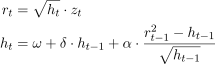
 is the conditional volatility and
  is a return, and then work out some properties of the estimator
 ![\mathbb{E}_t\left[ r_{t+2}^2\right]](https://alexchinco.com/wp-content/ql-cache/quicklatex.com-e3373d6e06ea65d5aed8867c334257f9_l3.svg "Rendered by QuickLaTeX.com") .
. , where
  is the horizon to the auto-correlation of the returns. The beta of a regression of the returns over the next
  Fama and French (1988) then run the regression below where
  is the investment horizon:
 would mean that high returns in the past year would predict high returns over the next
  of returns at horizon
 ![\begin{align*} \mathbb{V} \left[ r_{t \to (t+h)} \right] &= \mathbb{V} \left[ r_{t \to (t+1)} + r_{(t+1) \to (t+2)} + \dots + r_{(t+h-1) \to (t+h)}\right] \\ &= h \cdot \mathbb{V} \left[ r_{t \to (t+1)}\right] \end{align*}](https://alexchinco.com/wp-content/ql-cache/quicklatex.com-4bde35b41668f24ab25d1f197819c78a_l3.svg "Rendered by QuickLaTeX.com")
![\begin{align*} \mathtt{VR}(h) &= \frac{1}{h} \cdot \frac{\mathbb{V} \left[ r_{t \to (t+h)} \right]}{\mathbb{V} \left[ r_{t \to (t+1)} \right]} \\ &= \frac{1}{h} \cdot \frac{\mathbb{V} \left[ r_{t \to (t+1)} + r_{(t+1) \to (t+2)} + \dots + r_{(t+h-1) \to (t+h)}\right]}{\mathbb{V} \left[ r_{t \to (t+1)} \right]} \\ &= \frac{1}{h} \cdot \left( \sum_{i=1}^h \left| h - i \right| \cdot \rho_i \right) \end{align*}](https://alexchinco.com/wp-content/ql-cache/quicklatex.com-d9f9cefda3d709d9bfb7766d7caa2e59_l3.svg "Rendered by QuickLaTeX.com")
 term (i.e., the weights) comes from the fact that there are
  of the
  of the
  to capture the
 ![\begin{align*} \rho_i &= \mathtt{cor}\left[ r_{(t+i-1) \to (t+i)}, r_{(t-1) \to t} \right] \end{align*}](https://alexchinco.com/wp-content/ql-cache/quicklatex.com-2bb4ee14c44f3a5bb157f81facf5023e_l3.svg "Rendered by QuickLaTeX.com")
![\begin{align*} \beta(h) &= \frac{\mathbb{C} \left[ r_{t \to (t+h)}, r_{(t-1) \to t} \right]}{\mathbb{V}\left[ r_{t \to (t+h)} \right]} \\ &= \frac{h \cdot \mathbb{V} \left[ r_{t \to (t+1)} \right]}{\mathbb{V}\left[ r_{t \to (t+1)} \right]} \cdot \frac{1}{h} \cdot \sum_{i=1}^h \left| h - i \right| \cdot \rho_i \\ &= \sum_{i=1}^h \left| h - i \right| \cdot \rho_i \end{align*}](https://alexchinco.com/wp-content/ql-cache/quicklatex.com-2ec2e4e9b62c56ea77d06498d2953b23_l3.svg "Rendered by QuickLaTeX.com")
 with a period of about
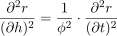
 . This constant term
  captures the mean reversion of the return process. Put differently, if you found an asset whose return was increasing at an increasing rate in the holding period, then you would want to hold onto that asset as long as possible. However, this wave equation says that the properties of the return are changing over time and the higher this acceleration of returns with respect to the time horizon, the faster the properties of the return have to be changing. The constant that regulates this relationship is
 as dictated by the physical properties of the problem: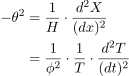
 or
or  ; however, I know that
  has to be
  as the property of no arbitrage dictates that I should never be able to earn excess returns without holding onto risk for some positive increment of time (…even if that increment is really small). Thus, I get the functional form:
![\begin{align*} r &= \sin \left[ \frac{n \cdot \pi \cdot h}{\overline{h}} \right] \cdot \cos \left[ \frac{n \cdot \pi \cdot \phi \cdot t}{\overline{h}} \right] \\ &= \sum_{n=1}^\infty f_n \cdot \sin \left[ \frac{n \cdot \pi \cdot h}{\overline{h}} \right] \cdot \cos \left[ \frac{n \cdot \pi \cdot \phi \cdot t}{\overline{h}} \right] \\ &= \frac{8 \cdot \sigma_r}{\pi^2} \cdot \left( \sin\left[ \frac{\pi \cdot h}{\overline{h}} \right] \cdot \cos \left[ \frac{\pi \cdot \phi \cdot t}{\overline{h}} \right] \right. \\ &\qquad \qquad \left. - \frac{1}{9} \cdot \sin \left[ \frac{3 \cdot \pi \cdot h}{\overline{h}} \right] \cdot \cos \left[ \frac{3 \cdot \pi \cdot \phi \cdot t}{\overline{h}} \right] + \dots \right) \end{align*}](https://alexchinco.com/wp-content/ql-cache/quicklatex.com-4628f8c6107371334a3f4a6ed15833c6_l3.svg "Rendered by QuickLaTeX.com")
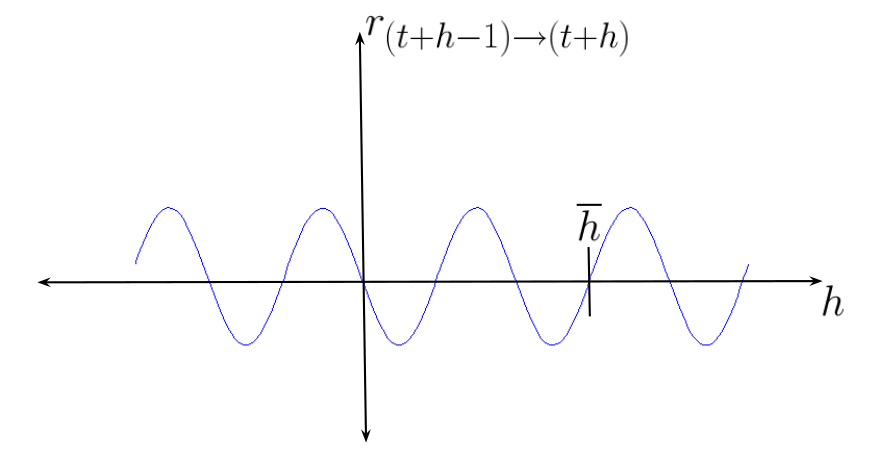
 at the horizon
  . Put differently, if you thought about attaching the return process of length
  to
to ![h \in [0,\overline{h}]](https://alexchinco.com/wp-content/ql-cache/quicklatex.com-8b50ba5bcd6d1091c67330c9695cc5ca_l3.svg "Rendered by QuickLaTeX.com") is, given any observation of the short rate process on the interval.
is, given any observation of the short rate process on the interval.![\begin{align*} \beta(h) &= \frac{\mathbb{C} \left[ r_{t \to (t+h)} \right]}{\mathbb{V} \left[ r_{(t-1) \to t} \right]} \\ &= \frac{\mathbb{C} \left[ \sum_{i=1}^h \sin \left\{ \frac{\pi \cdot i}{10} \right\} \cdot \cos \left\{\frac{\pi \cdot 0.12 \cdot t}{10} \right\}, \sin \left\{\frac{\pi \cdot -1}{10} \right\} \cdot \cos \left\{ \frac{\pi \cdot 0.12 \cdot t}{10} \right\} \right]}{\mathbb{V} \left[ \sin \left\{ \frac{\pi \cdot -1}{10} \right\} \cdot \cos \left\{\frac{\pi \cdot 0.12 \cdot t}{10} \right\} \right]} \end{align*}](https://alexchinco.com/wp-content/ql-cache/quicklatex.com-f188f6ff67486872caf1964c681c2d54_l3.svg "Rendered by QuickLaTeX.com")
 terms will drop out and we will get a sum of
  terms just as before.
 and aggregate demand
  :
: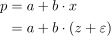
 denotes the average price while the coefficient
  represents the price’s responsiveness to aggregate demand changes. i.e.,
  , but also other traders who trade randomly and demand an amount
  . Suppose that the value of the asset is drawn from a distribution
  . The coefficients
  which is the amount demanded by the informed agents which is also linear in the asset value with coefficients
  and
and  :
:
 denote the informed agent’s utility from trading:
![\begin{align*} \Pi &= \max_{z} \left\{ \mathbb{E} \left[ (v - p) \cdot z \mid v \right] \right\} \\ &= \max_{z} \left\{ \mathbb{E} \left[ (v - a - b \cdot z - b \cdot \varepsilon) \cdot z \mid v \right] \right\} \end{align*}](https://alexchinco.com/wp-content/ql-cache/quicklatex.com-f519c242f3c419e141ece40e346b659d_l3.svg "Rendered by QuickLaTeX.com")
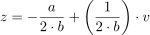
 as functions of the model primitives
  , I enforce the break even condition for the market maker which demands that the price of the asset be equal to the expected value of the asset conditional on observing the aggregate asset demand:
![\begin{align*} p &= \mathbb{E} \left[ v \mid x \right] \\ &= \mathbb{E} \left[ v \right] + \frac{\mathbb{C} \left[ x, v\right]}{\mathbb{V}\left[ x \right]} \cdot \left( x - \mathbb{E}[x] \right) \\ &= \mu_v + \frac{\mathbb{C} \left[ - \frac{a}{2 \cdot b} + \left( \frac{1}{2 \cdot b} \right) \cdot v + \varepsilon, v\right]}{\mathbb{V}\left[ - \frac{a}{2 \cdot b} + \left( \frac{1}{2 \cdot b} \right) \cdot v + \varepsilon \right]} \cdot \left( x - \left[ - \frac{a}{2 \cdot b} + \frac{\mu_v}{2 \cdot b} \right] \right) \\ &= \mu_v + \left( \frac{\left( \frac{1}{2 \cdot b} \right) \cdot \sigma_v^2}{ \left( \frac{1}{2 \cdot b} \right)^2 \cdot \sigma_v^2 + \sigma_{\varepsilon}^2} \right) \cdot \left( \frac{a}{2 \cdot b} - \frac{\mu_v}{2 \cdot b} \right) \\ &\qquad \qquad + \left( \frac{\left( \frac{1}{2 \cdot b} \right) \cdot \sigma_v^2}{ \left( \frac{1}{2 \cdot b} \right)^2 \cdot \sigma_v^2 + \sigma_{\varepsilon}^2} \right) \cdot x \end{align*}](https://alexchinco.com/wp-content/ql-cache/quicklatex.com-dabbfc1d74bf6c5a44a2db515a2ed3ff_l3.svg "Rendered by QuickLaTeX.com")
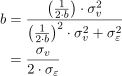
 . By using normally distributed random variables as well as linear pricing and informed demand rules, we can then get nice expressions for the coefficients of interest.
 shows the price you will set if you observe an aggregate demand of
  , you will set the price of
![\mathbb{E} [ \varepsilon ] = 0](https://alexchinco.com/wp-content/ql-cache/quicklatex.com-2b998dae14d78dc2093f726e2c1391e1_l3.svg "Rendered by QuickLaTeX.com") . This best guess is displayed in the plot by the mapping through the
. This best guess is displayed in the plot by the mapping through the  line on the green floor of the figure over to the z-axis. On the red wall of the figure, we see that this choice of
  , it must be the case that both the
 ![\mathbb{E}[\varepsilon]=0](https://alexchinco.com/wp-content/ql-cache/quicklatex.com-d1f966d47546a01c9ea632255547e3d6_l3.svg "Rendered by QuickLaTeX.com") .
.
You must be logged in to post a comment.