1. Motivating Example
This post gives a non-technical summary of the results in my job market paper, Trading on Coincidences (2012). I start with a simple example. Suppose you see Apple among the  stocks with the highest returns over the past quarter from October to December. Should you bother checking the tech industry more closely for a shock to fundamentals? Well, probably not. After all, there are always going to be stocks in the list of stocks with the highest returns. Investigating the tech industry would mean investigating
  or industries every single trading period.1 What’s more, Apple’s extreme performance might not have anything to do with its industry. Perhaps a California-specific shock was the culprit? So, if you are going to investigate the tech industry, you are going to end up analyzing every single attribute of every single stock in the top returns. That’s a lot of work!
However, if you see both Apple and Microsoft in the top returns, this calculus changes. Now, you might actually want to investigate the tech industry. Coincidences like this one—i.e.,  or more stocks with the same attribute in the top or bottom returns—are much less likely to occur by pure chance.2 In addition, using firms allows you to narrow the list of possible explanations. For instance, you can rule out any California-specific explanation since Microsoft is headquartered in Washington. Pushing this logic further, if Apple, Microsoft, and Research in Motion all realize top returns, then you should definitely look for a deeper explanation. Multi-stock coincidences like this are very rare, and these
  companies only share a handful of common attributes.3
2. Outline of Results
First, I start from the assumption that traders face an attention allocation problem. I build a model with  stocks that realize attribute-specific cash flow shocks. Traders can’t sort all stocks over and over again on each of the
  characteristics (e.g., industry, customer, country, accounting firm, etc…) to check for these attribute-specific shocks by brute force.4 They must use an attention allocation heuristic. Second, I then propose one such heuristic: trading on coincidences. i.e., traders only update their beliefs about an attribute after observing a coincidence. I characterize the information content of a coincidence in this model and solve for asset prices. Third, I show that if traders use this heuristic, then stock returns will display post-coincidence comovement. i.e., regardless of when the attribute-specific shock to fundamentals occurs, asset prices will only respond after traders observe a coincidence. Fourth, I take this prediction to the data. I find that post-coincidence comovement at the industry level generates an
  excess return that is not explained by any of the canonical factors models, other boundedly rational stories, or well known behavioral biases. Fifth and finally, I use computational complexity to give a physical basis for the scarcity of attention.
Roadmap:
- Assume traders face an attention allocation problem and build consistent model.
- Propose that traders use coincidences to solve this problem.
- Show that returns will display post-coincidence comovement as a result.
- Give empirical evidence of post-coincidence comovement suggesting that traders:
- Use coincidences to direct their attention, and
- Face an attention allocation problem with first order asset pricing implications.
- Give interpretation of scarce attention using on computational bounds.
3. Detailed Description
I now discuss the nuts and bolts of each of these  steps.
3.1. Model
First, I propose that traders face an attention allocation problem. Here is how I model this problem:
Assets: I consider a discrete time, infinite horizon economy. There are stocks and each stock has different attributes. For example, Apple is headquartered in Cupertino, is in the technology industry, is a major customer of Gorilla Glass, etc… Stocks realize persistent, rare, attribute-specific cash flow shocks. For example, if an innovation suddenly makes Gorilla Glass less expensive to manufacture in October, then all tablet making tech firms will realize a positive cash flow shock starting in October and lasting for several months (e.g., October, November, December, etc…). Firms pay out all of their earnings as dividends. Thus, the payout space is a giant  -dimensional matrix with all the attributes of all the stocks.
Agents: Traders are risk neutral and have priors about whether or not any particular attribute has realized a cash flow shock. I refer to these priors as a “mental model.” Because there are so many different ways to sort and groups stocks, I assume it is computationally infeasible for traders to check every single attribute-specific cluster of firms.56 Instead, they must use some attention allocation heuristic.7
3.2. Heuristic
Second, as one way to solve this problem, I show that traders can use coincidences as an attention allocation device.89 If agents trade on coincidences, then they only update their mental model about attribute-specific cash flows after they observe or more stocks with that attribute among the firms with the highest or lowest past returns. For instance, if the tech industry realizes a positive cash flow shock in October, most traders won’t immediately notice this change. There are too many possible stories explaining market returns for traders to investigate them all. Even though most traders haven’t noticed this industry-specific cash flow shock, all tech stocks will have slightly higher returns in October, November, December, etc… because of higher dividend payouts or because a few constrained specialists have started to incorporate this information into prices. However, most traders will only update their beliefs about the tech industry in December when Apple and Microsoft realize top returns and attract their attention. I solve for asset prices and give asymptotic expressions for the amount of information contained in coincidences.
3.3. Prediction
Third, I show that if traders use this heuristic, then stock returns will display post-coincidence comovement. For example, suppose again that the tech industry realizes a positive cash flow shock in October. Because there are so many things that could possibly affect stock returns at any one instant, most traders won’t immediately notice this event. The bomb has burst, but the blast wave hasn’t arrived yet. If people trade on coincidence, they will only notice this shock after Apple and Microsoft earn top returns in December. Thus, the prices of all tech stocks will rise in January after this coincidence—i.e., stock returns will display post-coincidence comovement. Crucially, this prediction holds “pointwise” across all characteristics that traders consider. For instance, suppose that traders look for both industry-specific coincidences and country-specific coincidences. Evidence of post-coincidence comovement at either the industry level or the country level is evidence that people are trading on coincidences.
3.4. Empirics
Fourth, I find that post-coincidence comovement at the industry level generates an excess return:
Is It Tradable? Suppose that Apple and Microsoft both earn top returns in December while Ford, GM, and Toyota all realize bottom returns in December. I show that a trading strategy that is long all tech stocks except for Apple and Microsoft in January and short all auto stocks except for Ford, GM, and Toyota in January generates an excess return with an annualized Sharpe ratio of  . The excess returns to this trading strategy are not explained by industry momentum or other canonical factor models.10 Post-coincidence comovement is a necessary but not a sufficient explanations for the trading strategy returns. In the theoretical model, traders should update their beliefs about the tech industry in the first nanosecond of January. Thus, there would be no scope for trading profits. Any trading profits are due unmodeled trading frictions or limits to arbitrage.
Is It Measurable? In response to this concern, I also use a panel regression specification. Specifically, I look at the returns to IBM in January after Apple and Microsoft realized top returns and then also in, say, August after Oracle and Cisco realized bottom returns. I then compute the average difference between these two numbers across all firms after taking out firm-specific and month-specific fixed effects. Again, I find a spread of which is on the same order of magnitude as the trading strategy  . This specification yields three additional results. First, I show that the size of this spread is largest after fresh coincidences. For instance, Apple and Microsoft might earn top returns in December, January, and February. I find that all of the post-coincidence comovement occurs in January in the month immediately after the first coincidence in December. This evidence is consistent with the idea that traders update their mental model after a coincidence attracts their attention. Next, I show that the size of this post-coincidence spread is increasing in the size of the coincidence. For instance, Apple and Microsoft might end up in the top returns in January by pure chance. However, if you see Apple, Microsoft, Research in Motion, Intel, and Cisco all in the top , something must have happened to the tech industry. Thus, coincidences involving more firms from an attribute are better signals and should yield a larger price reaction. Finally, I show that the cumulative abnormal returns following a coincidence are persistent out to
  months. Perhaps traders see Apple and Microsoft in the top , think to themselves: “Oh, wow! The tech industry must be doing fantastic.”, and then bid up the price of all tech stocks way too high. If this were the case, then the cumulative abnormal returns following a coincidence should spike and then revert back. This is not what happens.
3.5. Complexity
Finally, I give a physical interpretation for why traders’ attention is so scarce using tools from computational complexity. Suppose that you want to check every attribute-specific cluster of firms for a cash flow shock. I show that with  stocks, this brute force search strategy would take over
  to complete at
  . By contrast, I find that by trading on coincidences people can dramatically reduce their time costs and still uncover a large fraction of all attribute-specific cash flow shocks. For instance, using the same parameters, I find that trading on coincidences requires less than a
  of processing time. There are good reasons to be uneasy about the absolute level of the estimate. Nevertheless, this estimate does suggest that traders attention allocation problem is non-trivial. After all there are only
  trading days in month on average. What’s more, there is an order of magnitude gap between the time cost of following the brute force inference strategy and trading on coincidences.
4. Key Implications
Let me now briefly outline interesting takeaways from this paper. First, this paper highlights a completely new and empirically relevant layer to traders’ inference problem—i.e., how do traders direct their attention? After all, traders sit in front of  computer monitors for a reason. Finding the right inference problem to solve is hard. For another example, Warren Buffett justified Berkshire Hathaway’s cash holdings in his 1987 Annual Letter to shareholders by writing: “Our basic principle is that if you want to shoot rare, fast-moving elephants, you should always carry a loaded gun.” The lesson is clear: Pulling the trigger is easy. Finding the elephant is hard.
Second, this paper suggests that the innate pattern recognition skills that make people good doctors, lawyers, and engineers from 9-to-5 can be used to uncover subtle changes in the market. Pattern recognition skills are hardcoded and universal, and coincidences are just one particularly salient pattern. The machinery developed in this paper can be used to analyze traders’ reactions to streaks or regular cycles. For instance, traders might ask themselves: “What are the odds that gold futures prices would rise for  straight months by pure chance? Perhaps I should investigate this contract further?”
Finally, this paper poses the question: “How often should we see extreme price patterns?” Lots of other papers have looked for explanations for particular extreme events. For example, “How could we possibly rationalize the tech boom of the later 1990s?”, or “Why did house prices rise so much in Las Vegas in 2004 but not in Austin or Albuquerque?” By contrast, this paper takes an entirely different approach and asks: “How often should traders see some asset with an extreme price path?” For instance: “How unlikely is it that traders cycled their attention from biotech stocks to junk bonds back to dotcom stocks then to housing and most recently to gold futures over the course of a  year period?”
- When there are
 industries, you should expect to observe
  distinct industries when looking at randomly selected stocks. ↩
 - When there are industries, you should expect to see a -way coincidence in some industry out of every periods by pure chance. This is by no means rare, but it is an order of magnitude less frequent than when looking at every single industry represented in the top returns. ↩
- When there are industries, you should expect to see a -way coincidence in some industry once every
 periods by pure chance. ↩
 - i.e., traders face an “unsupervised learning problem” (see Hastie, Tibshirani, and Friedman (2009, Ch. 14)). They don’t just have to solve a really hard but well-defined inference problem; rather, they also have to figure out which inference problem to analyze in the first place. Punchline: Searching for the right problem to solve requires cognitive/computational resources. ↩
- This difficulty exists regardless of how easy it is to solve the resulting inference problems. e.g., the Sunday New York Times crossword puzzle is hard because it is difficult to search through all the words you know to come up with reasonable solutions to each clue. It is actually really easy to verify that the solution posted on Monday is indeed correct. Punchline: Search is harder than verification. ↩
- In Gabaix (2012), traders only pay a cost for thinking about the impact of Peruvian copper discoveries on Apple’s dividend if they actively include this particular factor in their predictive model. By contrast, in the current paper, the initial step of considering the impact of Peruvian copper discoveries on Apple’s future dividends and then deciding not to include this factor in a predictive model comes with a cost. Traders can’t do this preprocessing step for every single obscure factor that might possibly affect Apple’s future dividends. They have to limit their attention to a manageable subset of factors. ↩
- Contrary to popular belief, computer chess programs don’t use brute force. This is infeasible. Instead, they mine a huge database of past chess games known as “the book.” This database is big, but no where near as large as the universe of all possible games. Human players actually have the advantage when games “go off book.” For instance, Garry Kasparov famously went off book early in his games against Deep Blue. Punchline: Computers are really fast, but search is really really hard. ↩
- This particular heuristic is motivated by anecdotal evidence. Open up any new site and you will find quotes like: “half of the top performers on the Nikkei 225 this year are domestic-oriented.” —The Wall Street Journal. Japan Commands New Respect. Jun 15, 2004. ↩
- The trading on coincidences heuristic that I propose is not optimized in any sense. If a trader wanted to optimize this heuristic, he would surely have to consider engineering details like variation in the speed of computers, the length of the trading period, and the dimensions of the market. However, my goal is not optimality. I simply propose a plausible heuristic, derive a unique empirical prediction, and then ask the data whether or not people actually take this approach. ↩
- Why is this not the same as industry momentum? The timing is different. To illustrate, let’s think about this tech stock example and compare the post-coincidence comovement trading strategy to an industry momentum trading strategy that is long/short the industries with the highest/lowest returns over the last months. Tech stocks realize a positive cash flow shock in October. This shock raises the mean return of all tech stocks slightly, but not enough to push the tech stocks to the top of the industry return rankings. People trading on coincidences only notice this shock in December when Apple and Microsoft earn top returns. As a result, the price of all tech stocks jumps up in January. An industry momentum trading strategy is then going to be long the tech industry in February at the earliest. Post-coincidence comovement actually triggers inclusion in an industry momentum portfolio. ↩
 for
for  . The signal Bob sees
  each period is an iid draw from a binomial distribution with intensity,
  :
:![\begin{align*} \mathtt{Pr}[s_t=a] &= \theta, \qquad \theta \in [0,1] \end{align*}](https://alexchinco.com/wp-content/ql-cache/quicklatex.com-5e194b8bd6707dbe24bafd4a450fddc7_l3.svg "Rendered by QuickLaTeX.com")
 denote the set of all rates that could occur with positive probability,
  , so that
  . Bob’s challenge is to infer which
  ‘s and is fully Bayesian; however, he believes that there is some positive integer
  signals of
  signals of
  . Finally, so that the game does not end after
  such that there are at least two
  and
and  signals that can be drawn at each point in time. Thus, there exists
  such that:
 . Let
. Let  represents Bob’s posterior beliefs about the probability of each
  given that he is a type-
 beliefs represent the beliefs of a fully rational agent. In the text below, I will can this fully rational agent Alice for concreteness.
 on an odd period: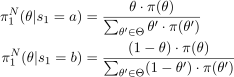
 and
and  are increasing in
  and
and  follow immediately from Bayes’ rule as, for example:
![\begin{align*} \pi_1^N(\theta|s_1=a) &= \frac{\mathtt{Pr}[s_1 = a|\theta] \cdot \mathtt{Pr}[\theta]}{\mathtt{Pr}[s_1 = a]} \\ &= \frac{\theta \cdot \pi(\theta)}{\sum_{\theta' \in \Theta} \theta' \cdot \pi(\theta')} \end{align*}](https://alexchinco.com/wp-content/ql-cache/quicklatex.com-fb2b74506cf5713d56788d2db7aa3b88_l3.svg "Rendered by QuickLaTeX.com")
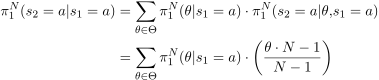
 follows from the fact that Bob believes the signals are drawn from an urn
  is increasing in
  is increasing in
  follows from symmetry.
 be a history of
  be a history of
  and
and  such that
  , both
  and
and  are strictly decreasing in
  , note that:
 . Each month, every stock realizes either a positive or negative return denoted by
  for positive returns or
  for negative returns which is drawn iid from a binomial distribution with parameter
 ![\theta_i \in [0,1]](https://alexchinco.com/wp-content/ql-cache/quicklatex.com-71f0d6d57b644b02d658a3ca9080249d_l3.svg "Rendered by QuickLaTeX.com") . Thus, in this market, positive returns for stock
. Thus, in this market, positive returns for stock  today do not in fact predict positive returns tomorrow or vice versa. Suppose that a fraction
  of the stocks have
  , a fraction
  of the stocks have
  and the remaining fraction
  of the stocks have
  .
. . Let
. Let  denote the list of stocks not chosen by Bob
  from month
  up to but not including month
  , Bob
, Bob  .
. , Bob
, Bob  . He buys a shares and holds onto it for the next four months,
  .
. , Bob
, Bob  . He buys a shares and holds onto it for the next four months,
  .
.
 of the Bobs exchanging the stock for another each period.
  given these previous return realizations in the right two columns of the same table.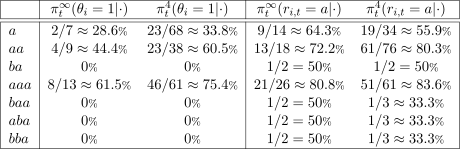
 following a string of positive returns. Next, in the table below, I conclude by computing the average belief about the probability that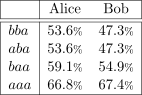
 underlying assets (e.g., mortgages) and
  derivative assets (e.g., CDOs) where:
 mortgages which each payout
  defined as:
 is an iid random variable such that
  with probability
  and
and  with probability
  while
while  is Gaussian white noise with distribution
  . For simplicity, I set
  and
and  in the analysis below.
 for each
  while the buyer does not.
 in cash to
  in mortgages with
  .
. mortgages from the seller, he would be worried that the seller would put all of the bad mortgages in this collection so that the buyer would receive a collection of mortgages worth
  rather than a “fair value” of
  . In such a world, the buyer would never purchase mortgages from the seller and the seller would be forced to hold onto all of the mortgages which he values at only
  due to his liquidity concerns. This loss of
  is the core of the asymmetric information problem.
 and (b) holds onto the junior tranche. After agreeing to accept the first
  since the white noise terms
 ![\begin{align*} (1/2) \cdot \sum_{i=1}^I x_i &= I/2 = \mathtt{E} \left[ \sum_{i=1}^I y_i \right] \end{align*}](https://alexchinco.com/wp-content/ql-cache/quicklatex.com-dec031ebfebdca94aac0787c7c980a16_l3.svg "Rendered by QuickLaTeX.com")
 with probability
  of the mortgages in the entire pool. Each of these
  where
where  if no more than
  of the underlying mortgages default and
  otherwise with: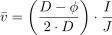
 of the
  mortgages have a payout of
  .
. denote the lemons cost to the buyer if the seller knows a set
  :
:![\begin{align*} \kappa_j(L) &= \mathtt{E}\left[ V_j \right] - \underset{\mathcal{L} \subseteq \mathcal{I}}{\mathtt{min}} \left\{ \mathtt{E}\left[ \ V_j \ \middle| \ x_i = 0, \ \forall i \in \mathcal{L} \ \right] \right\} \end{align*}](https://alexchinco.com/wp-content/ql-cache/quicklatex.com-8544e056bad529fb76dd9fa1cd51ff7c_l3.svg "Rendered by QuickLaTeX.com")
 has units of dollars.
 so that the lemons cost would have been
  .
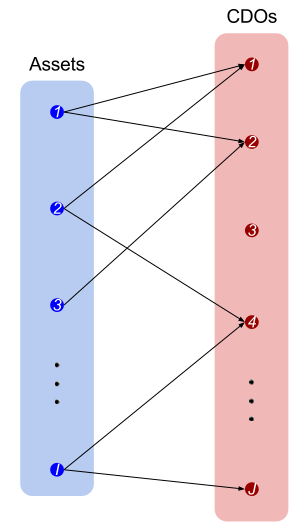
. and
and  , over the bipartite graph above:
 random mortgages for every CDO.
 CDOs (i.e., boobytrapped CDOs) and a number of lemons
  from the total population of mortgages and
  and
and  , then there is no polynomial time algorithm to distinguish between the distributions
  of the
  Notation):
 is little-
 as
as  approaches
  ” and write
  as
as  to mean that:
 of the assets in each CDO to affect payout as the expected number of defaults would be
  while the standard deviation would be
  . Thus, the lemons cost for a boobytrapped CDO will be
  where
where ![\Delta_\theta = \mathtt{N}[ (\theta - \phi)/(2 \cdot \sqrt{D})]](https://alexchinco.com/wp-content/ql-cache/quicklatex.com-89e816f83298cc26d608a5799c2e96d0_l3.svg "Rendered by QuickLaTeX.com") is the increase in the probability that a CDO does not payout due to the seller’s boobytrap and
is the increase in the probability that a CDO does not payout due to the seller’s boobytrap and ![\mathtt{N}[\cdot]](https://alexchinco.com/wp-content/ql-cache/quicklatex.com-e4e94ed576e2f835523c2b149c4d64b7_l3.svg "Rendered by QuickLaTeX.com") denotes the standard normal distribution. The seller then chooses the number of CDOs to boobytrap,
denotes the standard normal distribution. The seller then chooses the number of CDOs to boobytrap, 
 is concave for
  and convex if
  , the optimal choice of
  or
or  for some small constant
  .
. given this optimization program:
 and
and  , the seller will earn a utility:
![\begin{align*} U &\geq \left(1 - 2 \cdot \mathtt{N}[-\phi/(2 \cdot \sqrt{D})] - o(1) \right) \cdot B \cdot \bar{v} \approx L \cdot \sqrt{I/J} \end{align*}](https://alexchinco.com/wp-content/ql-cache/quicklatex.com-0dfa6fce34b28788de0e3881045e6517_l3.svg "Rendered by QuickLaTeX.com")
 , let
, let  denote the total number of defaulted mortgages. Since the CDO is boobytrapped
 ![\mathtt{E}[s_j]](https://alexchinco.com/wp-content/ql-cache/quicklatex.com-5d89d013e1bedaf37c9bfed47644d5ea_l3.svg "Rendered by QuickLaTeX.com") can be computed as:
can be computed as: ![\begin{align*} \mathtt{E}[s_j] = \frac{D - \theta}{2} + \theta \end{align*}](https://alexchinco.com/wp-content/ql-cache/quicklatex.com-b4ad6b7c34c9affa3439cd5c26f281ee_l3.svg "Rendered by QuickLaTeX.com")
![\begin{align*} \mathtt{Pr}\left[ \ s_j \geq \left(\frac{D + \phi}{2}\right) \ \right] &= 1 - \mathtt{N}\left[-\frac{\phi}{2 \cdot \sqrt{D}}\right] \end{align*}](https://alexchinco.com/wp-content/ql-cache/quicklatex.com-3d4ecd909ec9d0475a614246a8c9cb09_l3.svg "Rendered by QuickLaTeX.com")

 , plus the proportion of mortgages in the non-boobytrapped CDOs that default,
  . The right hand side is the number of defaults per securitized mortgage times the average number of times each mortgage is securitized into a CDO. Thus, by solving for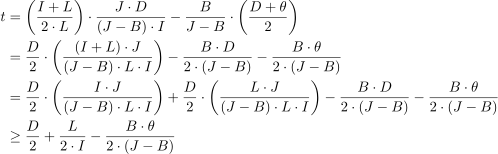
 can be computed as:
![\begin{align*} \mathtt{N}\left[ - 3 - \frac{B \cdot \theta}{2 \cdot (J - B) \cdot D} \right] &= \mathtt{N}\left[ - \frac{\phi}{2 \cdot \sqrt{D}} \right] - \left. \frac{d\mathtt{N}}{dx} \right|_{x = -3} \cdot \left( \frac{B \cdot \theta}{2 \cdot (J - B) \cdot D} \right) \\ &= \mathtt{N}\left[ - \frac{\phi}{2 \cdot \sqrt{D}} \right] - O \left( \frac{B \cdot \theta}{2 \cdot (J - B) \cdot D} \right) \end{align*}](https://alexchinco.com/wp-content/ql-cache/quicklatex.com-7266ef7ad4b89f9f69bd33c97e3b0f8d_l3.svg "Rendered by QuickLaTeX.com")
![J \cdot \mathtt{N}[ - \phi/(2 \cdot \sqrt{D})] + (1 - 2 \cdot \mathtt{N}[ - \phi/(2 \cdot \sqrt{D})]) \cdot B - o(B)](https://alexchinco.com/wp-content/ql-cache/quicklatex.com-e5f848ffd188e3851aac35ef9812a0b9_l3.svg "Rendered by QuickLaTeX.com") which is roughly
which is roughly ![(1 - 2 \cdot \mathtt{N}[ - \phi/(2 \cdot \sqrt{D})])](https://alexchinco.com/wp-content/ql-cache/quicklatex.com-d0e0de6f26976e3bd234678c756fcaca_l3.svg "Rendered by QuickLaTeX.com") smaller than the case with no boobytrapping.
smaller than the case with no boobytrapping.
 denote Bill’s value function in units of
  given an action
 , the current US GDP,
  , the recent increase in the cost of break pads,
  , and the completion of the new
  . Likewise, the vector
  denotes how much weight the Bill should place on each of the
  are in units that convert decision factors into units of
  . So, for example,
  would have units of
  while
while  would have units of
  .
.  is a constant with units of
  which balances the equation.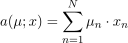
 has units of
  denote his choice of how many cars to produce where
  for most
  :
: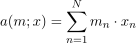
 but
but  then Bill will adjust the number of cars he produces in response to a change in the US GDP but not in response to a change in the price of break pads. Thus, Bill’s choice of how many cars to produce
  .
. which is closer to the optimal choice
  as he would suffer a quadratic loss from deviating from this optimal strategy defined by the function
  below, but no compensating “cognitive” gain from not having to think about how the construction of a bridge in Minneapolis should affect his production decision:
![\begin{align*} L(m,\mu) &= \mathtt{E} \left[ \ V(a(\mu;x); \mu,x) - V(a(m;x); \mu,x) \ \right] \\ &= - \frac{\gamma}{2} \cdot \mathtt{E} \left[ \ \left( \sum_{n=1}^N \left( m_n - \mu_n \right) \cdot x_n \right)^2 \ \right] \\ &= \frac{\gamma}{2} \cdot \sum_{n=1}^N \left( m_n - \mu_n \right)^2 \cdot 1_{\scriptscriptstyle \mathtt{dim}[x_n]}^2 \end{align*}](https://alexchinco.com/wp-content/ql-cache/quicklatex.com-dba6d57350887e1cf38c8afc0eade57a_l3.svg "Rendered by QuickLaTeX.com")
![1_{\scriptscriptstyle \mathtt{dim}[x_n]}^2](https://alexchinco.com/wp-content/ql-cache/quicklatex.com-7964444d85c1ecb201fd84a4fa835ae7_l3.svg "Rendered by QuickLaTeX.com") is a place holder which helps balance the units in the equation. One method for incorporating cognitive costs into Bill’s decision problem would be to charge him
is a place holder which helps balance the units in the equation. One method for incorporating cognitive costs into Bill’s decision problem would be to charge him  units of utility per
  unit of emphasis on each decision factor. So, for example, if
  and Bill increased his production by
  in GDP growth, then Bill would pay a cognitive cost of
  where
where  :
:![\begin{align*} L^{\scriptscriptstyle \mathtt{BR}}(m,\mu;\alpha) &= \min_{m \in \mathcal{R}^N} \left\{ \ \frac{\gamma }{2} \cdot \sum_{n=N} (m_n - \mu_n)^2 \cdot 1_{\scriptscriptstyle \mathtt{dim}[x_n]}^2 + \kappa \cdot \sum_{n=1}^N \left( |m_n| \cdot 1_{\scriptscriptstyle \frac{\mathtt{dim}[x_n]}{\mathtt{cars}}} \right)^\alpha \ \right\} \end{align*}](https://alexchinco.com/wp-content/ql-cache/quicklatex.com-691549d1b1d7b26907949ca1a064cd3a_l3.svg "Rendered by QuickLaTeX.com")
![1_{\scriptscriptstyle \mathtt{dim}[x_n] / \mathtt{cars}}](https://alexchinco.com/wp-content/ql-cache/quicklatex.com-fc880f0215e8d7376374b226ae3e161e_l3.svg "Rendered by QuickLaTeX.com") is constant with units
is constant with units ![\mathtt{dim}[x_n] / \mathtt{cars}](https://alexchinco.com/wp-content/ql-cache/quicklatex.com-0bb5da0eca8c7f08c1557a06811c9bb2_l3.svg "Rendered by QuickLaTeX.com") in order to balance the equation.
in order to balance the equation. . Below, I give
  with respect to an arbitrarily chosen dimension
  for simplicity we the optimality condition: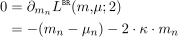
 :
:
 whenever
  .
.
 curve is exactly equal to the slope of the dashed black line.
 with the convention that
  , then I would want to again set:
 in
in  in the figure below. We can see for the blue solid line representing the
  case, an incremental increase in
  where
where  is just marginally greater than
  where
where  the increase in the weighting factor
  .
.
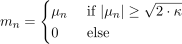
![\begin{align*} 0 &= \partial_{m_n} L^{\scriptscriptstyle \mathtt{BR}}(m,\mu;1) \\ &= - (m_n - \mu_n) - \kappa \cdot \mathtt{sgn} [m_n] \end{align*}](https://alexchinco.com/wp-content/ql-cache/quicklatex.com-b24b2e24f9270c56a5b20e1951fc673b_l3.svg "Rendered by QuickLaTeX.com")
![\mathtt{sgn}[\cdot]](https://alexchinco.com/wp-content/ql-cache/quicklatex.com-e1678a99c19f3c89104dcc38cf8f8418_l3.svg "Rendered by QuickLaTeX.com") denotes the sign operator which returns the sign of a real constant. Thus, we have
denotes the sign operator which returns the sign of a real constant. Thus, we have 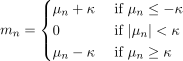
 will be ignored by the decision maker.
 being the only power coefficient which delivered both sparsity and a tractable solution; however, this result depended on Bill’s utility gain to increasing his weighting
  being linear. e.g., look at the black dashed line in the
  and action
  . For instance, in Bill’s problem above, this would be like allowing his value function
  to be non-quadratic and then approximating his problem as quadratic around a reference
  implying that his default decision is to ignore all variables except for last period’s demand and the current value of GDP and number of cars to produce
  .
.  and
and  as:
as: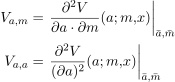
 . I then use these
  which captures how much information is lost via the quadratic approximation:
![\begin{align*} \Lambda &= - \mathtt{E} \left[ V_{a,m} V_{a,a}^{-1} V_{a,m} \right] \end{align*}](https://alexchinco.com/wp-content/ql-cache/quicklatex.com-b19895a4740efc04a44e28d9c3f38a4d_l3.svg "Rendered by QuickLaTeX.com")
 used in GMM to differentially interpret the error terms from each of the equations a la
  term in the weighting matrix
 captures the cognitive cost of a model and is defined as:
 plays the same role as
 ![1_{\scriptscriptstyle \frac{\mathtt{dim}[x_n]}{\mathtt{cars}}}](https://alexchinco.com/wp-content/ql-cache/quicklatex.com-de484a78e07b4e73e38179d0d2078046_l3.svg "Rendered by QuickLaTeX.com") in the motivating example and simply controls the units and scale of the agent’s choice of representations. In general,
in the motivating example and simply controls the units and scale of the agent’s choice of representations. In general,  will not be problem specific in any material sense.
 :
:
 , he might look at the facts
  described by the preferences below:
![\begin{align*} \mathtt{E}\left[ \ \sum_{t=0}^\infty \beta^t \cdot \frac{c_t^{1 - \gamma}}{1-\gamma} \ \right] \end{align*}](https://alexchinco.com/wp-content/ql-cache/quicklatex.com-df279491088e8ff6007973f4a6056c99_l3.svg "Rendered by QuickLaTeX.com")
 where
where  for simplicity. Then, I can write this representative agent’s problem recursively as follows:
![\begin{align*} \overline{V}(w_t) &= U(c_t) + \beta \cdot \mathtt{E}_t \left[ \ V\left( (1 + \bar{r}) \cdot (w_t -c_t) + \bar{y} \right) \ \right] \\ w_{t+1} &= (1 + \bar{r}) \cdot (w_t - c_t) + \bar{y} \end{align*}](https://alexchinco.com/wp-content/ql-cache/quicklatex.com-bb108fd62b7506a5350b9bfec6425b65_l3.svg "Rendered by QuickLaTeX.com")
 is the agent’s value function given wealth level
  and
and  is the constant endowment rate. In this world, it is easy to derive that the optimal consumption choice is given by:
![\begin{align*} \ln \bar{c}_t &= \ln \left[ \bar{r} \cdot w_t + \bar{y} \right] - \bar{r} \end{align*}](https://alexchinco.com/wp-content/ql-cache/quicklatex.com-f18de0da4be80c0f17134674ac021f9e_l3.svg "Rendered by QuickLaTeX.com")
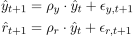
 and
and  where the idiosyncratic terms
  and
and  evolve according to
  processes below with mean
  and
and  :
:
 with
with ![\begin{align*} V(w_t;r_t,y_t) &= u(c_t) + \beta \cdot \mathtt{E}_t \left[ \ V\left( (1 + \bar{r} + \hat{r}_t) \cdot (w -c) + \bar{y} + \hat{y}_t;r_{t+1},y_{t+1} \right) \ \right] \\ w_{t+1} &= (1 + \bar{r} + \hat{r}_t) \cdot (w_t - c_t) + \bar{y} + \hat{y}_t \end{align*}](https://alexchinco.com/wp-content/ql-cache/quicklatex.com-f36678796db93702d2920f80b1904de8_l3.svg "Rendered by QuickLaTeX.com")
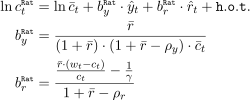
 .
.

 and
and  are given by the rule: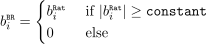
 for
for  as it would have the interpretation that the agent would set
  whenever taking the interest rate or endowment level into accound would change the standard deviation of log consumption by
  . Thus, an sparsity seeking boundedly rational representative agent has a particular rule in mind when figuring out which higher order Taylor terms to ignore.
 ) tells us that a (log) stock price follows a semi-martingale if and only if there is no arbitrage where a semi-martingale is defined as follows:
  defined on the filtered probability space
  is called a semi-martingale if it can be decomposed:
 is a local martingale and
  is an adapted process with locally bounded variation.
![\begin{align*} X_t &= X_0 + \underbrace{\int_0^t b_s \cdot ds}_{\text{``Drift''}} + \underbrace{\int_0^t \sigma_s \cdot dW_s}_{\text{``Brownian''}} + \underbrace{\int_0^t \int_{|x| \leq \epsilon} x \cdot (\mu - \nu)[ds,dx]}_{\text{\tiny ``Jump''}} + \underbrace{\int_0^t \int_{|x| > \epsilon} x \cdot \mu[ds,dx]}_{\text{\Large ``Jump''}} \end{align*}](https://alexchinco.com/wp-content/ql-cache/quicklatex.com-42a20f9201bfcf21d236e45dffcd41c1_l3.svg "Rendered by QuickLaTeX.com")
 which marks the cutoff between large and small jumps is arbitrary, but must be fixed. In this paper, the authors develop a suite of statistical tools based on spectrographic analysis in order to examine a time series properties of high frequency stock data over the time interval
 ![[0,T]](https://alexchinco.com/wp-content/ql-cache/quicklatex.com-b973f61bcb106aa293dfe22219a8c05d_l3.svg "Rendered by QuickLaTeX.com") and determine whether or not the data has:
and determine whether or not the data has:  over the interval
  seconds. For, notational convenience, the authors write the change in
  to observation
 . For instance, if
  then we’d have
 ![\mathtt{Var}[\Delta^n X] = (1/ \lfloor T/\Delta_n \rfloor) \cdot \sum_{i=1}^{ \lfloor T/\Delta_n \rfloor} \left| \Delta_i^n X \right|^2](https://alexchinco.com/wp-content/ql-cache/quicklatex.com-0a2d4b9155621ca9171216a1f220d981_l3.svg "Rendered by QuickLaTeX.com") .
. defined below to decompose movements in
 . As
. As  the smaller
  the larger
  the power variation estimator
  the estimator is tuned to pick up jumps in
  . Truncating large increments will eliminate large jumps from the series.
  and
and  . For instance, if
  , then the power variation will diverge to
  for a particular power level
  the power variation with converge to a finite value or to

 exists in the stochastic process
  the power variation of
  since only the size of the jumps not their frequency will matter. This intuition yields a test statistic
  :
:

 defined below with

 operator computes the nearest integer less than or equal to its argument. So for instance,
  .
.
You must be logged in to post a comment.