1. Introduction
In this note, I outline the main results in Scale Invariance, Bounded Rationality and Non-Equilibrium Economics (WP, 2009) by Sam Vazquez for use in a 5min presentation in Prof. Sargent‘s reading group.
This paper presents an agent based model (i.e., there are a finite number of agents) which makes  basic assumptions:
- Agents have a scale invariant utility function–i.e., consuming
 gallon of milk is as satisfying as consuming
  litres of milk.
 - Agents are boundedly rational and have beliefs about the exchange rates between a limited number of assets.
From these assumption, the author defines an ensemble of economic models using a variety of tools from physics (in particular, symmetry analysis, coarse graining and operator methods). This paper presents a new set of tools to address well known economic problems and illustrates the mathematical symmetry across the class of economic operators commonly employed by economic analysts.
2. An Analogy
To motivate this analysis for people with an economics background, I begin this note with an illustrative analogy. Physicists are used to modeling complex phenomena, e.g., think about the task of computing the pressure a gas such as oxygen exerts against the walls of a box such as a classroom. There are far too many individual oxygen atoms to count and keep track of at a micro level; however, scientists can compute the macro level properties of the gas such as the average pressure exerted on its chamber walls by subscribing to main modeling tricks.
First, they look for a key symmetry of the problem. This is a bit more of an art than a science. In the thermodynamics example above, this symmetric would be the fact that a particular atom of oxygen ought to behave in the exact same way regardless of where it is in the room. For instance, there is no such thing as a “near-the-floor” or “by-the-window” oxygen atom. This symmetry puts restrictions on the functional form of the equations we can use to model the movements and interactions of oxygen atoms and reduces the number of potential state variables.
Second, they look for an appropriate reference neighborhood within which to study the movement of oxygen atoms. For example, we know that the behavior of oxygen atoms in corner of the room are going to have a negligible impact on the behavior the oxygen atoms at the far corner of the room. Thus, we can study the local behavior of the atoms taking the boundaries of its neighborhood as given, and then integrate up across all neighborhoods. This procedure is called coarse graining and will affect the scope of the approximations rather than the functional form of the equations.
Now, let’s consider how to apply these principles to a financial model and follow the lead of Vazquez (2009). First, consider the problem of finding a symmetry. Vazquez chooses a scale symmetry whereby the unit of measure should not affect the utility of an agent. This assumption will put a functional form restriction on the space of viable utility functions. Next, consider the problem of coarse graining. In standard economic models, agents see and trade all assets. By analogy, this would be equivalent to directly linking all oxygen atoms in a room regardless of their distance. To break these connections and allow for coarse graining, Vazquez assumes that agents only carry around an information set containing a subset of all asset pairs which he calls a “what-by-what” matrix. Thus, these key assumptions allow Vazquez to use the statistical mechanics of fields to characterize the behavior of economic agents.
3. Economic Model
In this section, I tackle the basic modeling framework. Time is discrete and moves in integer steps.
3.1 Assets
There are  different kinds of assets labeled by
  with
with  denoting the set of all assets. Agents get (possibly time dependent) utility from holding different combinations of the assets; however, this utility generating mechanism is left unspecified.
3.2 Agents
There are a finite number of  agents indexed by
  with the set of all agents denoted by
  . Every agent has an inventory of products in the quantity
  for asset
  with
with  denoting the vector of holdings for agent
  . The state space of the economy at any point in time is given by the matrix
  . Let
. Let  denote the set of all possible states with
  .
.
Let  denote an asset specific positive scalar constant. Then, by scale invariance I mean that the economy should be unchanged if for every agent
  , we multiply the agent’s holdings of asset by
  :
:
(1) 
This is tantamount to saying that, if we counted all lengths in centimeters instead of meters so that  , no actual real outcomes should be changed. This restriction will imply that all essential functions will be homogeneous of degree .
3.3 Information
Agents have (possibly different) beliefs about how future of the economy will play out; i.e., about how will evolve. Let  denote the beliefs of agent . Each agent’s information may be biased, narrow or wrong. At each point in time, agents have in their mind an exchange rate matrix
  with entries denoted by
  which denotes the number of units of good that agent would accept in exchange for a unit of good
  . Let
. Let  denote the set of assets for which agent has an entry in her
  matrix. Thus, is a
  -algebra over matrices.
Each agent’s matrix has the following  properties:
- Reciprocality: Each agent is willing to buy and sell at the same price. i.e., there is no bid ask spread.
(2)

- Transitivity: There are no profit generating trade combinations. i.e., there are no arbitrage opportunities.
(3)

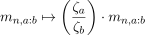
- Scale Symmetry: Adjusting prices by the ratio
 of scalar constants used to renormalize the asset units leaves the equilibrium allocations unchanged.
(4)
The matrices capture the idea that each agent’s field of vision or attention is bounded.
3.4 Preferences
Given his information set , each agent behaves rationally in accordance with von Neumann and Morgenstern axioms of decision theory1 yielding an index of satisfaction  as defined below:
(5) 
where ![V_n = \mathbb{E} \left[ U_n \mid \mathcal{I}_n \right]](https://alexchinco.com/wp-content/ql-cache/quicklatex.com-f0592f423a1d37701c3c5cf7453a2fc5_l3.svg "Rendered by QuickLaTeX.com") with
with  as agent ‘s utility function. has the properties that for each agent , the partial derivatives are
  and
and  for each asset
  where
where  for brevity. Also, suppose that between period
  and
and  , an agent changes his asset holdings from to
  , then I will abbreviate the corresponding change in happiness as:
(6) 
The fact that the economy must be scale invariant implies additional restrictions on the utility function of each agent. In particular, it must be the case that the utility function can vary at most by a constant due to a change in scale. i.e., we have that the utility function must be CRRA/log-like in nature such as:
(7) ![\begin{align*} U_n \left( X_n \right) &= \phi \cdot \ln \left[ \Psi_n^{\top} X_n \right] \end{align*}](https://alexchinco.com/wp-content/ql-cache/quicklatex.com-529a2910d960c99300994123ba8221ac_l3.svg "Rendered by QuickLaTeX.com")
where  is a
is a  vector of free parameters. For instance, consider the utility specification below which equates agent ‘s utility with the value of his asset holdings in terms of a numeraire good denoted by
  :
:
(8) ![\begin{align*} U_n &= \ln \left[ \sum_{a \in \mathcal{A}} \left( x_{n,a} \cdot m_{n,a:1} \right)^{\phi} \right] \end{align*}](https://alexchinco.com/wp-content/ql-cache/quicklatex.com-f624f29c5dd557b46f2de1e0c660000f_l3.svg "Rendered by QuickLaTeX.com")
Here, note that scaling up the numeraire on of the assets will have no affect on the first order condition. However, a key assumption in this class of models is that utility is myopic and depends only on the current period’s asset holding which fits nicely with Vazquez’s log utility assumption.
3.5 Economic Operators
Economic movements are classified as operators which are mappings which change agents’ portfolio holdings. For instance, if  is an arbitrary economic operator, then we have that:
(9) 
For example, think about the following examples:
- A consumption operator
 which removes asset holdings but increases utility,
 - A production operator
 which recombines asset holdings at a net surplus,
 - A trader operator
 which exchanges asset holdings between agents, or…
 - A depreciation operator
 which removes asset holdings but does not compensate agents with a utility boost.
Using this general framework, we can talk then about similarities and differences across economic operators. For instance, the trade operator preserves the aggregate asset proportions as it simply transfers assets between agents. Thus, we can think about trade as a conservative operator. Alternatively, the consumption, production and depreciation operators are not conservative with respect to the aggregate asset proportions.
In the analysis below, I overload the  terminology used to denote changes in satisfaction due to changes in holdings to be operator specific. In particular, for an arbitrary economic operator I define
  as:
as:
(10) ![\begin{align*} \Delta_{\mathbb{H}} V_n &= \mathbb{E} \left[ U \left( \mathbb{H} X_n \right) - U \left( X_n \right) \mid \mathcal{I}_{\alpha} \right] \end{align*}](https://alexchinco.com/wp-content/ql-cache/quicklatex.com-24a5c341e42c6559999866065e903a1d_l3.svg "Rendered by QuickLaTeX.com")
4. Examples
In Section above, I defined the basic elements of a class of economic models and then stopped just short of giving an equilibrium definition. In this section, I now look at examples of equilibria from this class of models. Each of these examples will essentially represent a different take on what the equilibrium price object will look like. I do not consider any models with production, consumption or depreciation decisions.
4.1 Fixed Exchange Rate
First consider a world with a single exchange rate for each asset wich is set by fiat. In this world, we have an equilibrium definition:
Definition (Equilibrium): An equilibrium is a
matrix of allocations
as well as a
symmetric matrix of exchange rates
with a unit diagonal representing
unique elements such that given the exchange rate matrix
- For each agent
(11)
- Markets clear such that for each
(12)


In such an economy, we can characterize the equilibrium allocations as follows:
Proposition (Equilibrium w/ Single Exchange Rate): Near the equilibrium, the amount of assets
is given by:
(13)
where
is a agent dependent positive constant.

This result follows directly from a first order Taylor expansion of the utility gain to trading around the fixed point of  :
:
Proof: Suppose that the trade operator
. Then, an equilibrium would represent a fixed point such that the following
(14)
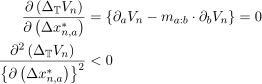
The first order condition says that agent
around its true fixed point yields first and second order terms:
(15)
Taking the first order condition with respect to asset
in its mirror image yields the equations above.

4.2 Barter
Next consider the case of pairwise trading between agents which I refer to as bartering. In this world, I assume that the bargaining process is exogenously specified and the agents take the split of the gains to trade as given. What’s more, because agents are perfectly myopic in their utility specifications, they have no concern for the matching process which assigns traders to new partners each period.
Definition (Equilibrium): An equilibrium is a
pairwise exchange rates
such that given each exchange rate, we have that:
- For each agent
(16)
- Each pairwise market clears:
(17)


In such a world, we have the following perturbation equilibrium reult:
Proposition (Equilibrium w/ Barter): Near the equilibrium, the amount of product
exchange as a result of a bargaining process
is given by:
(18)

This result builds on the equilibrium characterization from above:
Proof: Since the agents are still (somewhat unrealistically) price takers in this world, we can use the equilibrium formulae from the proposition above; however, now we have a additional information which we can use to further restrict the demand functionals. In particular, we know that every pairwise trade nets out to
:
(19)
As a result, we can solve for the fixed exchange rate by treating agents
(20)
Substituting this formula back into the equation for each agent’s demand function given an exogenous exchange rate yields the equilibrium result.


 stocks and
  indicies to study the behavior of the variance risk premium during the period from
  to
to  .
. objects:
 ,
,  day, variance swap contract on the S&P 500 at a rate of
  . Then, on day
  with certainty and Bob would pay Alice
  where
where  represents the realized variance of the S&P 500 on the first day of the contract. So, if the the first day happened to have a high annualized variance of
  , then Bob would have to pay Alice
  . Over the life of the contract, Bob will pay Alice a net amount
  given by:
 represents the notional amount of the contract which was
  cost at the onset, we can characterize the swap rate at the expected present value of the variance payments adjusted for risk by the prevailing stochastic discount factor:
![\begin{align*} S_{t \to T} &= \mathbb{E} \left[ M_{t \to T} \cdot V_{t \to T} \right] \end{align*}](https://alexchinco.com/wp-content/ql-cache/quicklatex.com-9128f10ac5948bd1d9bc43d93ea2470d_l3.svg "Rendered by QuickLaTeX.com")

 process is restricted to ensure that the futures price is always positive and is predictable
 . Suppose that the riskless rate process is deterministic so that the futures and forward prices are identical. Thus, we have that the annualized quadratic variation on the log futures return from time
  is given by: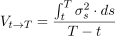
 with the same
  maturity using the formula:
![\begin{align*} \mathbb{E} \left[ M_{t \to T} \cdot V_{t \to T} \right] &\approx \frac{2}{T - t} \cdot \int_0^\infty \frac{Y_{t \to T}^{(k)}}{k^2 \cdot B_{t \to T}} \cdot dk \end{align*}](https://alexchinco.com/wp-content/ql-cache/quicklatex.com-79ec2e932ae059e2d9c3cd9585741bc3_l3.svg "Rendered by QuickLaTeX.com")
 denotes the time
  at time
  denotes the time
  and end date
  represents a call option if
  and a put if
  .
.![\begin{align*} \ln \left[ F_T \right] &= \ln \left[ F_t \right] + \int_t^T \frac{1}{F_s} \cdot dF_s - \frac{1}{2} \cdot \int_t^T \sigma_s^2 \cdot ds \end{align*}](https://alexchinco.com/wp-content/ql-cache/quicklatex.com-e6e76479e0392dba0d80c83e49e775ef_l3.svg "Rendered by QuickLaTeX.com")
 as:
as:![\begin{align*} V_{t \to T} &= 2 \cdot \left( \frac{F_T}{F_t} - 1 - \ln \left[ \frac{F_T}{F_t} \right] \right) + 2 \cdot \int_t^T \left( \frac{1}{F_s} - \frac{1}{F_t} \right) \cdot dF_s \\ &= \frac{1}{T - t} \cdot \int_t^T \sigma_s^2 \cdot ds \end{align*}](https://alexchinco.com/wp-content/ql-cache/quicklatex.com-a5b9e3dadb23b6f60f7c27cfc51b475a_l3.svg "Rendered by QuickLaTeX.com")
![\ln \left[ F_T \right]](https://alexchinco.com/wp-content/ql-cache/quicklatex.com-22de99e30f950ea2fd5e07c1943bcb10_l3.svg "Rendered by QuickLaTeX.com") around
around ![\ln \left[ F_t \right]](https://alexchinco.com/wp-content/ql-cache/quicklatex.com-4d6354821ba57899b967f3c5de7160fe_l3.svg "Rendered by QuickLaTeX.com") , we get:
, we get:![\begin{align*} \ln \left[ F_T \right] &= \ln \left[ F_t \right] + \left( \frac{1}{F_t} \right) \cdot \left( F_T - F_t \right) - \frac{1}{k^2} \cdot \int_0^{F_t} \left( k - F_T \right)^+ \cdot dk + \frac{1}{k^2} \cdot \int_{F_t}^\infty \left( F_T - k \right)^+ \cdot dk \end{align*}](https://alexchinco.com/wp-content/ql-cache/quicklatex.com-b070eb6e069ea7d32f3d6fabc619ddb5_l3.svg "Rendered by QuickLaTeX.com")
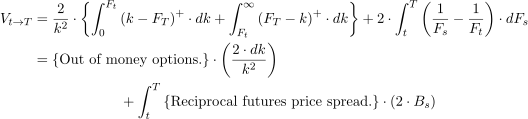
 . Since options contracts on futures are generally traded at
  day horizons with most contracts starting on the 15th of every month, there will not generally be a set 0f futures contracts with the appropriate maturity at each date. Thus, the authors interpolate the intermediary dates using the formula below:


![\ln \left[ V_{t \to T,j} / S_{t \to T,j} \right]](https://alexchinco.com/wp-content/ql-cache/quicklatex.com-eb4071c877fd5a277f7553c7ce730323_l3.svg "Rendered by QuickLaTeX.com") computed as the spread between the log realized variance and the log swap rate and various market factors denoted by
computed as the spread between the log realized variance and the log swap rate and various market factors denoted by  using the regression specification below:
![\begin{align*} \ln \left[ \frac{V_{t \to T,j}}{S_{t \to T,j}} \right] &= \alpha_j + \beta_j \cdot Z_{t \to T} + \varepsilon_{t \to T,j} \end{align*}](https://alexchinco.com/wp-content/ql-cache/quicklatex.com-91e121ba5b7500a9249ae9f949955887_l3.svg "Rendered by QuickLaTeX.com")
 as well as statistically significant negative
  ‘s.
‘s. using inputs of capital
  and labor
  .
.  denotes the total factor productivity and evolves according to a diffusion process with mean
  and variance
  :
:
 is the depreciation rate and
  is the aggregate investment level:
![i \in [0,1]](https://alexchinco.com/wp-content/ql-cache/quicklatex.com-d4b6b704cfa1a255d8c1ddaa96ae337a_l3.svg "Rendered by QuickLaTeX.com") . At the beginning of every period, each household
. At the beginning of every period, each household  gets a signal about tomorrow’s TFP with noise
  that is distributed normally with mean
  :
:
 as the “knowledge” of agent
  over consumption streams
  given his relative investment in stocks rather than bonds
  :
:![\begin{align*} \begin{split} V_t(i) &= \max_{ \left\{ C_t(i) \right\}_{t=0}^\infty, \left\{ \omega_t(i) \right\}_{t=0}^\infty} \mathcal{E}_{i,t} \left[ \sum_{s=t}^\infty \beta^{s-t} \cdot \log C_s(i) \right] \\ &\text{s.t.} \\ W_{t+1} &= \left[ (1 - \omega_t(i)) \cdot (1 + r) + \omega_t(i) \cdot \left( 1 + \tilde{r}_{t+1} \right) \right] \\ &\qquad \times \left( W_t(i) + w_t \cdot L - C_t(i) \right) + \tau_t(i) \end{split} \end{align*}](https://alexchinco.com/wp-content/ql-cache/quicklatex.com-deef5a4c95cda2ac840d31d4cbb1cf55_l3.svg "Rendered by QuickLaTeX.com")
 denotes agent
  denotes agent
  denotes the return on stocks,
  denotes the wage rate for all agents,
  denotes the payments from the contingent claims trading. Equity prices are given by
  which is related to dividends
  via the market return
 be the “true” rational expectations operator which is linked to each agent’s subjective expectations via a common mean
  which has volatility
  :
:![\begin{align*} \begin{split} \mathbb{E}_{i,t} \left[ \cdot \right] &= \mathbb{E} \left[ \cdot \mid s_t(i), Q_t, K_t, B_{t-1}, \eta_t \right] \\ \mathcal{E}_{i,t} \left[ \eta_{t+1} \right] &= \mathbb{E}_{i,t} \left[ \eta_{t+1} \right] + \tilde{\varepsilon}_t \end{split} \end{align*}](https://alexchinco.com/wp-content/ql-cache/quicklatex.com-277b7ab1321964393cdfd98131acb67c_l3.svg "Rendered by QuickLaTeX.com")
 and factor prices
  and
and  :
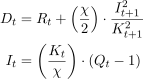
:
 represents the value of acquiring
  represents cost from selling
  represents an adjustment cost:
 an equilibrium in this economy is a time path of quantities
 , signals
  and prices
  with the properies:
 solve the households’ maximization problem given the vector of prices, initial wealth and the random sequences
  ;
; solve the representative firm’s maximization problem given the vector of prices;
 is the investment sector’s optimal policy given the vector of prices;
 clears the labor market,
  clears the stock market and
  clears the market for capital services;
 and the price of the consumption good is normalized to
  are defined such that all households enter each period with the same amount of wealth; and
 are given by the identities:
![\begin{align*} B_t(i) &= \left[ 1 - \omega_t(i) \right] \cdot \left( W_t(i) - C_t(i) \right) \\ X_t &= \int_0^1 X_t(i) \cdot di, \ \ \forall X \in \left\{ B, C, W \right\} \\ \omega_t &= \frac{Q_t \cdot K_{t+1}}{W_t - C_t} \end{align*}](https://alexchinco.com/wp-content/ql-cache/quicklatex.com-a7f13550ee13b247c63514996f4caa6c_l3.svg "Rendered by QuickLaTeX.com")
 :
: .
. . Such an equilibrium is
  stable if the welfare gain to an individual household of obtaining rational expectations is less that
  which represents the difference between the average expectation of the total factor productivity at time
  and the average expectation in a world where
 ![\begin{align*} \varepsilon_t &= \gamma \cdot \tilde{\varepsilon}_t \\ &= \int_{\tilde{\varepsilon}_t>0} \mathcal{E}_{i,t} \left[ \eta_{t+1} \right] \cdot di - \int_{\tilde{\varepsilon}_t=0} \mathcal{E}_{i,t} \left[ \eta_{t+1} \right] \cdot di \end{align*}](https://alexchinco.com/wp-content/ql-cache/quicklatex.com-5bc09f23db13ed60630cb72d6760acb0_l3.svg "Rendered by QuickLaTeX.com")
 as a ratio we can ask: How much market forces amplify (
 ) the existing common error?
 denote the state space. Then, I can express these
 ![\begin{align*} \begin{split} C_t \left( \Theta_t, \nu_t(i) \right)^{-1} &= \beta \cdot \mathcal{E}_{i,t} \left[ \left( 1 + \tilde{r}_{t+1} \right) \cdot C_{t+1} \left( \Theta_{t+1}, \nu_{t+1}(i) \right)^{-1} \right] \\ C_t \left( \Theta_t, \nu_t(i) \right)^{-1} &= \beta \cdot \mathcal{E}_{i,t} \left[ \left( 1 + r \right) \cdot C_{t+1} \left( \Theta_{t+1}, \nu_{t+1}(i) \right)^{-1} \right] \end{split} \end{align*}](https://alexchinco.com/wp-content/ql-cache/quicklatex.com-3319262519ede4f04760fd82256bd4ac_l3.svg "Rendered by QuickLaTeX.com")
 households’ expectations depend non-linearly on their beliefs about the current
  asset prices depend non-linearly on the average belief about future productivity. In a related paper,
 ![\begin{align*} \begin{split} \hat{q}_t &= \int \mathcal{E}_{i,t} \left[ \eta_{t+1} \right] \cdot di \\ &= \int \mathbb{E}_{i,t} \left[ \eta_{t+1} \mid \hat{q}_t , s_t(i) \right] \cdot di + \tilde{\varepsilon}_t \end{split} \end{align*}](https://alexchinco.com/wp-content/ql-cache/quicklatex.com-1043fea60fc485fca548b663a67b1bc0_l3.svg "Rendered by QuickLaTeX.com")
 .
. is an affine function of the value and the noise term with parameters
  ,
,  and
and  :
:
![\int_{\tilde{\varepsilon}_t=0} \mathcal{E}_{i,t} \left[ \eta_{t+1} \right] \cdot di](https://alexchinco.com/wp-content/ql-cache/quicklatex.com-c18b727d14fa3319fa73c3b8c6dbb44c_l3.svg "Rendered by QuickLaTeX.com") is the price in a world with no common error
is the price in a world with no common error ![\mathbb{E}_{i,t} \left[ \eta_{t+1} \right]](https://alexchinco.com/wp-content/ql-cache/quicklatex.com-c6a623985c0779286874566b169407e7_l3.svg "Rendered by QuickLaTeX.com") as an affine function of each agent’s beliefs and the prevailing price using the coefficients
as an affine function of each agent’s beliefs and the prevailing price using the coefficients  ,
,  and
and  which derive from the change of variables procedure which I do not outline here:
![\begin{align*} \mathbb{E}_{i,t} \left[ \eta_{t+1} \right] &= A_0 + A_1 \cdot s_t(i) + A_2 \cdot \hat{q}_t \end{align*}](https://alexchinco.com/wp-content/ql-cache/quicklatex.com-3e6add15cd2c2bbc2bfbe4cf6a758dcd_l3.svg "Rendered by QuickLaTeX.com")
![\begin{align*} \begin{split} \int \mathcal{E}_{i,t} \left[ \eta_{t+1} \right] \cdot di &= \left( A_0 + A_2 \cdot \pi_0 \right) \\ &\qquad \qquad + \left( A_1 + A_2 \cdot \pi_1 \right) \cdot \eta_{t+1} \\ &\qquad \qquad \qquad \qquad + \left( A_2 \cdot \gamma + 1 \right) \cdot \tilde{\varepsilon}_t \end{split} \end{align*}](https://alexchinco.com/wp-content/ql-cache/quicklatex.com-dfac36ec8a2f8fb518149ddd02c6812b_l3.svg "Rendered by QuickLaTeX.com")

![\int \mathcal{E}_{i,t} \left[ \eta_{t+1} \right] \cdot di](https://alexchinco.com/wp-content/ql-cache/quicklatex.com-3ce8fd3917f3e0825eef64cd5cd8e2b7_l3.svg "Rendered by QuickLaTeX.com") above yields a system of
above yields a system of 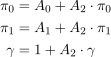
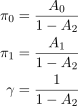
 ?
?  ? Now consider a world in which
  so that agents experience a common shock to their preferences. Now, for instance, agents might revise their expectations upward, hold more stocks as a result, and then influence others to do the same for capital gains purposes as the price depends on the average value of agent’s expectations. In such a world with a positive feedback loop, how much worse are prices at conveying the true value of the asset? If in the world with no common shock, you could see a price of
  and know that the asset was worth something between
  and
and  , in a world with a common shock have the bounds now expanded to
  ?
? :
:
 with respect to
  . Then we know that the optimal consumption plan will be myopically proportional to his wealth as agent’s have log utility:
![\begin{align*} \omega_t(i) &= \frac{\mathcal{E}_{i,t} \left[ 1 + \tilde{r}_{t+1} \right] - \left( 1 + r\right)}{\sigma^2} \end{align*}](https://alexchinco.com/wp-content/ql-cache/quicklatex.com-853f6e69bc814b5dfc7148c72312cbd8_l3.svg "Rendered by QuickLaTeX.com")
 . At the steady state, the aggregate degree of stock holdings is: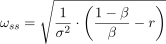

![\begin{align*} D_{t+1} &= e^{\eta_{t+1}} \cdot \left( \frac{d}{dK} F(K_{t+1}, L) \right) \\ \mathbb{E}_{ss} \left[ D_{ss} \right] &= \left( \frac{d}{dK} F(K_{ss}, L) \right) \end{align*}](https://alexchinco.com/wp-content/ql-cache/quicklatex.com-38b50fcb082466de53f3d799c7fa0141_l3.svg "Rendered by QuickLaTeX.com")


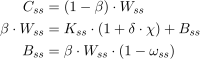


 and then take the full derivative:
 students denoted by
  . There is a set of
  courses,
  with
with  seats in each course
  . A consumption bundle
  for student
  with
with  :
:  . Each student
  . Let
. Let  be the set of admissible schedules where the utility from an inadmissible schedule is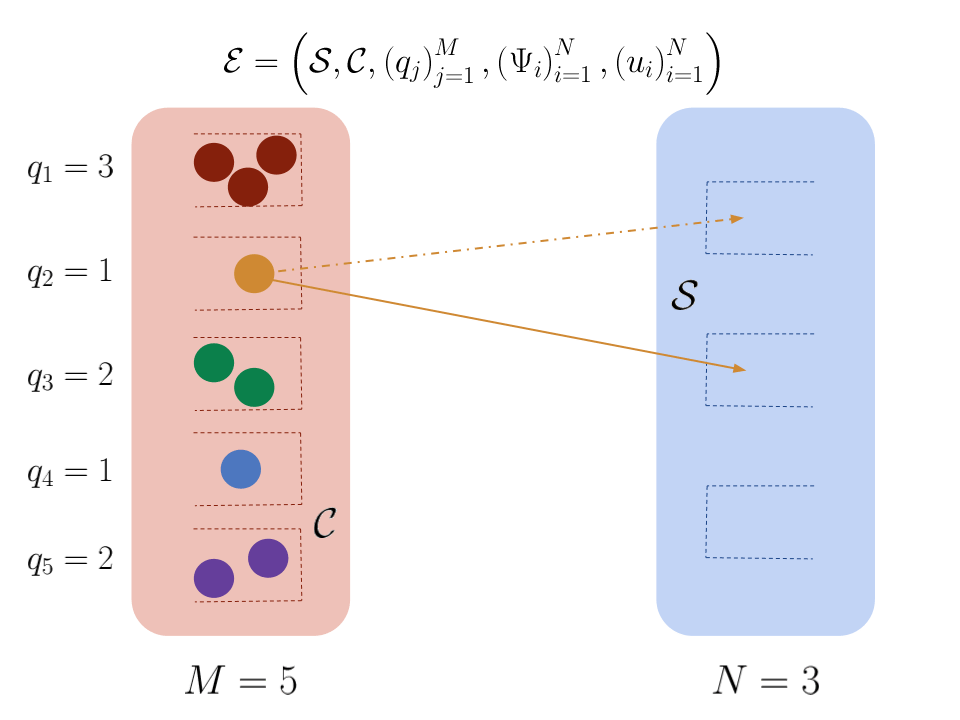
 of fake currency and the market clears at prices
  for each class
  .
. . For this economy, the allocation
  , budgets
  and prices
  constitute a
  -Approximate CEEI if the following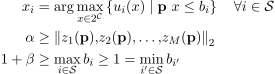
 .
. , and then there are at most
  too many students:
  . Alternatively, there could be
  students too many students. Turning to
  , then the student with the least fake class-seat-buying currency has
  dollars.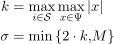
 , there exists a
  -Approx CEEI.
![[1,1+\beta]](https://alexchinco.com/wp-content/ql-cache/quicklatex.com-a3b5b2a971b44c6924df1a1b0575b3db_l3.svg "Rendered by QuickLaTeX.com") interval and any
interval and any  , there exists a
  that satisfy the condition:
 . The second part of the result captures the fact that, for any budget vector
 . Then, Alice would be able to buy the big diamond at a price of
  . Given that Alice would then have no more money, Bob could then afford to purchase both the small diamond and the big rock:
 that satisfy the
  and
and 
 -Approximate CEEI. The jump from this baseline result to the tighter
  with
with  . The Euclidean distance in the change in the aggregate demand due to such a shift would be
  . To get a clearer idea of this magnitude, consider the
  case below:
 , such a shift might lead to an
  change in the aggregate demand vector. However, if every agent has a unique budget
  , then in general there will be at most
  who is closest to his budget constraint hyperplane in the
  direction:
 shift in the aggregate demand vector.
 might make you demand less of asset
  might make you demand more as the good you would have liked to buy is now too expensive and you have to settle. To do this, I use a limiting result. Consider a tatonnement process
  such that:
 would represent a set of market clearing prices. Then convexify the mapping
  as follows:
 is upper hemi-continuous and convex. Thus, if I can find a fixed point for
  is compact and convex and
  is any mapping, then we have that:
 .
. is particularly nice because it doesn’t depend on either
  or
or  is an
is an  that Pareto improves on
  we have that
  . However, this means that the consumption bundle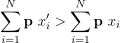
 , either:
 such that
 in the economy where
  and give them to me. Then, I will show you the good
  is an
is an  -Approx CEEI with
 times the amount of money as Bob so that she could buy both the big and small diamonds. Thus, we should suspect that envy bounded by a single good will fall out of an
  denote the number of objects envied in bundle
  by agent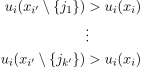
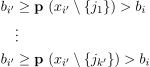
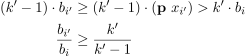
 we can replace
  in the above inequality with the term
  . However, we know that at most the ratio of
  can be
  so have that if
  there is a contradiction!
 .
. -Approximate CEEI’s.
 .
. uniformly from
  .
. ,
,  and
and  .
. small.
 -Approximate CEEI with
![\mathcal{S}^\infty = (0,N]](https://alexchinco.com/wp-content/ql-cache/quicklatex.com-1c62d01c1d8a8d75ebeb346c4af10489_l3.svg "Rendered by QuickLaTeX.com") so that agent
so that agent ![(0,1]](https://alexchinco.com/wp-content/ql-cache/quicklatex.com-8a7f9b20b556cd35f8e5cafbdd1f6fd7_l3.svg "Rendered by QuickLaTeX.com") , agent
, agent ![(1,2]](https://alexchinco.com/wp-content/ql-cache/quicklatex.com-f73b6a5941a867006de768c4cddbaa34_l3.svg "Rendered by QuickLaTeX.com") , agent
, agent ![(2,3]](https://alexchinco.com/wp-content/ql-cache/quicklatex.com-8bf2df5fc4664b4d566e13dc0a0460c3_l3.svg "Rendered by QuickLaTeX.com") and so on…
and so on… . Consider agent
  and fix all other agent’s reports. Agent
  EViews workspace file containing the adjusted closing price of

 “) the new series:

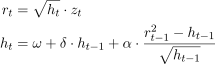
 is the conditional volatility and
  is a return, and then work out some properties of the estimator
 ![\mathbb{E}_t\left[ r_{t+2}^2\right]](https://alexchinco.com/wp-content/ql-cache/quicklatex.com-e3373d6e06ea65d5aed8867c334257f9_l3.svg "Rendered by QuickLaTeX.com") .
.
You must be logged in to post a comment.