1. Introduction
I introduce the concept of Pearson-Wong diffusions and then show how this mathematical object can be put to use in macro-finance.
Roughly speaking, Pearson-Wong diffusions link properties of stochastic processes to properties of cross-sectional distributions in the resulting population. For example, suppose you have in mind a stochastic process that governs the total sales of each firm in the US. If this stochastic process is a Pearson-Wong diffusion you would also know what the steady state cross-sectional distribution of firm sales would be. Conversely, if you observed a particular cross-sectional distribution of firm sales, then if you assumed all firms had a similar sales growth process and that the economy was in a steady state, you could then back out which Pearson-Wong diffusion was governing sales growth in the economy up to an affine transformation.
First, in the Section 2, I define the Pearson (1895) system of distributions. Next, in Section 3, I elaborate on work by Wong (1964) and show that a broad class of diffusion processes with polynomial volatility called Pearson-Wong diffusions lead to steady state distributions in the Pearson system. I show that these distributions are uniquely defined by their polynomial coefficients. In Section 4, I show how a broad set of common continuous time processes in macro-finance such as Ornstein-Uhlenbeck processes and Feller square root processes sit in this class of Pearson-Wong diffusions. Finally, I conclude in Section 5 by returning to this sales volume example above taken from Gabaix (2011) and showing that variation in the cross-sectional distribution of firm sales volume implies variation in the functional form of the stochastic process governing each firm’s aggregate sales.
2. The Pearson System of Distributions
In this section I motivate and define the Pearson system of distributions. Karl Pearson developed the Pearson system of distributions as a taxonomy for understanding the skewed distributions he was finding in the biological data he was studying. For instance, Pearson had access to data on dimensions of crabs caught off the coast of Naples as illustrated in the figure below1. When studying the ratio of the length of the crabs to their breadth, he found a distribution that was non-normal, and almost seemed to be a mixture of  normal distributions.

The data give the ratio of "forehead" breadth to body length for 1000 crabs sampled at Naples. Source: R mixdist package (http://goo.gl/CaGkt).
In order to manipulate these data analytically, Pearson then searched out a simple functional form that would capture the main features of these skewed distributions with only a handful of parameters. In particular, he was after a formulation that fit continuous, single peaked distributions over various ranges with varying levels of skewness and kurtosis. Through guess and check, he settled on the definition below2:
Definition (Pearson System): A continuous, univariate, probability distribution
over
is a member of the Pearson System if it satisfies the differential equation below with constants
,
,
and
:
(1)

What are the features of this formulation? First, if is not a root of the polynomial  then is finite. Next, we see that characterizes the signle peak of the distribution as
  when
when  . What’s more, we know that has to be single peaked as
  and
and  , so and
  must tend towards
  as
as  goes to
  .
.
Heuristically speaking, we can think about as parameterizing the peak of the distribution and the quadratic polynomial as characterizing the rate of descent from this peak in either direction as a function of . Importantly, the solution to this differential equation will depend on the character of the roots of the quadratic polynomial:
(2) 
In his original 1895 paper, Pearson spent most of his time actually classifying different types of distributions based on the nature of their respective polynomials. Below is a short list of distributions that fall into the Pearson class:
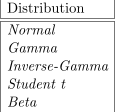
Below, I walk through an example showing how the normal distribution fits into the Pearson system:
Example (Gaussian Distribution): When
we get the Gaussian PDF. First, note that given these assumptions, the differential equation above can be written as:
(3)
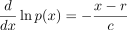
Thus, by integrating up we see that the solution has the form:
(4)
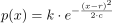
If we choose
such that the probability mass over the real line is
, we get
.
3. Main Results
In this section I define the class of Pearson-Wong diffusions and outline the mapping between the coefficients of the stochastic process and the parameters of the cross-sectional distribution. In the analysis below, I consider time homogeneous diffusion processes; i.e., the coefficients of the stochastic process can only depend on time  through the value of
  :
:
Definition (Time Homogeneous Diffusion): Let
and
be real valued functions that are Lipschitz on the interval
with
. Then a diffusion
(5)

Next, I define the class of Pearson-Wong diffusions:
Definition (Pearson-Wong Diffusion): A Pearson-Wong polynomial diffusion is stationary, time homogeneous solution to a stochastic differential equation of the form below, where
,
is a Brownian motion and the triple of coefficients
are such that the square root is well defined when
(6)

What sorts of processes fit inside this class of diffusions? For one example, consider an Ornstein-Uhlenbeck process which would arise if we set  ,
,  and
and  . In this setting,
  . In the next section, I show how more exotic process also fit into this box of Pearson-Wong diffusions.
Now, given this definition, I need to derive a mapping between the values of the polynomial coefficients  and the form of the resulting cross-sectional distribution . I do this in
  steps. First, I characterize the scale function
  and speed density
  of the diffusion . Next, I link the infinitesimal generator of the diffusion process to the scale function and speed density of
  . Finally, I show that given the mapping between the infinitesimal generator and stochastic processes in the class of Pearson diffusions, if is an ergodic process then this mapping is unique.
Below, I define the scale function for a stochastic process which captures how much the probability of reaching different points  and
and  in the domain of varies with the starting point :
Definition (Scale Function): Let
such that for all
with
, we have that:
(7)
where
.
![\begin{align*} \mathtt{Pr}[\tau(y) < \tau(w)] &= \frac{U(x) - U(w)}{U(y) - U(w)} \end{align*}](https://alexchinco.com/wp-content/ql-cache/quicklatex.com-9a1e9b58ae155a579f6e279d5bb35cd1_l3.svg "Rendered by QuickLaTeX.com")
For instance, if  is a scale function for , then we say that is in its natural scale. By definition, is a local martingale and satisfies the equation:
(8) 
This is a linear first order differential equation of  with variable coefficients leading to a standard solution:
(9) 
where  is a fixed point such that
  . Next, I define a speed measure which captures the probability that will exceed a certain value in finite time; i.e., will ever reach a value:
Definition (Speed Measure): The speed measure
(10)
where we have that:
(11)
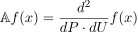
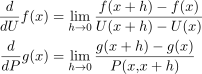
Thus, it is in fact the  of the cross-sectional distribution as we consider this probability as
  . This measure has a particularly nice functional form which allows for easy analytical computations in the case of Pearson-Wong diffusions. The lemma below characterizes this formulation:
Lemma (Speed Measure): The speed density of a Pearson-Wong diffusion is given by the fomula below where
(12)
with
and
.

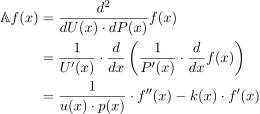
The proof of this lemma stems from the definition of the infinitesimal generator:
Proof (Speed Measure): On one hand, from the definition of the speed measure, we have that:
(13)
where
is some well behaved function of
(14)
Thus, we have that
.

Thus, we have now marched through the framework for first steps of the construction of the link between a stochastic process in the class of Pearson-Wong diffusions and their corresponding cross-sectional distributions. All I need to do now is flesh out the requirements for uniqueness. In order to attain this property, I need an additional assumption on the class of Pearson-Wong diffusions: ergodicity. Below, I give a formal definition of this additional assumption:
Definition (Ergodic Pearson-Wong Diffusion): If
for all
(15)
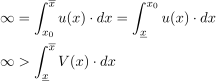
If  , then the boundary
  can be reached in finite time with positive probability.
Proposition (Pearson-Wong Mapping): For all ergodic diffusions in the Pearson-Wong class parameterized by the coefficient vector
Ergodicity ensures that there are no eddies in the state space where multiple diffusions can get trapped yielding observationally equivalent cross-sectional distributions for different diffusion processes.
Proof (Pearson-Wong Mapping): From the lemma above, we know that the scale measure as the density:
(16)
where
is a point such that
(17)
Differentiating
(18)



4. Examples
In this section I work through examples which illustrate how to fit the Vasicek process and a reflecting process that generates a cross-sectional distribution that satisfies Zipf’s law.
In a Vasicek model returns follow an Ornstein-Uhlenbeck process:
(19) 
with  . Thus, in the functional notation of the Pearson-Wong diffusion, we have that
  ,
,  and
and  . Using the formulation above, we see that:
(20) 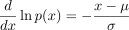
This is the exact same formulation as the Ornstein-Uhlenbeck example from the first section. Thus, we have that:
(21) 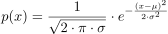
by solving for the constant via the boundary condition that  .
.
Next, consider a more complicated reflecting process that is defined only on the positive half-line in the form of a power law distribution with reflecting boundary at  . Specifically, suppose that you have a cross-sectional probability density defined as:
(22) 
which is defined on  . We see that the cummulative probability density is proportional to
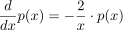
  so that Zipf’s law3 holds. However, note that there is no term in the numerator of the differential equation defining :
(23) 
Thus, the power law cross-sectional distribution acts as a limiting case of the class of Pearson-Wong diffusions with  and
and  :
:
(24) 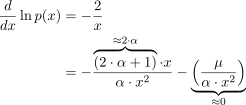
This solution works given the reflecting boundary  as, for
  large enough the second term on the right hand side will be roughly and the
  in the first term will be negligible.
5. Conclusions
In the text above, I outline the topic of Pearson-Wong diffusions and also relate these results in continuous time mathematics to topics in macro-finance.
I conclude by looking at a final application in a recent Econometrica article, Gabaix (2011), on the granular origins of aggregate macroeconomic fluctuations. The core idea of this paper is that, when the cross-sectional distribution of firm production,  , is Gaussian or some other thin-tailed distribution, shocks to the largest firms won’t matter as the number of firms
  . However, if firm production is distributed according to a fat tailed distribution, then shocks to the production of the largest firms will matter.4
Proposition 2 of Gabaix (2011) gives the central result. Namely, that if firm size is distributed according to a power law,
(25) ![\begin{align*} \mathtt{Pr}[S > \bar{s}] &= a \cdot x^{-\zeta}, \end{align*}](https://alexchinco.com/wp-content/ql-cache/quicklatex.com-d5e6d1a2925039315c351e9d927e7b5f_l3.svg "Rendered by QuickLaTeX.com")
then as , if  shocks to large firms won’t matter, while if
  shocks to large firms will matter.
Interestingly, the Pearson-Wong diffusion mathematics above gives us a new results for the implications of switching from the limiting case of  to the case of
  . With , there will now be a new parameter
  to estimate. Thus, variation in how dispersed firms are in terms of their output reveals meaningful information about the structure of the stochastic process to which each firm’s output adheres.
- Source: R mixdist package. ↩
- Background info comes from Ord (1985). ↩
- Gabaix (1999) or Tao (2009). ↩
- In practice, shocks to the largest couple of firms do seem to have an impact on even large economies. For example, in December 2004, Microsoft issued a
 one-time dividend which boosted the growth in average personal income that year from
  to
to  in the United States. ↩
 months in an economy with variable rare disasters as outlined in
 is the premium due to Gaussian noise and
  is the premium due to disasters. If we looked at an economy in which there was no Gaussian noise as in the main sections of Gabaix (2011), then the entire risk premium would be due to disaster risk. However, here I am going to study a world in which there exists normal times Gaussian noise. Specifically, consider an asset with price
  that evolves according to the rule,
 as
as  . The functional form of
  is given in Gabaix (2011), but will not be important here.
 be the value of a
  ,
,![\begin{align*} \hat{V}_t(K) &= \mathbb{E}_t \left[ \frac{M_{t+1}}{M_t} \cdot \left( K - \frac{P_{t+1}}{P_t} \right)^+ \right] \end{align*}](https://alexchinco.com/wp-content/ql-cache/quicklatex.com-3c99f7a6d2738cbbbf5e7d5338e3453d_l3.svg "Rendered by QuickLaTeX.com")
![\begin{align*} \hat{V}_t(K) &= e^{- \delta + \mu_t} \cdot \left\{ \hat{V}^{\mathtt{N}}_t(K) + \hat{V}^{\mathtt{D}}_t(K) \right\} \\ \hat{V}^{\mathtt{N}}_t(K) &= (1 - p_t) \cdot V(K \cdot e^{- \mu_t}) \\ \hat{V}^{\mathtt{D}}_t(K) &= p_t \cdot \mathbb{E}^{\mathtt{D}}_t \left[ B_{t+1}^{-\gamma} \cdot \left( K \cdot e^{-\mu_t} - F_{t+1} \right)^+ \right] \end{align*}](https://alexchinco.com/wp-content/ql-cache/quicklatex.com-4e23cacdd8a178e322e8e8fadfb5c53c_l3.svg "Rendered by QuickLaTeX.com")
 is the Black-Scholes value of a put option with volatility
  , initial price
  , the disaster risk premium can be written as,
 will always be less than the discounted strike price value of
  in the event of a disaster; i.e., the value of
  .
.![\begin{align*} r_t - r_t^f &= p_t \cdot \mathbb{E}^{\mathtt{D}}_t \left[ B_{t+1}^{-\gamma} \cdot \left( 1 - F_{t+1} \right) \right] \end{align*}](https://alexchinco.com/wp-content/ql-cache/quicklatex.com-dc001cc93c85cb37db4c456f0bbc4d4d_l3.svg "Rendered by QuickLaTeX.com")
 we can drop the
  operator. Thus, for
  is equal to the disaster risk premium.
 and the realized variance of the underlying asset to the excess rate of return on the market over the next
 is the annualized excess return on the S&P 500 and
  is an error term,
 be the
  of the standard Gaussian distribution: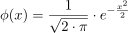
 to the risk premium
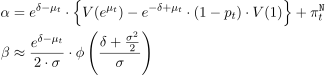
 , increasing an economy’s variance premium
  scaled by the
  -statistic for
  . Note that the coefficient
  in the data. Then, we can approximate the implied volatility using the Black-Scholes
  (i.e., “vega”) via the relationship:
![\begin{align*} \hat{V}(K) &= V(K) + \nu \cdot \left[ \ \tilde{\sigma} - \sigma \ \right] \\ \nu &= S \cdot \phi \left( \frac{\ln(S/K) + \delta + \frac{\sigma^2}{2}}{\sigma} \right) \end{align*}](https://alexchinco.com/wp-content/ql-cache/quicklatex.com-2e08c39c7be9d1c9548ca80c27d0b2c7_l3.svg "Rendered by QuickLaTeX.com")
 , we have that
  .
.![\begin{align*} \hat{V}(e^{\mu_t}) &= V(e^{\mu_t}) + \phi \left( \frac{\delta + \frac{\sigma^2}{2}}{\sigma} \right) \cdot \left[ \ \tilde{\sigma} - \sigma \ \right] \\ &= e^{- \delta + \mu_t} \cdot \left\{ \hat{V}^{\mathtt{N}}_t(e^{\mu_t}) + \pi_t^{\mathtt{D}} \right\} \\ &= e^{- \delta + \mu_t} \cdot \left\{ (1 - p) \cdot V(1) + \pi_t^{\mathtt{D}} \right\} \end{align*}](https://alexchinco.com/wp-content/ql-cache/quicklatex.com-72ddbcbc22aeea4f94a6fb43d2c3c0f9_l3.svg "Rendered by QuickLaTeX.com")
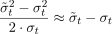
 :
:
 given below: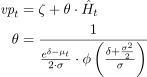
 using the parameter values given in Bollerslev et al. (2009) which estimates the regression given in Equation (8) above.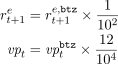
 is the standard deviation operator,
![\begin{align*} \begin{array}{l|c} & \text{Estimate} \\ \hline \hline \mathbb{E}[r^e_{t+1}] & 0.069 \\ \mathbb{S}[r^e_{t+1}] & 0.138 \\ \hline \mathbb{E}[\textit{vp}_t] & 0.022 \\ \mathbb{S}[\textit{vp}_t] & 0.0053 \end{array} \end{align*}](https://alexchinco.com/wp-content/ql-cache/quicklatex.com-0f4149c4e500e38e2d8c779dc7d458e2_l3.svg "Rendered by QuickLaTeX.com")
 a year. This gap had a volatility of
  a year. What’s more, the average distance between the VIX implied variance and the realized variance for the S&P 500 was
  .
. with a
  . Below I report the remainder of the regression results where the values in square brackets represent standard errors,
 and
and  . I take the annualized values of
  and
and  from Gabaix (2011). I take the estimate of the annualized realized variance from Bollerslev et al. (2009) of
  . Using these values, I find that,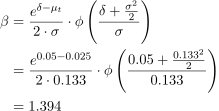
 per year, then the equity premium will rise by
  per year.
 users in May, 2010. The firm makes time tracking software that keeps an eye on what workers do and where they go online.
 searches on the Google page. Each one of these searches lasts about
  seconds. Putting Pac-Man on the Google homepage increased the average time spent on the page by an average of about
  seconds.
 million unique users who visit the main Google page day-to-day, this represents an increase of
  million hours – equal to about
  years! In dollar terms, assuming people are paid roughly
  , this equates to about
  in lost productivity.
 of US GDP. However, this study focuses on expenditures in the corporate finance side of the financial industry.
 years
years as shown below
 -dimensional stochastic process of
  is such a process, then:
 in an
in an  ).
). matrix
  is called Hermitian if it is self-adjoint:
 of a Hermitian matrix
  in
in  :
:
 below is a real instance of a Hermitian matrix:
 is a probability space over the vector space of
  defined as:
 will be drawn from
  while each element
  along the diagonal will be drawn from
  . To get a feel for what this definition really means, consider a concrete example. Suppose that we want to know the probability
  for the example
 ![\begin{align*} \begin{split} (A')^2 \ &= \ \begin{bmatrix} 2 & 3 \cdot i \\ - 3 \cdot i & 5 \end{bmatrix} \\ \mathtt{Tr}[(A')^2] \ &= \ 2 \ + \ 5 \ = \ 7 \\ \mu(A') \ &= \ \frac{1}{2^{\frac{2}{2}} \cdot \pi^{\frac{2^2}{2}}} \cdot e^{-\frac{2}{2} \cdot 7} \\ &= \ \frac{1}{2 \cdot \pi^2} \cdot e^{-7} \\ &= \ 0.0000462 \end{split} \end{align*}](https://alexchinco.com/wp-content/ql-cache/quicklatex.com-19ff0a9149ae2648ef71508e405aa812_l3.svg "Rendered by QuickLaTeX.com")
 in order to test your model.
 Brownian motions
  that have been restricted to never intersect. The problem of modelling the eigen-values of Hermitian matrices and non-intersecting Brownian processes are not link a priori. However, constructing these non-intersecting processes is hard and an elegant solution emerges via solving the eigen-value process problem for Hermitian matrices which have a simple spectrum. For an example of the economic usefulness of such a trick, conside modelling the real option of a worker to switch jobs.
 by a well chosen inverse. However, when using complex valued matrices, this inverse is no longer possible as complex numbers are periodic; i.e.,
 and a steel maker
  at a price of
  dollars per ton would manifest itself as
  and
and  . Thus, by introducing an additional dimension to the Leontif matrix, the physical properties of the process it represents changes dramatically.
 ,
,  and
and  be the spectrum of eigen-values of the
  . Then, we have:
 , where
  and
and  are independent Brownian motion processes.
 is pushed an pulled by
  and
and  but also
  and
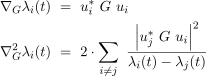
and  as well as each and every eigen-level in between.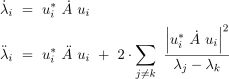








You must be logged in to post a comment.