1. Motivation
Imagine that we’re trying to predict the cross-section of expected returns, and we’ve got a sneaking suspicion that  might be a good predictor. So, we regress today’s returns on to see if our hunch is right,

The logic is straightforward. If explains enough of the variation in today’s returns, then must be a good predictor and we should include it in our model of tomorrow’s returns,  .
.
But, how much variation is “enough variation”? After all, even if doesn’t actually predict tomorrow’s returns, we’re still going to fit today’s returns better if we use an additional right-hand-side variable,

The effect is mechanical. If we want to explain all of the variation in today’s returns, then all we have to do is include  right-hand-side variables in our OLS regression. With linearly independent right-hand-side variables we can always perfectly predict stock returns, no matter what variables we choose.
The Bayesian information criterion (BIC) tells us that we should include as a right-hand-side variable if it explains at least  of the residual variation,

But, where does this penalty come from? And, why is following this rule the Bayesian thing to do? Bayesian updating involves learning about a parameter value by combining prior beliefs with evidence from realized data. So, what parameter are we learning about when using the Bayesian information criterion? And, what are our priors beliefs? These questions are the topic of today’s post.
2. Estimation
Instead of diving directly into our predictor-selection problem (should we include in our model?), let’s pause for a second and solve our parameter-estimation problem (how should we estimate the coefficient on ?). Suppose the data-generating process for returns is

where  ,
,  , and is normalized so that
 ![\frac{1}{N} \cdot \sum_{n=1}^N x_n^2 = \widehat{\mathrm{Var}}[x_n] = 1](https://alexchinco.com/wp-content/ql-cache/quicklatex.com-0e370c46f4b22c73be09aa0cd1a87617_l3.svg "Rendered by QuickLaTeX.com") . For simplicity, let’s also assume that
. For simplicity, let’s also assume that  in the analysis below.
If we see returns from this data-generating process,  , then we can estimate
  by choosing the parameter value that would maximize the posterior probability of realizing these returns:

This is known as maximum a posteriori (MAP) estimation, and the second equality in the expression above points out how we can either maximize the posterior probability or minimize  of this function,

We can think about  as the average improbability of the realized returns given
  .
.
 So, what is this answer? Because and , we know that

where the first line is  and the second line is
  .
.  What’s more, because we’re specifically choosing
  to minimize , we also know that

And, solving this first-order condition for tells us exactly how to estimate :
![\begin{align*} \hat{\beta}_{\text{MAP}} &= \frac{ N \cdot \left\{ \frac{1}{N} \cdot \sum_{n=1}^N r_{n,t} \cdot x_{n,t-1} \right\} }{ \frac{1}{\sigma^2} + N \cdot \left\{ \frac{1}{N} \cdot \sum_{n=1}^N x_{n,t-1}^2 \right\} } = \frac{ N \cdot \widehat{\mathrm{Cov}}[r_{n,t}, \, x_{n,t-1}] }{ \frac{1}{\sigma^2} + N \cdot \widehat{\mathrm{Var}}[x_{n,t-1}] }. \end{align*}](https://alexchinco.com/wp-content/ql-cache/quicklatex.com-b297062842b5de08739ae76da52a9066_l3.svg "Rendered by QuickLaTeX.com")
3. Selection
Now that we’ve seen the solution to our parameter-estimation problem, let’s get back to solving our predictor-selection problem. Should we include in our predictive model of tomorrow’s returns? It turns out that answering this question means learning about the prior variance of . Is is equally likely to take on any value,  ? Or, should we assume that
  regardless of the evidence,
  ?
?
To see where the first choice comes from, let’s think about the priors we’re implicitly adopting when we include in our predictive model. Since , this means looking for a  such that
  . Inspecting the solution to our parameter-estimation problem reveals that
![\begin{align*} \lim_{\sigma^2 \to \infty} \hat{\beta}_{\text{MAP}} &= \lim_{\sigma^2 \to \infty} \left( \frac{ N \cdot \widehat{\mathrm{Cov}}[r_{n,t}, \, x_{n,t-1}] }{ \frac{1}{\sigma^2} + N \cdot \widehat{\mathrm{Var}}[x_{n,t-1}] } \right) = \frac{ \widehat{\mathrm{Cov}}[r_{n,t}, \, x_{n,t-1}] }{ \widehat{\mathrm{Var}}[x_{n,t-1}] } = \hat{\beta}_{\text{OLS}}. \end{align*}](https://alexchinco.com/wp-content/ql-cache/quicklatex.com-84b88eda6686d32105afe4a50265d0d0_l3.svg "Rendered by QuickLaTeX.com")
So, by including , we’re adopting an agnostic prior that is equally likely to be any value under the sun.
To see where the second choice comes from, let’s think about the priors we’re implicitly adopting when we exclude from our predictive model. This means looking for a such that  regardless of the realized data,
  . Again, inspecting the formula for reveals that
![\begin{align*} \lim_{\sigma^2 \to 0} \hat{\beta}_{\text{MAP}} &= \lim_{\sigma^2 \to 0} \left( \frac{ N \cdot \widehat{\mathrm{Cov}}[r_{n,t}, \, x_{n,t-1}] }{ \frac{1}{\sigma^2} + N \cdot \widehat{\mathrm{Var}}[x_{n,t-1}] } \right) =0. \end{align*}](https://alexchinco.com/wp-content/ql-cache/quicklatex.com-aa6fdf9e284382723c8d44aec0e86b6c_l3.svg "Rendered by QuickLaTeX.com")
So, by excluding , we’re adopting a religious prior that regardless of any new evidence.
Thus, when we decide whether to include in our predictive model, what we’re really doing is learning about our priors. So, after seeing returns,  , we can decide whether to include in our predictive model by choosing the prior variance, , that maximizes the posterior probability of realizing these returns,

where the second equality in the expression above points out how we can either maximize the posterior probability or minimize of this function—i.e., its average improbability. Either way, if we estimate  , then we should include ; whereas, if we estimate
  , then we shouldn’t.
4. Why log(N)/N?
The posterior probability of the realized returns given our choice of priors is given by

In this section, we’re going to see how to evaluate this integral. And, in the process, we’re going to see precisely where that penalty term in the Bayesian information criterion comes from.
Here’s the key insight in plain English. The realized returns are affected by noise shocks. By definition, excluding from our predictive model means that we aren’t learning about from the realized returns, so there’s no way for these noise shocks to affect either our estimate of or our posterior-probability calculations. By contrast, if we include in our predictive model, then we are learning about from the realized returns, so these noise shocks will distort both our estimate of and our posterior-probability calculations. The distortion caused by these noise shocks are going to be the source of the penalty term in the Bayesian information criterion.
Now, here’s the same insight in Mathese. Take a look at the Taylor expansion of around ,

There’s no first-order term because is chosen to minimize , and there are no higher-order terms because both and  are normally distributed. From the formula for we can calculate that

Recall that measures the average improbability of realizing given that . So, if  for a given choice of priors, then having any
  is infinitely improbable under those priors. And, this is exactly what we find when we exclude from our predictive model,
  . By contrast, if we include in our predictive model, then
  , meaning that we are willing to entertain the idea that due to distortions caused by the noise shocks.
To see why these distortions warrant a penalty, all we have to do then is evaluate the integral. First, let’s think about the case where we exclude from our predictive model. We just saw that, if  , then we are unwilling to consider any parameter values besides . So, the integral equation for our posteriors given that simplifies to

This means that the average improbability of realizing given the priors is given by

To calculate our posterior beliefs when we include , let’s use this Taylor expansion around again,

The first term is the probability of observing the realized returns assuming that  . The second term is a penalty that accounts for the fact that might be different from the estimated
  in finite samples. Due to the central-limit theorem, this difference between and is going to shrink at a rate of
  :
:

So, the average improbability of realizing given the priors is given by

where  is big-“O” notation denoting terms that shrink faster than
  as
as  .
.
5. Formatting
Bringing everything together, hopefully it’s now clear why we can decide whether to include in our predictive model by checking whether

The penalty term accounts for the fact that you’re going to be overfitting the data in sample when you include more right-hand-side variables. This criterion was first proposed in Schwarz (1978), who showed that the criterion becomes exact as . The Bayesian information criterion is often written as an optimization problem as well:

Both ways of writing down the criterion are the same. They just look different due to formatting. There is one interesting idea that pops out of writing down the Bayesian information criterion as a optimization problem. Solving for the suggests that you should completely ignore any predictors with sufficiently small OLS coefficients:

 E-Mini S&P 500 futures contracts… late in the trading day… [with] many of the contracts bought by… computerized traders who… [then] traded contracts back and forth [like a] ‘hot potato’.”
 a barrel… [and] market players were unable to identify any single bank or fund orchestrating a massive sale to liquidate positions… [rather] computerized trading just kicked in when key price levels were reached.”
 minutes of trading, the S&P 500-stock index jumped more than
  points with no news to account for the rally. If you were left scratching your head, you were not alone… [and, the] culprit behind the late-day market swings: exchange-traded funds or ETFs.”
 ‘s fundamentals change, so a trading strategy sells stock
  . This purchase of stock
  . And, this sale forces…
 stocks,
  , where
  will force some trading strategy to rebalance and buy stock
  instead, then let’s say that stock
  . This uniform-random-matching assumption means that the number of neighbors that each stock has,
  , is
, is ![\lambda \overset{\scriptscriptstyle \mathrm{def}}{=} \mathrm{E}[N_s]](https://alexchinco.com/wp-content/ql-cache/quicklatex.com-f56903489fa29dfba54b68c57e7f0a88_l3.svg "Rendered by QuickLaTeX.com") ,
,
![\lambda = \mathrm{O}[\log(S)]](https://alexchinco.com/wp-content/ql-cache/quicklatex.com-b2419976fb73dee4d964c63ab1bdd762_l3.svg "Rendered by QuickLaTeX.com") . The figure below gives examples of this sort of random network when
. The figure below gives examples of this sort of random network when  .
.
 is an indicator variable for whether or not stock
![\phi \in (0, \, 1]](https://alexchinco.com/wp-content/ql-cache/quicklatex.com-83f38ffeb690912dfb8004bfbfb318c7_l3.svg "Rendered by QuickLaTeX.com") captures the vulnerability of a stock’s fundamentals to rebalancing. If there are lots of different strategies trading stock
captures the vulnerability of a stock’s fundamentals to rebalancing. If there are lots of different strategies trading stock  , then no single rebalancing decision will be important enough to change stock
  neighbors, then a change in the fundamentals of a single neighbor will generate enough rebalancing to cause stock
  such vulnerable neighbors.
 . If
. If  . And, if
  , then the second wave of rebalancing caused by our initial shock to stock
  . If stock
 , and vulnerability threshold,
  .
. , after one flip is given by:
 , then the coin is fair. The generating function for this same distribution is:
 is the probability of realizing
  heads.
  is the probability of realizing
  heads. We say that
  generates the distribution because we can compute all its moments by evaluating the derivatives of the generating function at
  . For example, the
  th-order derivative,
  , says that the coin never lands on its edge or winks out of existence. And, if we want to compute the expected number of heads, then we can use the
 ![\begin{align*} \mathrm{E}[h|\text{1 flip}] &= \left. x \cdot \mathrm{G}'(x|\text{1 flip}) \right|_{x=1} \\ &= \left. x \cdot {\textstyle \sum_{h=0}^1} \, p_h \cdot h \cdot x^{h-1} \right|_{x=1} \\ &= \left. {\textstyle \sum_{h=0}^1} \, p_h \cdot h \cdot x^h \right|_{x=1} \\ &= p_0 \cdot 0 \cdot 1^0 + p_1 \cdot 1 \cdot 1^1 \\ &= q. \end{align*}](https://alexchinco.com/wp-content/ql-cache/quicklatex.com-2fee7951f5435d9891dfc7621097b87c_l3.svg "Rendered by QuickLaTeX.com")
 th power, then we get the generating function for the total number of heads in
 .
. flips by
  , then we have the generating function for the total number of heads in all
 .
. be the generating function distribution of cascade lengths that we would start with an exogenous shock to stock
 gives the probability that a shock to stock
  . If stock
  . Whereas, if a shock to stock
  . Next, let
  be the generating function for the number of vulnerable neighbors that stock
 is the probability that stock
  vulnerable neighbors.
 vulnerable neighbor,
  excluding stock
  vulnerable neighbors,
  excluding stock
  vulnerable neighbors, then an initial shock to stock
  .
.
 is the generating function for the probability that
  . And, we also know from the previous section (property 3: partial information) that we have to multiply through by
  . So, the generating function for the distribution of cascade lengths has to satisfy the following internal-consistency condition as the number of stocks gets large,
  :
:
 , gives the probability that the initial stock
 ![\begin{align*} \mathrm{E}[C_s] = \left. x \cdot \mathrm{G}_c'(x) \right|_{x=1} &= 1 + \mathrm{G}_v'(1) \cdot \mathrm{G}_c'(1) \\ &= 1 + \mathrm{G}_v'(1) \cdot \mathrm{E}[C_s]. \end{align*}](https://alexchinco.com/wp-content/ql-cache/quicklatex.com-acec116e7a490e33386a6536a52a8b17_l3.svg "Rendered by QuickLaTeX.com")
![\begin{align*} \mathrm{E}[C_s] = \frac{1}{1 - \mathrm{G}_v'(1)}. \end{align*}](https://alexchinco.com/wp-content/ql-cache/quicklatex.com-90ec4d8fb5d28f6925f8fbcb413fc86e_l3.svg "Rendered by QuickLaTeX.com")
![\mathrm{G}_c'(1) = \mathrm{E}[C_s]](https://alexchinco.com/wp-content/ql-cache/quicklatex.com-298563089522f41fcc086bd26aee0deb_l3.svg "Rendered by QuickLaTeX.com") (property 1: derivatives are moments), the expected number of vulnerable neighbors that each stock has is given by
(property 1: derivatives are moments), the expected number of vulnerable neighbors that each stock has is given by ![\mathrm{G}_v'(1) = \mathrm{E}[V_s]](https://alexchinco.com/wp-content/ql-cache/quicklatex.com-68d1e0aaee2d1ed47d1b87c825e6383a_l3.svg "Rendered by QuickLaTeX.com") . When stocks typically have less than
. When stocks typically have less than ![\mathrm{E}[V_s] < 1](https://alexchinco.com/wp-content/ql-cache/quicklatex.com-6d7f484b021fb59f5eda04ea07af2787_l3.svg "Rendered by QuickLaTeX.com") , we have an expression for the average rebalancing-cascade length as a function of the market’s connectivity,
, we have an expression for the average rebalancing-cascade length as a function of the market’s connectivity, 
![\begin{align*} \mathrm{E}[V_s] = \mathrm{G}_v'(1) &= \lambda \times \mathrm{Pr}[N_s \leq N^\star] \\ &= \lambda \times \mathrm{Pr}[N_s < (\lfloor \sfrac{1}{\phi} \rfloor +1)] \\ &=\lambda \times \left\{ \, \sum_{n < (\lfloor \sfrac{1}{\phi} \rfloor+1)} e^{-\lambda} \cdot \frac{\lambda^n}{n!} \, \right\}. \end{align*}](https://alexchinco.com/wp-content/ql-cache/quicklatex.com-da7d77fa7a178da015ffc760e6333dc3_l3.svg "Rendered by QuickLaTeX.com")
 as the fraction of all stocks affected by an infinitely long rebalancing cascade,
 of the time, then we would have said that
  . So, if
  , gives us a way to solve for the fraction of the market that’s typically affected by an infinitely long rebalancing cascade,
  .
.
 -stock long rebalancing cascades. Take a look at the figure above. Each panel has
  stocks (the dots) and represents a single realization of trading-strategy rebalancing rules (the lines) in markets where each stock has
  neighbors (left) and
  neighbors (right) respectively. Both these markets are observationally equivalent. But, as shown in the figure below, when
  an initial shock to stock
 ![\mathrm{E}[V_s] = 1](https://alexchinco.com/wp-content/ql-cache/quicklatex.com-6d4cdbae24a8a6b74dfd70f3f1c0100f_l3.svg "Rendered by QuickLaTeX.com") can have huge effects on the cascade-length distribution. What’s more, right at this transition point where
can have huge effects on the cascade-length distribution. What’s more, right at this transition point where ![\begin{align*} \mathrm{Pr}[C_s = c] \sim c^{-\sfrac{3}{2}}, \end{align*}](https://alexchinco.com/wp-content/ql-cache/quicklatex.com-fb6fbb0474f3fff0bb3bc94a72d1ddfe_l3.svg "Rendered by QuickLaTeX.com")

 , which is Apple’s long-run expected return,
  , plus some random noise,
  :
:
 that’s as close as possible to the realized
 is the strength of this penalty. If you use the LASSO, then you’ll estimate:
 . If Apple’s most recent stock return was
  , then the LASSO will pick
  . And, if Apple’s most recent stock return was
  , then the LASSO will still pick
  , then the LASSO will give an estimate of
  .
.
 and
and  . So, it’s surprising that, if Apple’s long-run expected return,
 , then it’s correct to just ignore any return smaller than
  when estimating
  . But, lot’s of distributions use the absolute-value operator (e.g., the
  ,
,  , or
, or  instead of
  :
:

 is the posterior likelihood that Apple’s long-run expected return is
  given that you’ve just seen a realized return of
  is the probability that Apple realizes a return of
  is the probability that Apple’s long-run expected return is
  in the first place.
 small. On the other hand, you could pick a
  small. Your priors determine what you do: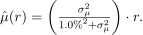
 ), then you’re going to pick
  since
since  . By contrast, if you have very strong priors (
 ), then you’re going to pick
  since
since  . To illustrate, suppose that you’re really sure that Apple’s long-run expected return is close to
  with
with  . Then, if you see Apple realize a return of
  , you’re going to think that this realization was probably due to a positive random shock,
  , and only pick
  .
.
 and the low value much smaller than
  . It turns out that you’re going to behave a lot like someone using the LASSO when you estimate Apple’s long-run expected return in this mixture model.

 , then you’d pick
  . Whereas, if you knew that
  , then you’d pick
  . Your estimate when
  is going to really different from your estimate when
  .
.
 analytically when
  and
and  can take on arbitrary values, but the assumption that
  simplifies things nicely. And, the resulting analysis reveals why you’re going to do something LASSO-esque when learning about Apple’s long-run expected return in this mixture model.
 . This really big return would be really unlikely if
  because
  is really small. So, you can safely assume that
 ), then you should ignore them since
  . So, you’re going to set
  whenever
  . Again, this really small return would be really unlikely if
  because
 . So, you’re going to set
  whenever

 , then these standard deviations could be either really large or really small. We just saw that this is exactly what needs to happen for a LASSO-like estimation strategy to be optimal. There are lots of distributions for
  that have this property—we just saw another one above. But, if you use
  line up in such a way that it’s precisely optimal to use the LASSO.
 is a random variable. This clearly isn’t necessary. You just need the standard deviation of Apple’s long-run expected return to fluctuate wildly around
  .
.
 instead of
  is small. With these new numbers,
  rather than
  . When choosing a distribution for
  stocks that assigns each trader a typical investment horizon. Others have measured horizon-specific trading activity for a large number of stocks but only at a single horizon. e.g.,
  -period horizon. Suppose that returns are generated by a simple
 and the level of the factor evolves according to an
  model,
 . Note that this is the exact same factor structure used in
 , it’s possible to compute the conditional mean and variance of these
  :
:
 observe the current level of the factor,
 ![\Delta_H[x_t] = \sum_{h=0}^{H-1} \Delta_1[x_{t-h}]](https://alexchinco.com/wp-content/ql-cache/quicklatex.com-f751d2bae1fef26ec23352a9ee0affad_l3.svg "Rendered by QuickLaTeX.com") denote the change in a trader’s portfolio position over the period from
denote the change in a trader’s portfolio position over the period from  , and let
 ![\begin{align*} v_t(\Delta_H[x_t]) &= \mu_{H,t} \cdot \Delta_H[x_t] - {\textstyle \frac{\gamma}{2}} \cdot \sigma_H^2 \cdot \Delta_H[x_t]^2. \end{align*}](https://alexchinco.com/wp-content/ql-cache/quicklatex.com-fbd4c401eb07d20fe1e753ab6d1532ca_l3.svg "Rendered by QuickLaTeX.com")
![\begin{align*} \mathit{tc}(\Delta_H[x_t]) &= \min_{\{\Delta_1[x_{t-h}] \}_{h=0}^{H-1}} \, \left\{ \, {\textstyle \frac{\kappa}{2} \cdot \sum_{h=0}^{H-1}} \Delta_1[x_{t-h}]^2 \, \middle| \, \Delta_H[x_t] \, \right\}, \end{align*}](https://alexchinco.com/wp-content/ql-cache/quicklatex.com-b516167b8747541285c9b7af1bf0304a_l3.svg "Rendered by QuickLaTeX.com")
 is a positive constant that captures the severity of these transaction costs. Thus, traders with an
 ![\begin{align*} \max_{\Delta_H[x_t]} \, \left\{ \, v_t(\Delta_H[x_t]) - \mathit{tc}(\Delta_H[x_t]) \, \right\}. \end{align*}](https://alexchinco.com/wp-content/ql-cache/quicklatex.com-bbb89827757d7afaeffd3e046698d753_l3.svg "Rendered by QuickLaTeX.com")
 , since
 ![\Delta_1[x_{t+1}] = \Delta_2[x_t] - \Delta_1[x_t]](https://alexchinco.com/wp-content/ql-cache/quicklatex.com-3da51b73241c18869bf60840668fbaef_l3.svg "Rendered by QuickLaTeX.com") . Suppose that traders know optimal final position
. Suppose that traders know optimal final position ![\Delta_2[x_t]](https://alexchinco.com/wp-content/ql-cache/quicklatex.com-e0b5a1b12303185d02003be0a63a0986_l3.svg "Rendered by QuickLaTeX.com") . Then, traders’ optimization problem from Equation (
. Then, traders’ optimization problem from Equation (![\begin{align*} \max_{\Delta_1[x_t]} \left\{ \, \mu_{2,t} \cdot \Delta_2[x_t] - {\textstyle \frac{\gamma}{2}} \cdot \sigma_H^2 \cdot \Delta_2[x_t] - \sfrac{\kappa}{2} \cdot \left\{ \, \Delta_1[x_t]^2 + (\Delta_2 [x_t] - \Delta_1 [x_t])^2 \, \right\} \, \right\}. \end{align*}](https://alexchinco.com/wp-content/ql-cache/quicklatex.com-2f1892c3aaa02fa2032b0f49f814dbc8_l3.svg "Rendered by QuickLaTeX.com")
![\Delta_1[x_t]](https://alexchinco.com/wp-content/ql-cache/quicklatex.com-274fd67d5bfa79b4728c4dc8dc349e77_l3.svg "Rendered by QuickLaTeX.com") ,
,![\begin{align*} 0 &= - \kappa \cdot \left[ \, \Delta_1 [x_t] - (\Delta_2[x_t] - \Delta_1[x_t]) \, \right], \end{align*}](https://alexchinco.com/wp-content/ql-cache/quicklatex.com-69aaf64a57dc8c61b6dace27ebd6aabb_l3.svg "Rendered by QuickLaTeX.com")
![\Delta_1[x_t] = \sfrac{\Delta_2[x_t]}{2}](https://alexchinco.com/wp-content/ql-cache/quicklatex.com-d87e5965e7917d15fecee5c65982b735_l3.svg "Rendered by QuickLaTeX.com") . This simple exercise verifies that, when there are convex transaction costs, traders will want to split their orders up evenly across their investment horizon. In general, if traders have an
. This simple exercise verifies that, when there are convex transaction costs, traders will want to split their orders up evenly across their investment horizon. In general, if traders have an ![\Delta_1[x_{t+h}] = \sfrac{\Delta_H[x_t]}{H}](https://alexchinco.com/wp-content/ql-cache/quicklatex.com-fbca743ee092d64fa1bc9a190af96169_l3.svg "Rendered by QuickLaTeX.com") . Traders with an
. Traders with an 
 ,
,  , and
, and  , I simulate a long return time series. From Equation (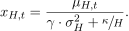
 different horizons,
  , I then simulate the trading-volume time series that would occur if all traders operated at horizon
  . The figure below shows the fraction of the trading-volume variance occurring at each horizon according to the wavelet-variance estimator. Just as you’d expect, there is a spike the fraction of trading-volume variance at the true horizon,
  , precisely at
  .
.
 -period horizon and half of the volume comes from traders operating at the
  -period horizon. The figure below shows the fraction of the trading-volume variance occurring at each horizon according to the wavelet-variance estimator. Again, just as you’d expect, there’s is a spike the fraction of trading-volume variance at both the
 bagels each. So, at the start of each morning, there’s a bin of
 months to a year, then home buyers might get the impression that the supply of houses is getting low. I now outline a simple model to make these ideas more concrete.
 denote the total number of houses,
  denote the number of owner-occupied houses,
  denote the number of investor-owned houses, and
  denote the number of houses that are currently for sale in month

 represents the probability a house goes from being owner occupied one month to for sale the next. And,
  represents the probability that a house is investor owned in month
  given that it was investor owned in month
  since a house has to be for sale before it can pass from one owner to the next. The diagram below gives an alternative way of representing these transition probabilities that doesn’t use matrix notation.
 . So, when there aren’t any investors, the number of houses that a home buyer can choose from after looking for
  . The number of houses that are always investor owned after
  . So, when there are investors, the number of houses that a home buyer can choose from after looking for

 . If
. If  , then investors decrease the number of houses for sale over the course of
  . If there would have been
  houses for sale over the course of
  houses for sale with investors.
 . Owners typically hold onto their houses for
  . Owners and investors are equally likely to buy houses,
  . Suppose that the typical house stays on the market for
  .
.
 of the housing stock is for sale in any given month (
 houses in
  of houses are initially owned by investors. The dashed green line says that
  drop in the housing supply as perceived by naïve home buyers. As the number of months that a naïve home buyer searches drops, the impact of investor holdings rises sharply. When search durations are really short, like they were in Las Vegas during the mid 2000s, tiny amounts of investor ownership can have enormous impacts on the perceived housing supply.
You must be logged in to post a comment.