1. Motivation
Imagine you’re a trader who’s about to put on a position for the next month. You want to hedge away the risk in this position associated with daily fluctuations in market returns. One way that you might do this would be to short the S&P 500 since E-mini contracts are some of the most liquid in the world.

 But… how much of the variation in the index’s returns is due to fluctuations at the daily horizon? e.g., the blue line in the figure to the right shows the minute-by-minute price of the E-mini contract on May 6th, 2010 during the flash crash. Over the course of
  minutes, the contract price fell
  ! It then rebounded back to nearly its original position over the next hour. Clearly, if most of the fluctuations in the E-mini S&P 500 contract value is due to shocks on the sub-hour time scale, this contract will do a poor job hedging away daily market risk.
This post demonstrates how to decompose the variance of a time series (e.g., the minute-by-minute returns on the E-mini) into horizon specific components using wavelets. i.e., using the wavelet variance estimator allows you to ask the questions: “How much of the variance is coming from fluctuations on the scale of  minutes?
  hour? day? month?” I then investigate how this wavelet variance approach compares to other methods financial economists might employ such as auto-regressive functions and spectral analysis.
2. Wavelet Analysis
In order to explain how the wavelet variance estimator works, I first need to give a quick outline of how wavelets work. Wavelets allow you to decompose a signal into components that are independent in both the time and frequency domains. This outline will be as bare bones as possible. See Percival and Walden (2000) for an excellent overview of the topic.
Imagine you’ve got a time series of just  returns:
(1) 
and assume for simplicity that these returns have mean ![\mathrm{E}[r_t] = \mu_r = 0](https://alexchinco.com/wp-content/ql-cache/quicklatex.com-19f53337bebb1b52835e621bb2777963_l3.svg "Rendered by QuickLaTeX.com") . One thing that you might do with this time series is estimate a regression with time fixed effects:
. One thing that you might do with this time series is estimate a regression with time fixed effects:  . Here is another way to represent the same regression:
(2) 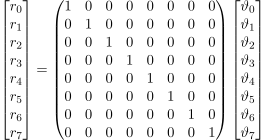
It’s really a trivial projection since  . Call the projection matrix
  for “fixed effects” sot that
  .
.
Obviously, the above time fixed effect model would be a bit of a silly thing to estimate, but notice that the projection matrix has an interesting property. Namely, each column is orthonormal:
(3) 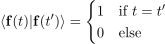
It’s orthogonal because  unless
  . This requirement implies that each column in the projection matrix is picking up different information about
  . It’s normal because
  is normalized to equal . This requirement implies that the projection matrix is leaving the magnitude of unchanged. The time fixed effects projection matrix, , compares each successive time period, but you can also think about using other orthonormal bases.
e.g., the Haar wavelet projection matrix compares how the st half of the time series differs from the  nd half, how the st quarter differs from the nd quarter, how the
  rd quarter differs from the th quarter, how the st eighth differs from the nd eighth, and so on… For the
  period return time series, let’s denote the columns of the wavelet projection matrix as:
(4) 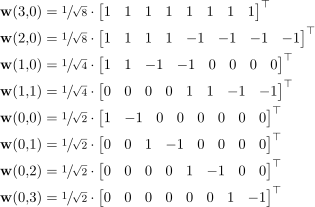
and simple inspection shows that each column is orthonormal:
(5) 
Let’s look at a concrete example. Suppose that we want to project the vector:
(6) 
onto the wavelet basis:
(7) 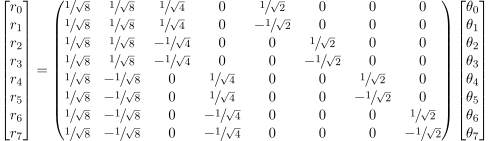
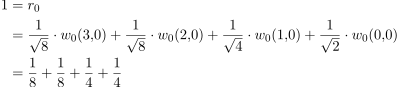
What would the wavelet coefficients  look like? Well, a little trial and error shows that:
(8) 
since this is the only combination of coefficients that satisfies both  :
:
(9) 
and  for all
  .
.
What’s cool about the wavelet projection is that the coefficients represent effects that are isolated in both the frequency and time domains. The index  denotes the
  length of the wavelet comparison groups. e.g. the wavelets with
  compare
  period increments: the st period to the nd period, the rd period to the th period, and so on… Similarly, the wavelets with
  compare
  period increments: the st periods to the nd periods and the rd periods to the th periods. Thus, the
  captures the location of the coefficient in the frequency domain. The index
  signifies which comparison groups at horizon we are looking at. e.g., when , there are
  different comparisons to be made. Thus, the
  captures the location of the coefficient in the time domain.
3. Wavelet Variance
With these basics in place, it’s now easy to define the wavelet variance of a time series. First, I massage the standard representation of a series’ variance a bit. The variance of our term series is defined as:
(10) 
since  . Using the tools from the section above, let’s rewrite
  . This means that the variance formula becomes:
(11) 
But I know that  since each of the columns is orthonormal. Thus:
(12) 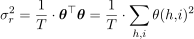
This representation gives the variance of a series as an average of squared wavelet coefficients.
The sum of the squared wavelet coefficients at each horizon, , is then an interesting object:
(13) 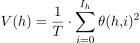
since  denotes the fraction of the total variance of the time series explained by comparing successive periods of length
  . I refer to as the wavelet variance of a series at horizon . The sum of the wavelet variances at each horizon gives total variance:
(14) 
4. Numerical Example
Let’s take a look at how the wavelet variance of a time series behaves out in the wild. Here’s the code I used to create the figures: [code][/code]. Specifically, let’s study the simulated data plotted below which consists of  days of minute-by-minute return data with day-specific shocks:
(15) 
where the volatility of the process is given by  and there is a
  probability of realizing a
  shock on any given day. The days on which the data realized a shock are highlighted in red. These minute-by-minute figures amount to a
  annualized return and a
  annualized volatility.

The figure below then plots the wavelet coefficients, , at each horizon associated with this time series. A trading day is  , so notice the spikes in the coefficient values in the
  panels near the day-specific shock dates corresponding to comparing successive
  ,
,  , and
, and  minute intervals. The remaining variation in the coefficient levels comes from the underlying white noise process
  . Because the break points in the wavelet projection affect the estimated coefficients, each data point in the plot actually represents the average of the coefficient estimates
  at a given point of time for all possible starting dates. See Percival and Walden (2000, Ch. 5) on the maximal overlap discrete wavelet transform for details.

Finally, I plot the  of the wavelet variance at each horizon for both the simulated return process (red) and a white noise process with an identical mean and variance (blue). Note that I’ve switched from to
  on the
  -axis here, so a spike in the amount of variance at
  corresponds to a spike in the amount of variance explained by successive
  increments. This is exactly what you’d expect for day-specific shocks which have a duration of
  as indicated by the vertical gray line. The wavelet variance of an appropriately scaled white noise process gives a nice comparison group. To see why, note that for covariance stationary processes like white noise, the wavelet variance at a particular horizon is related to the power spectrum as follows:
(16) 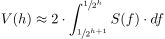
Thus, the wavelet variance of white noise should follow a power law with:
(17) 
giving a nice smooth reference point in plots.

5. Comparing Techniques
I conclude by considering how the wavelet variance statistic compares to other ways that a financial economist might look for horizon specific effects in data. I consider alternatives: auto-regressive models and spectral density estimators. First, consider estimating the auto-regressive model below with lags  :
:
(18) 
The left-most panel of the figure below reports the estimated values of  for lags
  using the simulated data (red) as well as a scaled white noise process (blue). Just as before, the vertical grey line denotes the number of minutes in a day. There is no meaningful difference between the sets of coefficients. The reason is that the day-specific shocks are asynchronous. They aren’t coming at regular intervals. Thus, no obvious lag structure can emerge from the data.

Next, let’s think about estimating the spectral density of . This turns out to be the exact same exercise as the auto-regressive model estimation in different clothing. As shown in an earlier post, it’s possible to flip back and forth between the coefficients of an  process and its spectral density via the relationship:
(19) 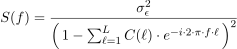
This one-to-one mapping between the frequency domain and the time domain for covariance stationary processes is known as the Wiener–Khinchin theorem with  . Thus, the spectral density plot just reflects the same random noise as the auto-regressive model coefficients because of the same issue with asynchrony. The most interesting features of the middle panel occur at really high frequencies which have nothing to do with the day-specific shocks.
Here’s the punchline. The wavelet variance is the only estimator of the which can identify horizon-specific contributions to a time series’ variance which are not stationary.

 articles in the WSJ referencing Garmin (
 articles referencing Sprint (
 different subject tags used in the articles about Sprint! This finding is consistent with the idea that some firms face a much wider array of shocks than others. i.e., the width of the market matters.


 of the downloaded articles were duplicates resulting from the WSJ publishing the same article in different editions. I identify these observations by checking for articles published on the same day with identical word counts about the same companies. I tried using
  articles over
  years about
  companies. Many articles reference multiple S&P 500 companies. The figure below plots the total number of articles in the database per month. There is a steady downward trend. The first part of the sample was the height of the financial crisis, so this makes sense. As markets have calmed down, journalists have devoted fewer articles to corporate news relative to other things such as politics and sports.
 articles over the sample period, the
  different articles a piece. By comparison, the least popular
  of companies are mentioned in only
 unique subject tags.
 tags used in this month; whereas, if “technology shock” is then used again on Feb
 different subject tags used in the
  times as many subjects as the median firm; whereas, the most written about companies are referenced in
  times as many articles as the median firm.
 of tags are used in only
  articles or more. e.g., there are roughly
  times are more. Likewise, there are well over
  that are used only once!
 scale, so a
 different feature-specific shocks:
 is identifiable, then different values of
  . This is only the case if assets are sufficiently different from one another. e.g., consider the analogy to randomized control trials. In an RCT, randomizing which subjects get thrown in the treatment and control groups makes it exceptionally unlikely that, say, all the people in the treatment group will by chance happen to all have some other common trait that actually explains their outcomes. Similarly, randomizing which assets get sold makes makes it exceptionally unlikely that
  can explain the observed returns.
 houses have sold at a discount in a neighborhood that looks like this:
 sales in the area. Most of the prices looked just about right, but some of the houses sold for a bit more than you would have expected and some sold for a bit less than you would have expected. You’re trying to decide whether or not to buy the
  th house if the
  today:
![\begin{align*} U &= \max_{\{\text{Buy},\text{Don't}\}} \left\{ \, \mathrm{E}\left[ r_{N+1} \right] - \frac{\gamma}{2} \cdot \mathrm{Var}\left[ r_{N+1} \right] - c, \, 0 \, \right\} \end{align*}](https://alexchinco.com/wp-content/ql-cache/quicklatex.com-a46902401b1630d89d7430853363dbb9_l3.svg "Rendered by QuickLaTeX.com")
![\mathrm{E}[r_{N+1}] - \sfrac{\gamma}{2} \cdot \mathrm{Var}[r_{N+1}] \geq c](https://alexchinco.com/wp-content/ql-cache/quicklatex.com-867ffdfa0f5d271e48560f1675be0c8e_l3.svg "Rendered by QuickLaTeX.com") .
. features mattered ahead of time and the elements of
  were given by
  . In this setting, your average estimation error per relevant feature is given by:
![\begin{align*} \Omega^\star = \mathrm{E}\left[ \, \frac{1}{K} \cdot \sum_{q=1}^Q \left( \widehat{\alpha}_q - \alpha_q \right)^2 \, \right] &= \frac{K \cdot \sigma_{\epsilon}^2}{N} \end{align*}](https://alexchinco.com/wp-content/ql-cache/quicklatex.com-b6272310d534edf682030d7c3ed48c6d_l3.svg "Rendered by QuickLaTeX.com")

 -type inference problem:
 denotes your estimation error when each of the elements
  are drawn independently and
  denotes your estimation error in the general case when
  , then:
 is unbiased, feature selection risk will simply increase
 ![\mathrm{Var}[r_{N+1}]](https://alexchinco.com/wp-content/ql-cache/quicklatex.com-d2917053055d20863303b1c816aeaf28_l3.svg "Rendered by QuickLaTeX.com") making it less likely that you will buy the house in this stylized model:
making it less likely that you will buy the house in this stylized model:
 -dimensional measurement matrix containing all the features of the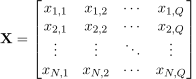
 th house, and each column represents the level to which the
  denote a unit-normed column from this measurement matrix: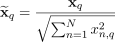

 is roughly
  corresponding to the red line in the figure below. As the correlation between elements in the same column increases, the coherence increases since different terms in the above cross-product are less likely to cancel out.

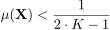
 , then:

 . Let’s plug in some numbers. If
  and
and  , then the result means that
  is less than
  with probability
  .
.
 , to the number of amenities that houses have:
![\begin{align*} \xi &\approx \frac{\log(\sfrac{1}{p}) - \frac{1}{2} \cdot \log\left[ \pi \cdot \log Q \right]}{\sfrac{1}{2} + \log(Q)} \end{align*}](https://alexchinco.com/wp-content/ql-cache/quicklatex.com-b3bec12315aef113f53b17f75c76f277_l3.svg "Rendered by QuickLaTeX.com")
 large enough we can effectively regard the error bounds as the variance. Importantly, this quantity is increasing in the coherence of the measurement matrix. i.e., when assets are more similar, I am less sure that I am drawing the correct conclusion from past returns.
 and
and  , which have houses of the exact same value,
  . In neighborhood
 ![\begin{align*} 0 = \mathrm{E}[m \cdot r_n] \quad \text{for all } n=1,2,\ldots,N \end{align*}](https://alexchinco.com/wp-content/ql-cache/quicklatex.com-508a9b2be9012405afbe52f1f9ace924_l3.svg "Rendered by QuickLaTeX.com")
 denotes the expectation operator,
  denotes the stochastic discount factor, and
  today to borrow at the riskless rate, buy a stock, and hold the position for
 ![\mathrm{E}[r_n]](https://alexchinco.com/wp-content/ql-cache/quicklatex.com-c1c4d3c62fc95adb501bdfff487e1cc8_l3.svg "Rendered by QuickLaTeX.com") , vary across assets even though they all have the same price today by construction (see my earlier
, vary across assets even though they all have the same price today by construction (see my earlier  , and noise,
  :
:
 and
and  . I use a Taylor expansion to linearize the function
  and assume
  terms are negligible so
 ![\mathrm{E}[r_n] = \alpha_n + \sfrac{\gamma_n}{2} \cdot \sigma_x^2](https://alexchinco.com/wp-content/ql-cache/quicklatex.com-9a3e91c7bd5a49c76324b127fc7bd134_l3.svg "Rendered by QuickLaTeX.com") and
and ![\mathrm{Var}[r_n] = \beta_n^2 \cdot \sigma_x^2 + \sigma_z^2](https://alexchinco.com/wp-content/ql-cache/quicklatex.com-12e2da3ed43e012d1ce11a6f7a4afbad_l3.svg "Rendered by QuickLaTeX.com") . This means that if the excess return on the market is
. This means that if the excess return on the market is  larger than expected, then asset
  larger.
![\begin{align*} \mathrm{E}[r_n] = \alpha_n + \frac{\gamma_n}{2} \cdot \sigma_x^2 = \underbrace{\text{Constant} \times \beta_n}_{\text{Predicted}} \end{align*}](https://alexchinco.com/wp-content/ql-cache/quicklatex.com-b39998197ded6695fa456331032ccb3b_l3.svg "Rendered by QuickLaTeX.com")
![\text{Constant} = c \cdot (\sfrac{\mathrm{Var}[m]}{\mathrm{E}[m]})](https://alexchinco.com/wp-content/ql-cache/quicklatex.com-f0e508f53a2eab3a7440848bea6904b4_l3.svg "Rendered by QuickLaTeX.com") , depends on the exact asset pricing model. Equation (
, depends on the exact asset pricing model. Equation (

 shows up in the expression for
  ; however, idiosyncratic volatility,
  , better not be priced since it shows up nowhere above.
 . The authors actually look at each stock’s exposure to changes in aggregate volatility. To see how this changes the math, consider rewriting the intercept above as:
 around its mean with some small
  will impact the estimated intercept:
![\begin{align*} \mathrm{A}_n(\Delta \sigma_x) &= \mathrm{A}_n(0) + \mathrm{A}_n'(0) \cdot \Delta \sigma_x + \cdots \\ &\approx \left[ \alpha_n + \frac{\gamma_n}{2} \cdot \langle\sigma_x\rangle^2 \right] + \gamma_n \cdot \langle\sigma_x\rangle \cdot \Delta \sigma_x \end{align*}](https://alexchinco.com/wp-content/ql-cache/quicklatex.com-e4767386cedfa210b242c920cb810f29_l3.svg "Rendered by QuickLaTeX.com")
 by definition,
  and
and  will have the same sign. Thus, testing for whether exposure to changes in aggregate volatility is priced is tantamount to testing for whether exposure to aggregate volatility is priced.
![\begin{align*} \Delta \sigma_{x,d+1} = \mathit{VXO}_{d+1} - \mathit{VXO}_d \qquad \text{with} \qquad \mathrm{E}[\Delta \sigma_{x,d+1}] = 0.01{\scriptstyle \%}, \, \mathrm{StD}[\Delta \sigma_{x,d+1}] = 2.65{\scriptstyle \%} \end{align*}](https://alexchinco.com/wp-content/ql-cache/quicklatex.com-1fcb5273efb718f3d57f082e0e6e35a9_l3.svg "Rendered by QuickLaTeX.com")
 , then options markets expect the S&P 100 to move up or down
  calendar days. The authors use the VXO contract price rather than the VIX contract price because it has a longer time series dating back to 1986. The only difference between the
  over the sample period from January 1986 to December 2012 as shown in the figure below.
 using the daily data in month
  :
:
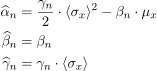
 , is the excess return on the CRSP value-weighted market index. I include AMEX, NYSE, and NASDAQ stocks with
  daily observations in month
 . Note that because the factor
  is common to all stocks in month
  . For each portfolio
  with
with  denoting the stocks with the lowest aggregate volatility exposure and
  denoting the stocks with the highest aggregate volatility exposure, the authors then calculate the daily portfolio returns in month
  in the low aggregate volatility exposure portfolio in January 1986, then you would have over
  more dollars in December 2012 than if you had invested that same

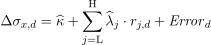
 . They then define the factor mimicking portfolio return at daily horizon in month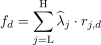
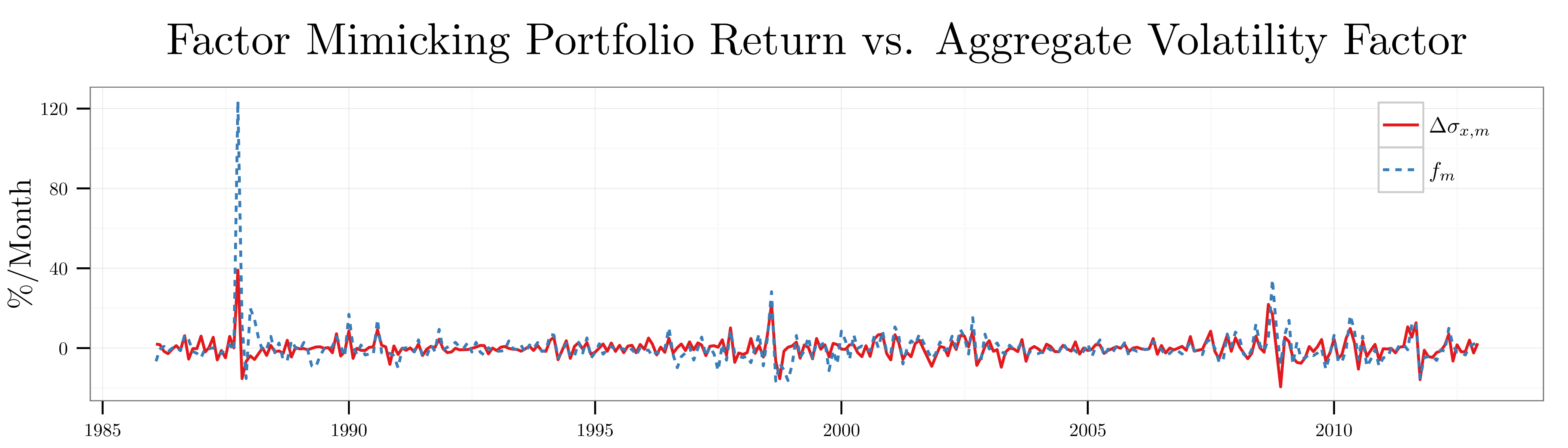
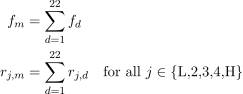

 coefficients in the figure below. Consistent with the idea that exposure to aggregate volatility is driving the disparate excess returns of the
 :
:

![\begin{align*} \sigma_{z,n} &= \mathrm{StD}[\mathit{Error}_{n,d}] \end{align*}](https://alexchinco.com/wp-content/ql-cache/quicklatex.com-0e07c5257a89dc3d311fe765f3ef3663_l3.svg "Rendered by QuickLaTeX.com")

 values. The figure above reports the cumulative returns to these
  more in December 2012 than if you had invested in the high idiosyncratic volatility portfolio. The figure below reports the estimated abnormal returns,
  , for each of the idiosyncratic volatility portfolios over the full sample and confirms that the poor performance of the high idiosyncratic volatility portfolio cannot be explained by exposure to common risk factors.

 in month
 hours that changes how awesome it is to have an additional
  , then the stochastic discount factor is
  and the stuff (i.e., risk factor) is changes in log consumption.
 and
and  , the following identity holds:
![\begin{equation*} \mathrm{E}[u\cdot v] = \mathrm{Cov}[u,v] - \mathrm{E}[u] \cdot \mathrm{E}[v] \end{equation*}](https://alexchinco.com/wp-content/ql-cache/quicklatex.com-16993b6a2e80a877af59cc50e0d6c8f5_l3.svg "Rendered by QuickLaTeX.com")
![\begin{align*} \mathrm{E}[r_n] &= \frac{\mathrm{Cov}[m, r_n]}{\mathrm{Var}[m]} \cdot \left( - \frac{\mathrm{Var}[m]}{\mathrm{E}[m]} \right) \end{align*}](https://alexchinco.com/wp-content/ql-cache/quicklatex.com-023d62367a131093e91202e01a0bdebd_l3.svg "Rendered by QuickLaTeX.com")
 , is common across all assets, and represents the price of exposure to the risk factor
 ![\mathrm{E}[x] = \mu_x](https://alexchinco.com/wp-content/ql-cache/quicklatex.com-6411ed9752816dd91538c8e365d12b4c_l3.svg "Rendered by QuickLaTeX.com") and
and ![\mathrm{Var}[x] = \sigma_x^2](https://alexchinco.com/wp-content/ql-cache/quicklatex.com-f44c7d370b1b9e635a871c3e8e69c523_l3.svg "Rendered by QuickLaTeX.com") . I then write the stochastic discount factor as the sum of a function of
. I then write the stochastic discount factor as the sum of a function of  , and some noise,
  :
:
![\mathrm{E}[m] = \phi + \sfrac{\psi}{2} \cdot \sigma_x^2](https://alexchinco.com/wp-content/ql-cache/quicklatex.com-a8070063ca4ebee8f50073cd8ae6c321_l3.svg "Rendered by QuickLaTeX.com") and
and ![\mathrm{Var}[m] = \chi^2 \cdot \sigma_x^2 + \sigma_y^2](https://alexchinco.com/wp-content/ql-cache/quicklatex.com-a9ec188a9b386204745dc4f85913fbde_l3.svg "Rendered by QuickLaTeX.com") . This means that if the risk factor is
. This means that if the risk factor is  , then agents value having an additional
  more than usual. Similarly, suppose each excess return is the sum of an asset-specific function of
  larger than average.
![\begin{equation*} \begin{split} \mathrm{E}[r_n] &= \frac{\mathrm{Cov}[m,r_n]}{\mathrm{Var}[m]} \cdot \left( - \, \frac{\mathrm{Var}[m]}{\mathrm{E}[m]} \right) \\ &= \frac{\chi \cdot \beta_n \cdot \sigma_x^2}{\chi^2 \cdot \sigma_x^2 + \sigma_y^2} \cdot \left( - \, \frac{\chi^2 \cdot \sigma_x^2 + \sigma_y^2}{\phi + \frac{\psi}{2} \cdot \sigma_x^2} \right) \\ &= - \, \left( \frac{\chi \cdot \sigma_x^2}{\phi + \frac{\psi}{2} \cdot \sigma_x^2} \right) \cdot \beta_n \\ &= \text{Constant} \times \beta_n \end{split} \end{equation*}](https://alexchinco.com/wp-content/ql-cache/quicklatex.com-83e50959264021c3181adf48cea6e6c0_l3.svg "Rendered by QuickLaTeX.com")
 . Assets which have higher realized returns when the risk factor is high (have a large
  , is proportional to its exposure to the risk factor,
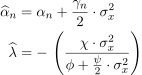
 ![\begin{align*} \mathrm{E}[r_n] = \underbrace{\alpha_n + \frac{\gamma_n}{2} \cdot \sigma_x^2}_{\text{Realized } \langle r_n \rangle} = \underbrace{- \, \left( \frac{\chi \cdot \sigma_x^2}{\phi + \frac{\psi}{2} \cdot \sigma_x^2} \right) \cdot \beta_n}_{\text{Predicted}} \end{align*}](https://alexchinco.com/wp-content/ql-cache/quicklatex.com-8a4215c40d3fb29e2ec057faa7091723_l3.svg "Rendered by QuickLaTeX.com")
 we can interpret this relationship as a realization of the first
 ![\begin{align*} \frac{\mathrm{StD}[m_{t+1}]}{\mathrm{E}[m_{t+1}]} = \frac{\chi \cdot \sigma_x}{\phi + \frac{\psi}{2} \cdot \sigma_x^2} = \frac{\alpha_n + \frac{\gamma_n}{2} \cdot \sigma_x^2}{\beta_n \cdot \sigma_x} = \left| \frac{\mathrm{E}[r_{n,t+1}]}{\mathrm{StD}[r_{n,t+1}]} \right| \end{align*}](https://alexchinco.com/wp-content/ql-cache/quicklatex.com-38383535590884c4f38e581d8647b4b0_l3.svg "Rendered by QuickLaTeX.com")
 unknown parameters:
 periods of observations. i.e.,
  equations to estimate these parameters with via
  assets:
![\begin{align*} \begin{pmatrix} 0 \\ 0 \\ \vdots \\ 0 \\ 0 \\ \vdots \\ 0 \\ 0 \\ \vdots \\ 0 \end{pmatrix} &= \mathrm{E}[\mathrm{G}(\widehat{\boldsymbol \theta};\mathbf{r}_t,x_t)] = \mathrm{E} \begin{bmatrix} x_t - \widehat{\mu}_x \\ r_{1,t} - \left\{ \widehat{\alpha}_1 + \widehat{\beta}_1 \cdot (x_t - \widehat{\mu}_x) \right\} \\ \vdots \\ r_{N,t} - \left\{ \widehat{\alpha}_N + \widehat{\beta}_N \cdot (x_t - \widehat{\mu}_x) \right\} \\ \left( r_{1,t} - \left\{ \widehat{\alpha}_1 + \widehat{\beta}_1 \cdot (x_t - \widehat{\mu}_x) \right\} \right) \cdot (x_t - \widehat{\mu}_x) \\ \vdots \\ \left( r_{N,t} - \left\{ \widehat{\alpha}_N + \widehat{\beta}_N \cdot (x_t - \widehat{\mu}_x) \right\} \right) \cdot (x_t - \widehat{\mu}_x) \\ r_{1,t} - \widehat{\beta}_1 \cdot \widehat{\lambda} \\ \vdots \\ r_{N,t} - \widehat{\beta}_N \cdot \widehat{\lambda} \end{bmatrix} \end{align*}](https://alexchinco.com/wp-content/ql-cache/quicklatex.com-0d7036149fac2068adb1977f18c0c148_l3.svg "Rendered by QuickLaTeX.com")
 equations identify the
  parameters governing the relationship between the risk factor and each asset’s excess returns. The final
  , for exposure to the risk factor
  .
.
 and
and  ,
,  , and
, and  are not identifiable from this approach since they satisfy conservation laws which leave the estimates for
 and decrease
  , then the estimate of
  month windows to estimate each asset’s
  . Is this too long a window relative to how much factor exposures vary over time? Alternatively, should we be using a longer window to more accurately pin down these parameters? It turns out that the estimation strategy gives some guidance about the relationship between the optimal estimation window and parameter persistence which I discuss below.
 . Suppose the true market price of risk,
  , follows a random walk:
 so that the final
  is a random variable with distribution:

 denotes estimation error from the GMM procedure. There is an additional complication to consider. Namely, if the true market price of risk is floating around during the estimation period, it will add additional noise to the parameter estimates and increase
  . To keep things simple, suppose that nature sets the market price of risk to
 ![\begin{align*} T = \arg \min_{T \geq 0} \mathrm{E}\left[ (\lambda_T - \widehat{\lambda})^2 \right] = \arg \min_{T \geq 0} \mathrm{E}\left[ (\lambda_T - \lambda)^2 + (\lambda - \widehat{\lambda})^2 \right] \end{align*}](https://alexchinco.com/wp-content/ql-cache/quicklatex.com-467158ef5da5daab7017885f6c5ef1d2_l3.svg "Rendered by QuickLaTeX.com")
![\begin{align*} 0 = \frac{d}{dT} \left[ T \cdot \sigma_l^2 + \left(\frac{1}{\sigma_{\lambda}^2} + \frac{T}{\sigma_s^2} \right)^{-1} \right] \end{align*}](https://alexchinco.com/wp-content/ql-cache/quicklatex.com-153fe27339fd548d4c7d9198ce9a1ed7_l3.svg "Rendered by QuickLaTeX.com")
 denotes the variance of my priors about the market price of risk governing the estimation sample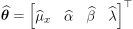
![\begin{align*} \begin{pmatrix} 0 \\ 0 \\ 0 \\ 0 \end{pmatrix} &= \mathrm{E}[\mathrm{G}(\widehat{\boldsymbol \theta};r_t,x_t)] = \mathrm{E} \begin{bmatrix} x_t - \widehat{\mu}_x \\ r_t - \left\{ \widehat{\alpha} + \widehat{\beta} \cdot (x_t - \widehat{\mu}_x) \right\} \\ \left( r_t - \left\{ \widehat{\alpha} + \widehat{\beta} \cdot (x_t - \widehat{\mu}_x) \right\} \right) \cdot (x_t - \widehat{\mu}_x) \\ r_t - \widehat{\beta} \cdot \widehat{\lambda} \end{bmatrix} \end{align*}](https://alexchinco.com/wp-content/ql-cache/quicklatex.com-20202e553631746df71f98477b1607e9_l3.svg "Rendered by QuickLaTeX.com")
 , then GMM reduces to OLS and
  since:


 , then
  and you should pick
  or as large as possible. Second, notice that if you already know the true
  and you should pick
  . Finally, notice that if the test asset has no exposure to the risk factor,
  , then the equation is undefined since any window length gives you the same amount of information—i.e., none.
You must be logged in to post a comment.