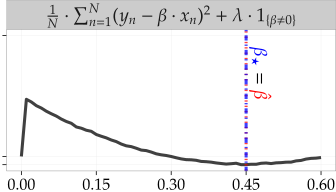
1. Motivation Imagine that we're trying to predict the cross-section of expected returns, and we've got a sneaking suspicion that $x$ might be a good predictor. So, we regress today's returns on $x$ to see if our hunch is … [Continue reading]
A Model of Rebalancing Cascades

1. Motivating Examples Trading strategies can interact with one another to amplify small initial shocks to fundamentals: Quant Crisis, Aug 2007: "During the week of August 6, 2007, a number of [quantitative hedge funds] experienced … [Continue reading]
Intuition Behind the Bayesian LASSO

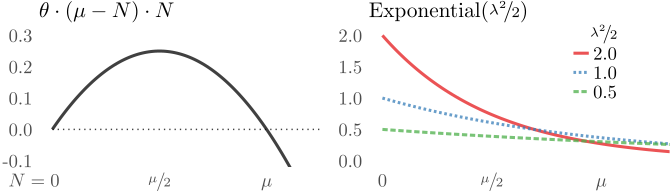
1. Motivating Question Imagine you've just seen Apple's most recent return, $r$, which is Apple's long-run expected return, $\mu^\star$, plus some random noise, $\epsilon \overset{\scriptscriptstyle \mathrm{iid}}{\sim} \mathrm{N}(0, \, … [Continue reading]
Inferring Trader Horizons from Trading Volume

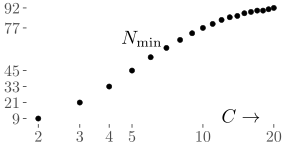
1. Motivating Example This post shows that, if traders face convex transaction costs (i.e., it costs them more per share to buy $2$ shares of stock than to buy $1$ share of stock), then it is possible to infer traders' investment horizons from … [Continue reading]
Investor Holdings, Naïve Beliefs, and Artificial Supply Constraints

1. Motivation In the standard model of house-price dynamics, there are two kinds of cities: supply constrained and supply unconstrained. In supply-constrained cities (e.g., New York, Boston, or San Francisco), it's difficult and costly to build … [Continue reading]